
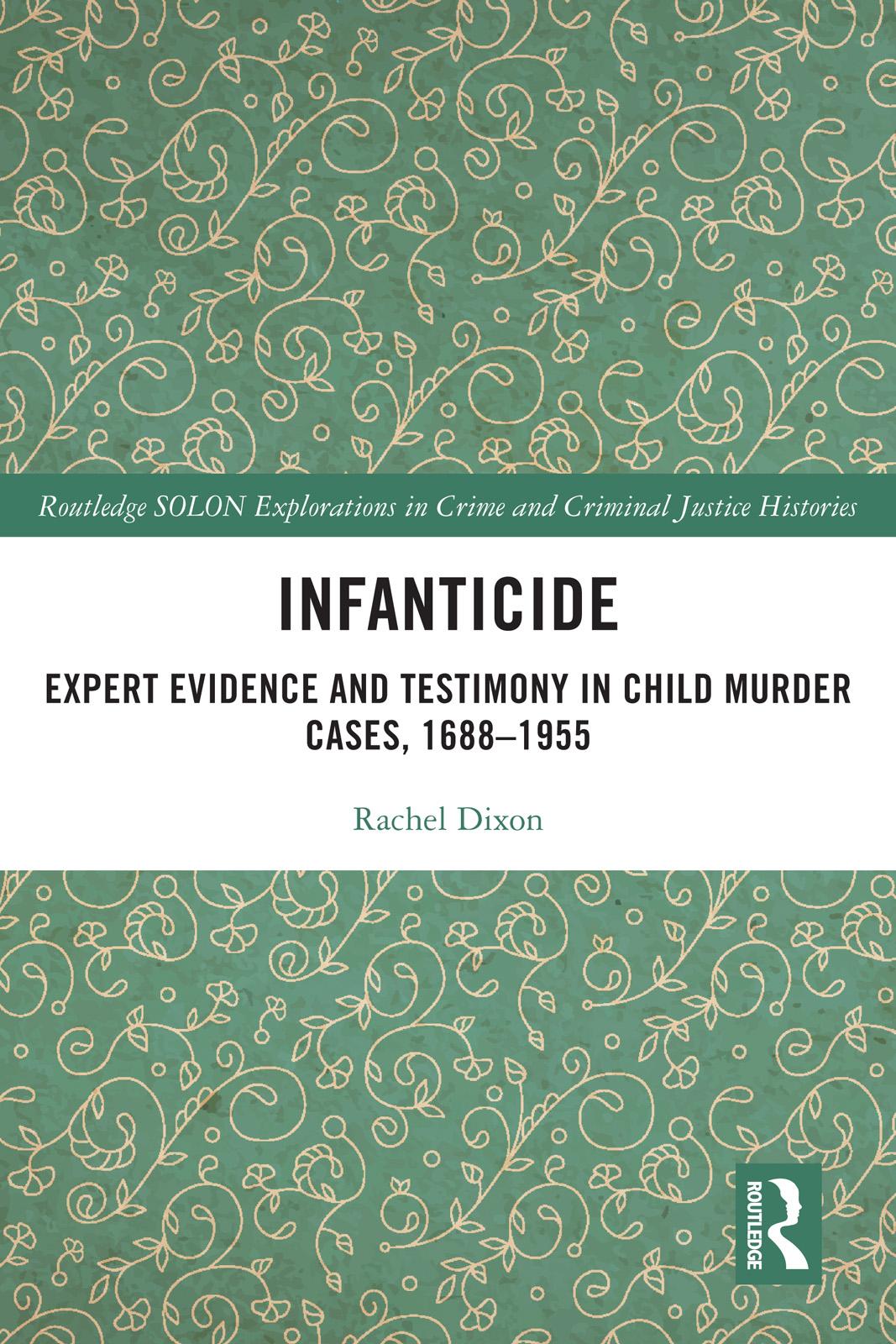
Infanticide examines medical expert evidence in infanticide cases, focusing specifically on the shifting notion of "certainty" in medical testimony. Beginning in the Early Modern period and concluding in the mid-twentieth century, it considers how courts determined whether an infant died from natural causes or other reasons, including violence.
The book explores expert evidence in cases of infanticide and examines the extent of certainty created by medical specialists who founded their testimony on anatomical exploration and science. As the book progresses, it becomes clear that medical specialists were unable to scientifically establish cause of death and in doing so conveyed uncertainty in court proceedings. Rather than being regarded as a professional failing, Dixon argues that the uncertainty created by medical specialists redirected the outcomes of infanticide cases. The combination of uncertainty and the changing perceptions of infanticidal women by the court lead juries to find infanticidal women not guilty of a capital offence in many cases.
This book will be of great interest to students and scholars of Criminology, Law and History.
Zahle einfach mit Karte, Klarna, Apple Pay oder Google Pay. Nicht zufrieden? Du hast immer ein 14-tägiges Widerrufsrecht. Lies mehr in unseren AGB. Hast du Fragen, schreib uns eine E-Mail an hello@memmo.org.
Memmo macht das Lernen einfacher – wo auch immer du bist. Bei uns findest du deine Kursbücher und smarte Lerntools an einem Ort: Zusammenfassungen, Quizzes, Podcasts und Lernkarten. Und Ted, dein Lernbuddy, beantwortet alles, was du wissen möchtest. Über 50.000 Studierende lernen bereits hier – gemacht, damit du schneller lernst und weniger Stress hast.