
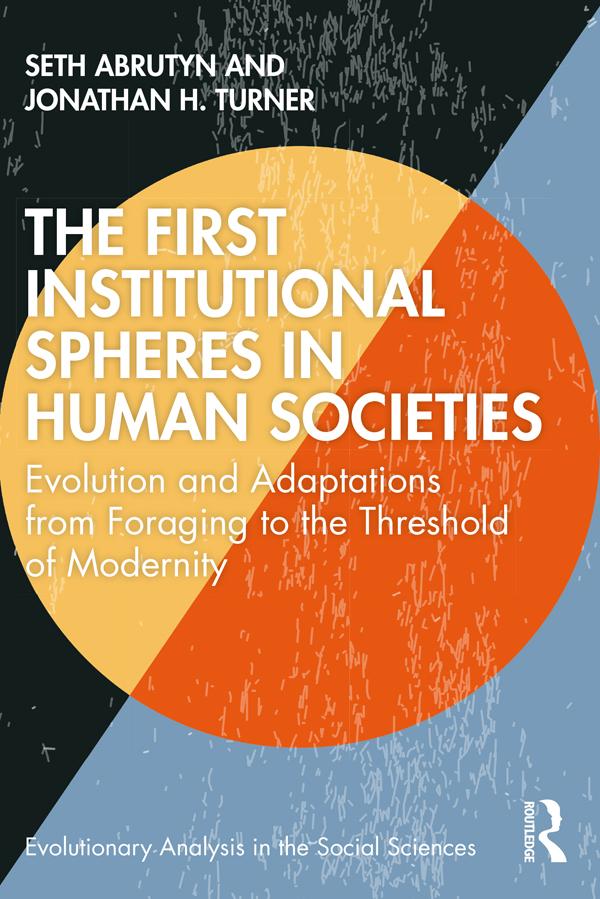
Few concepts are as central to sociology as institutions. Yet, like so many sociological concepts, institutions remain vaguely defined. This book expands a foundational definition of the institution, one which locates them as the basic building blocks of human societies—as structural and cultural machines for survival that make it possible to pass precious knowledge from one generation to the next, ensuring the survival of our species. The book extends this classic tradition by, first, applying advances in biological evolution, neuroscience, and primatology to explain the origins of human societies and, in particular, the first institutional sphere: kinship. The authors incorporate insights from natural sciences often marginalized in sociology, while highlighting the limitations of purely biogenetic, Darwinian explanations. Secondly, they build a vivid conceptual model of institutions and their central dynamics as the book charts the chronological evolution of kinship, polity, religion, law, and economy, discussing the biological evidence for the ubiquity of these institutions as evolutionary adaptations themselves.
Zahle einfach mit Karte, Klarna, Apple Pay oder Google Pay. Nicht zufrieden? Du hast immer ein 14-tägiges Widerrufsrecht. Lies mehr in unseren AGB. Hast du Fragen, schreib uns eine E-Mail an hello@memmo.org.
Memmo macht das Lernen einfacher – wo auch immer du bist. Bei uns findest du deine Kursbücher und smarte Lerntools an einem Ort: Zusammenfassungen, Quizzes, Podcasts und Lernkarten. Und Ted, dein Lernbuddy, beantwortet alles, was du wissen möchtest. Über 50.000 Studierende lernen bereits hier – gemacht, damit du schneller lernst und weniger Stress hast.