
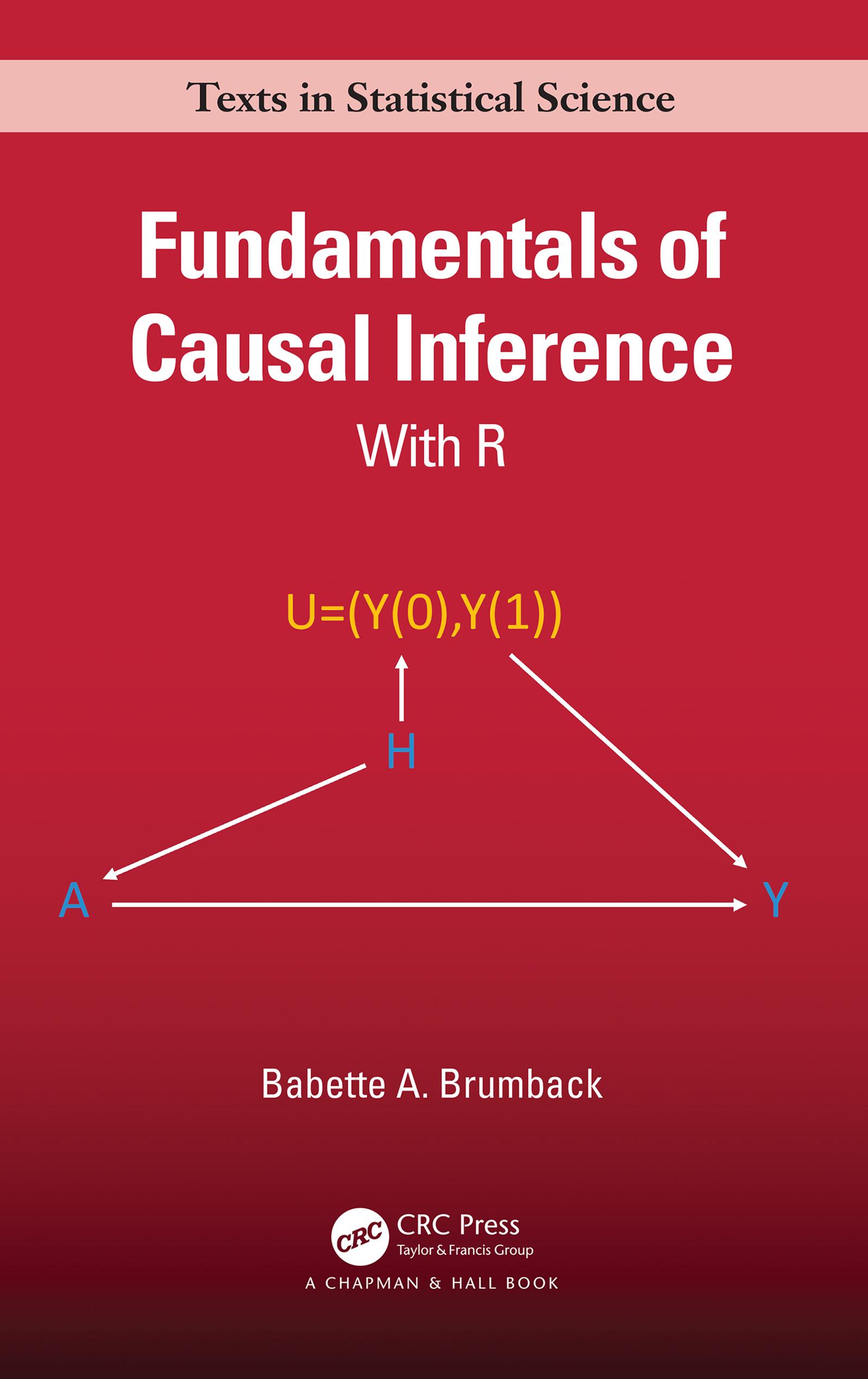
"Overall, this textbook is a perfect guide for interested researchers and students who wish to understand the rationale and methods of causal inference. Each chapter provides an R implementation of the introduced causal concepts and models and concludes with appropriate exercises."-An-Shun Tai & Sheng-Hsuan Lin, in Biometrics
One of the primary motivations for clinical trials and observational studies of humans is to infer cause and effect. Disentangling causation from confounding is of utmost importance. Fundamentals of Causal Inference explains and relates different methods of confounding adjustment in terms of potential outcomes and graphical models, including standardization, difference-in-differences estimation, the front-door method, instrumental variables estimation, and propensity score methods. It also covers effect-measure modification, precision variables, mediation analyses, and time-dependent confounding. Several real data examples, simulation studies, and analyses using R motivate the methods throughout. The book assumes familiarity with basic statistics and probability, regression, and R and is suitable for seniors or graduate students in statistics, biostatistics, and data science as well as PhD students in a wide variety of other disciplines, including epidemiology, pharmacy, the health sciences, education, and the social, economic, and behavioral sciences.
Beginning with a brief history and a review of essential elements of probability and statistics, a unique feature of the book is its focus on real and simulated datasets with all binary variables to reduce complex methods down to their fundamentals. Calculus is not required, but a willingness to tackle mathematical notation, difficult concepts, and intricate logical arguments is essential. While many real data examples are included, the book also features the Double What-If Study, based on simulated data with known causal mechanisms, in the belief that the methods are best understood in circumstances where they are known to either succeed or fail. Datasets, R code, and solutions to odd-numbered exercises are available on the book's website at www.routledge.com/9780367705053. Instructors can also find slides based on the book, and a full solutions manual under 'Instructor Resources'.
Zahle einfach mit Karte, Klarna, Apple Pay oder Google Pay. Nicht zufrieden? Du hast immer ein 14-tägiges Widerrufsrecht. Lies mehr in unseren AGB. Hast du Fragen, schreib uns eine E-Mail an hello@memmo.org.
Memmo macht das Lernen einfacher – wo auch immer du bist. Bei uns findest du deine Kursbücher und smarte Lerntools an einem Ort: Zusammenfassungen, Quizzes, Podcasts und Lernkarten. Und Ted, dein Lernbuddy, beantwortet alles, was du wissen möchtest. Über 50.000 Studierende lernen bereits hier – gemacht, damit du schneller lernst und weniger Stress hast.