
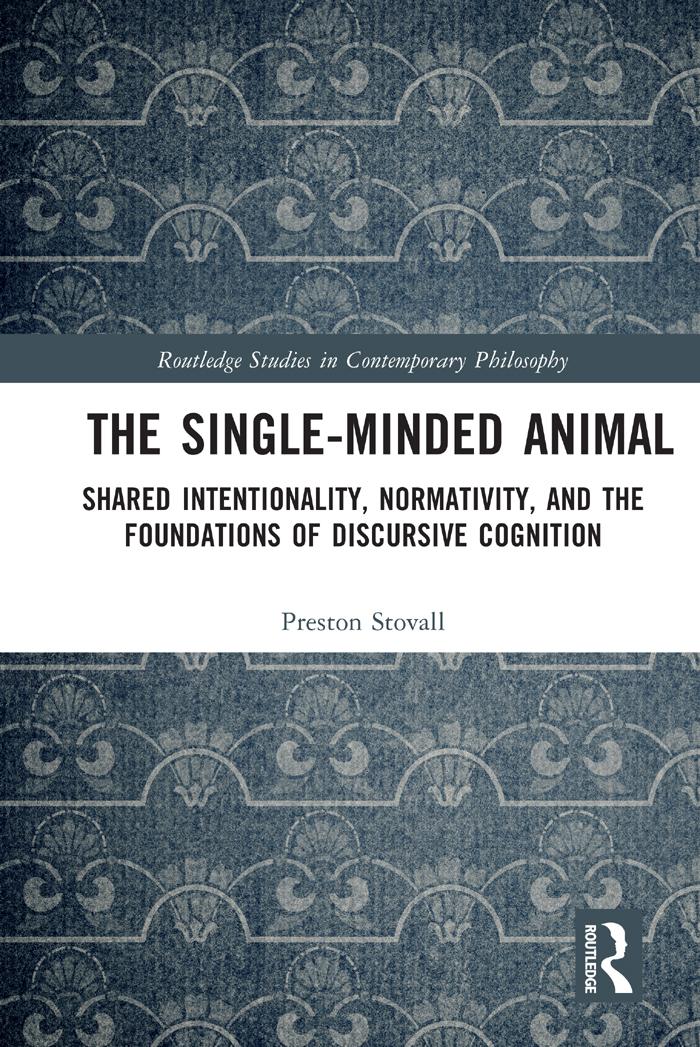
This book provides an account of discursive or reason-governed cognition, by synthesizing research in the philosophy of language, the philosophy of mind, and evolutionary anthropology.
Using the grasp of a natural language as a model for the autonomous or self-governed rationality of discursive cognition, the author uses a semantics for individual intentions, shared intentions, and normative attitudes as a framework for understanding what it is to be a rational animal. This semantics interprets claims about shared intentions and claims about what people ought and may do as the expression of plans of action that involve taking the points of view of other people within a community. This has important consequences for our understanding of both the natural basis and the social relevance of intentional and normative mental states. In order to distinguish the strong and weak modal force, which characterizes normativity but not shared intentionality, the author argues that a notion of single-minded practical cognition is necessary. This account of single-mindedness is then used to shed light on the autonomy or self-government characteristic of discursive cognition, as manifest in a linguistic community whose members are able to adopt the standpoints of others.
Drawing together research in philosophy and the related sciences, the formal account of the semantic content of the claims we use to give expression to shared intentional and normative mental states integrates well with research in cognitive science, evolutionary anthropology, and social psychology concerning the ontogenetic and phylogenetic development of shared intentionality and norm psychology in human beings and other primates. The Single-Minded Animal will appeal to researchers and advanced students working on shared intentionality, normativity, rationality, cognitive science, social and developmental psychology, and evolutionary anthropology.
Zahle einfach mit Karte, Klarna, Apple Pay oder Google Pay. Nicht zufrieden? Du hast immer ein 14-tägiges Widerrufsrecht. Lies mehr in unseren AGB. Hast du Fragen, schreib uns eine E-Mail an hello@memmo.org.
Memmo macht das Lernen einfacher – wo auch immer du bist. Bei uns findest du deine Kursbücher und smarte Lerntools an einem Ort: Zusammenfassungen, Quizzes, Podcasts und Lernkarten. Und Ted, dein Lernbuddy, beantwortet alles, was du wissen möchtest. Über 50.000 Studierende lernen bereits hier – gemacht, damit du schneller lernst und weniger Stress hast.