
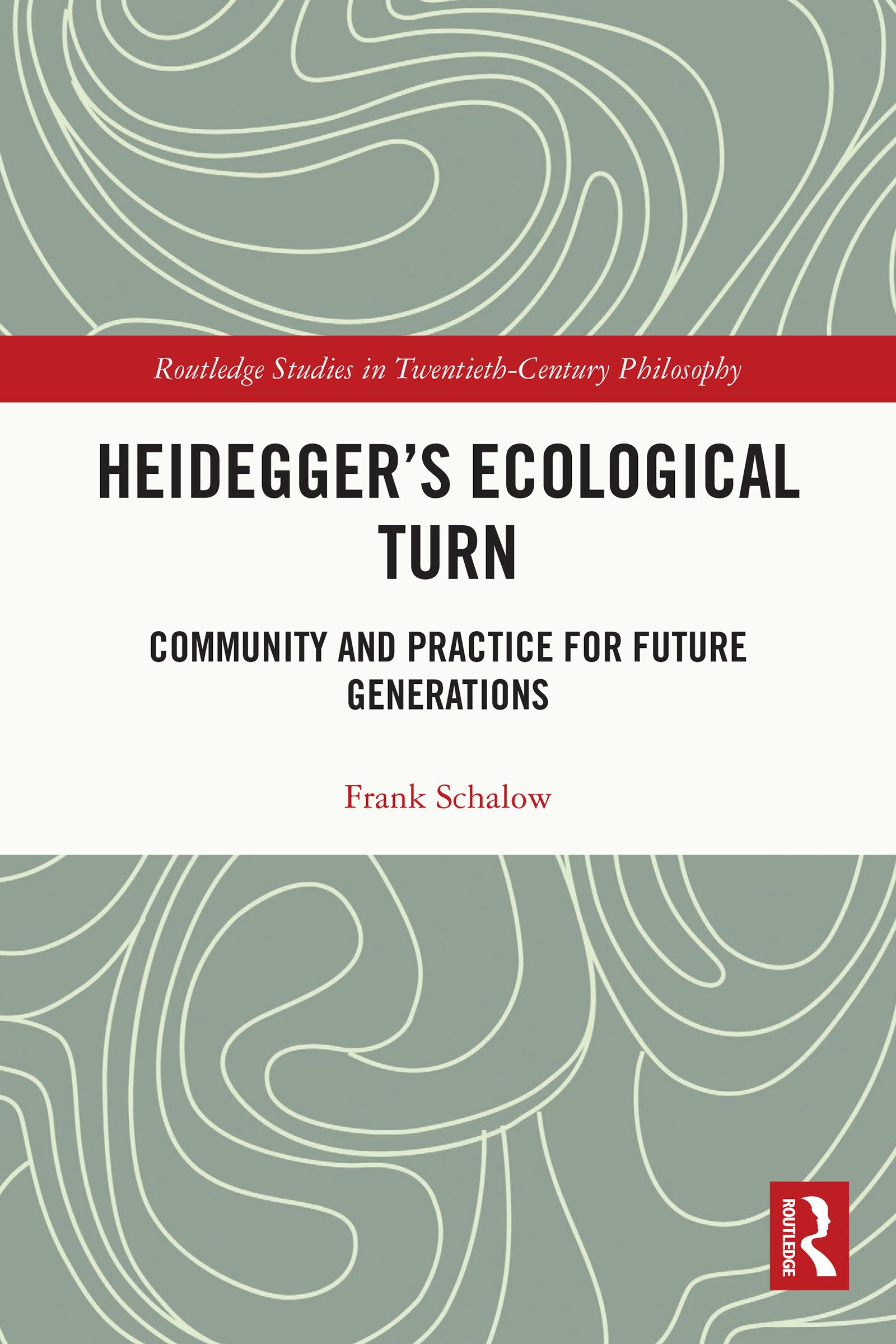
This book makes explicit the ecological implications of Martin Heidegger. It examines how the trajectory of Heidegger’s thinking harbors an "ecological turn," which comes to the forefront in his attempt to anticipate the impending crisis precipitated by modern technology.
Schalow’s emphasis on such key motifs as stewardship, dwelling, and "letting be" (Gelassenheit) serves to coalesce the problem of freedom in a new and innovative way, in order to expand the interpretive or hermeneutic horizon for re-examining Heidegger’s philosophy. By prioritizing a response to today’s environmental crisis and the possible impact upon future generations, the author traverses a divide within Heidegger scholarship by developing a deeper, critical outlook on his philosophy—without either reiterating standard interpretations or rejecting them wholesale. He develops a trans-human approach to ethics, which, by prioritizing the welfare of the earth, nature, and animals, counters the anthropocentric bias and destructive premise of modern technology.
Heidegger’s Ecological Turn will be of interest to Heidegger scholars and researchers working in phenomenology, hermeneutics, continental philosophy, and environmental philosophy.
Zahle einfach mit Karte, Klarna, Apple Pay oder Google Pay. Nicht zufrieden? Du hast immer ein 14-tägiges Widerrufsrecht. Lies mehr in unseren AGB. Hast du Fragen, schreib uns eine E-Mail an hello@memmo.org.
Memmo macht das Lernen einfacher – wo auch immer du bist. Bei uns findest du deine Kursbücher und smarte Lerntools an einem Ort: Zusammenfassungen, Quizzes, Podcasts und Lernkarten. Und Ted, dein Lernbuddy, beantwortet alles, was du wissen möchtest. Über 50.000 Studierende lernen bereits hier – gemacht, damit du schneller lernst und weniger Stress hast.