
Praise for the previous edition
[. . .] Dr. Popko’s elegant new book extends both the science and the art of spherical modeling to include Computer-Aided Design and applications, which I would never have imagined when I started down this fascinating and rewarding path.
His lovely illustrations bring the subject to life for all readers, including those who are not drawn to the mathematics. This book demonstrates the scope, beauty, and utility of an art and science with roots in antiquity. [. . .] Anyone with an interest in the geometry of spheres, whether a professional engineer, an architect or product designer, a student, a teacher, or simply someone curious about the spectrum of topics to be found in this book, will find it helpful and rewarding.
– Magnus Wenninger, Benedictine Monk and Polyhedral Modeler
Ed Popko's comprehensive survey of the history, literature, geometric, and mathematical properties of the sphere is the definitive work on the subject. His masterful and thorough investigation of every aspect is covered with sensitivity and intelligence. This book should be in the library of anyone interested in the orderly subdivision of the sphere.
– Shoji Sadao, Architect, Cartographer and lifelong business partner of Buckminster Fuller
Edward Popko's Divided Spheres is a "thesaurus" must to those whose academic interest in the world of geometry looks to greater coverage of synonyms and antonyms of this beautiful shape we call a sphere. The late Buckminster Fuller might well place this manuscript as an all-reference for illumination to one of nature's most perfect inventions.
– Thomas T. K. Zung, Senior Partner, Buckminster Fuller, Sadao, & Zung Architects.
This first edition of this well-illustrated book presented a thorough introduction to the mathematics of Buckminster Fuller’s invention of the geodesic dome, which paved the way for a flood of practical applications as diverse as weather forecasting and fish farms. The author explained the principles of spherical design and the three classic methods of subdivision based on geometric solids (polyhedra).
This thoroughly edited new edition does all that, while also introducing new techniques that extend the class concept by relaxing the triangulation constraint to develop two new forms of optimized hexagonal tessellations. The objective is to generate spherical grids where all edge (or arc) lengths or overlap ratios are equal.
New to the Second Edition
- New Foreword by Joseph Clinton, lifelong Buckminster Fuller collaborator
- A new chapter by Chris Kitrick on the mathematical techniques for developing optimal single-edge hexagonal tessellations, of varying density, with the smallest edge possible for a particular topology, suggesting ways of comparing their levels of optimization
- An expanded history of the evolution of spherical subdivision
- New applications of spherical design in science, product design, architecture, and entertainment
- New geodesic algorithms for grid optimization
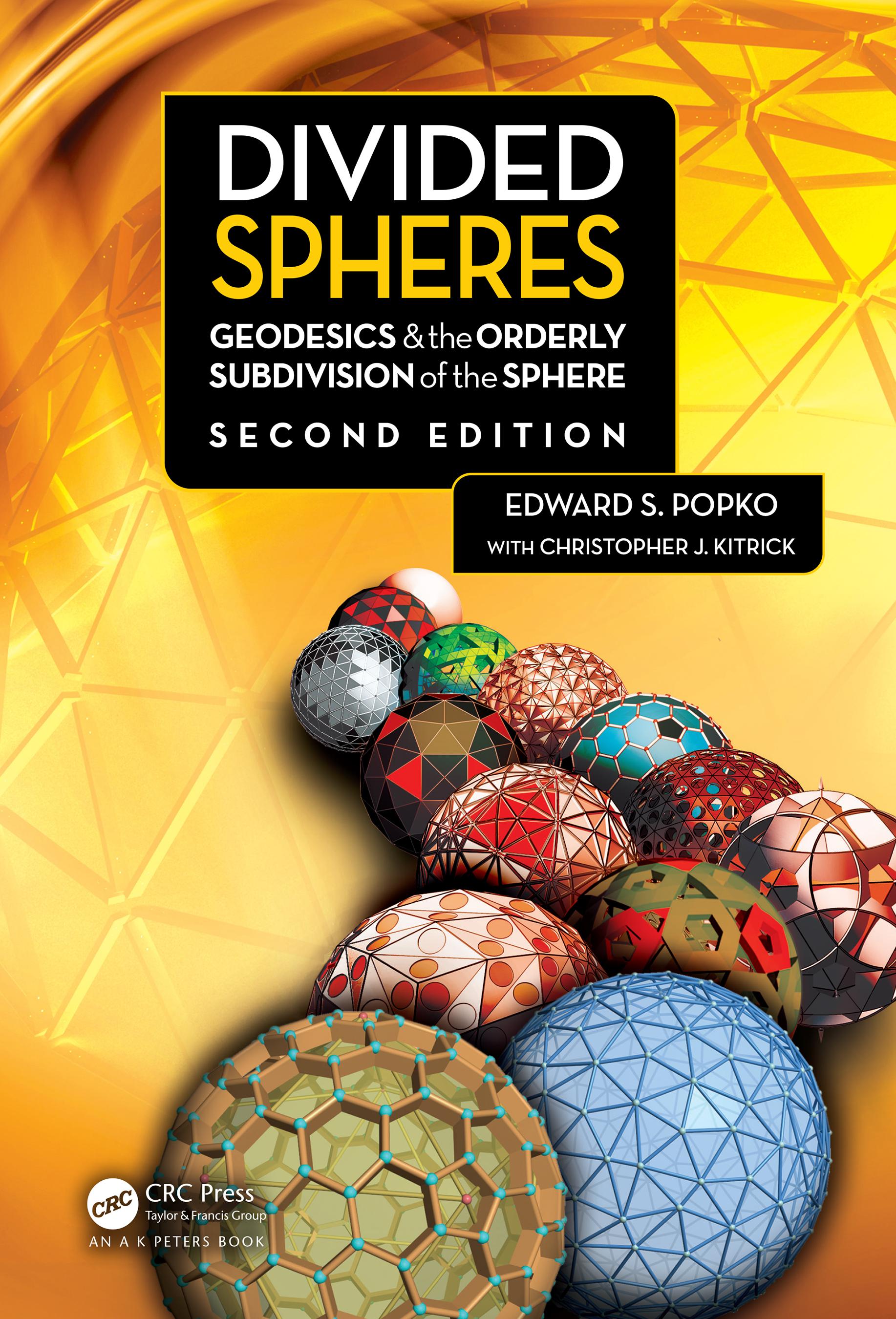
- New full-color spherical illustrations created using DisplaySphere to aid readers in visualizing and comparing the various tessellations presented in the book
- Updated Bibliography with references to the most recent advancements in spherical subdivision methods
Zahle einfach mit Karte, Klarna, Apple Pay oder Google Pay. Nicht zufrieden? Du hast immer ein 14-tägiges Widerrufsrecht. Lies mehr in unseren AGB. Hast du Fragen, schreib uns eine E-Mail an hello@memmo.org.
Memmo macht das Lernen einfacher – wo auch immer du bist. Bei uns findest du deine Kursbücher und smarte Lerntools an einem Ort: Zusammenfassungen, Quizzes, Podcasts und Lernkarten. Und Ted, dein Lernbuddy, beantwortet alles, was du wissen möchtest. Über 50.000 Studierende lernen bereits hier – gemacht, damit du schneller lernst und weniger Stress hast.