
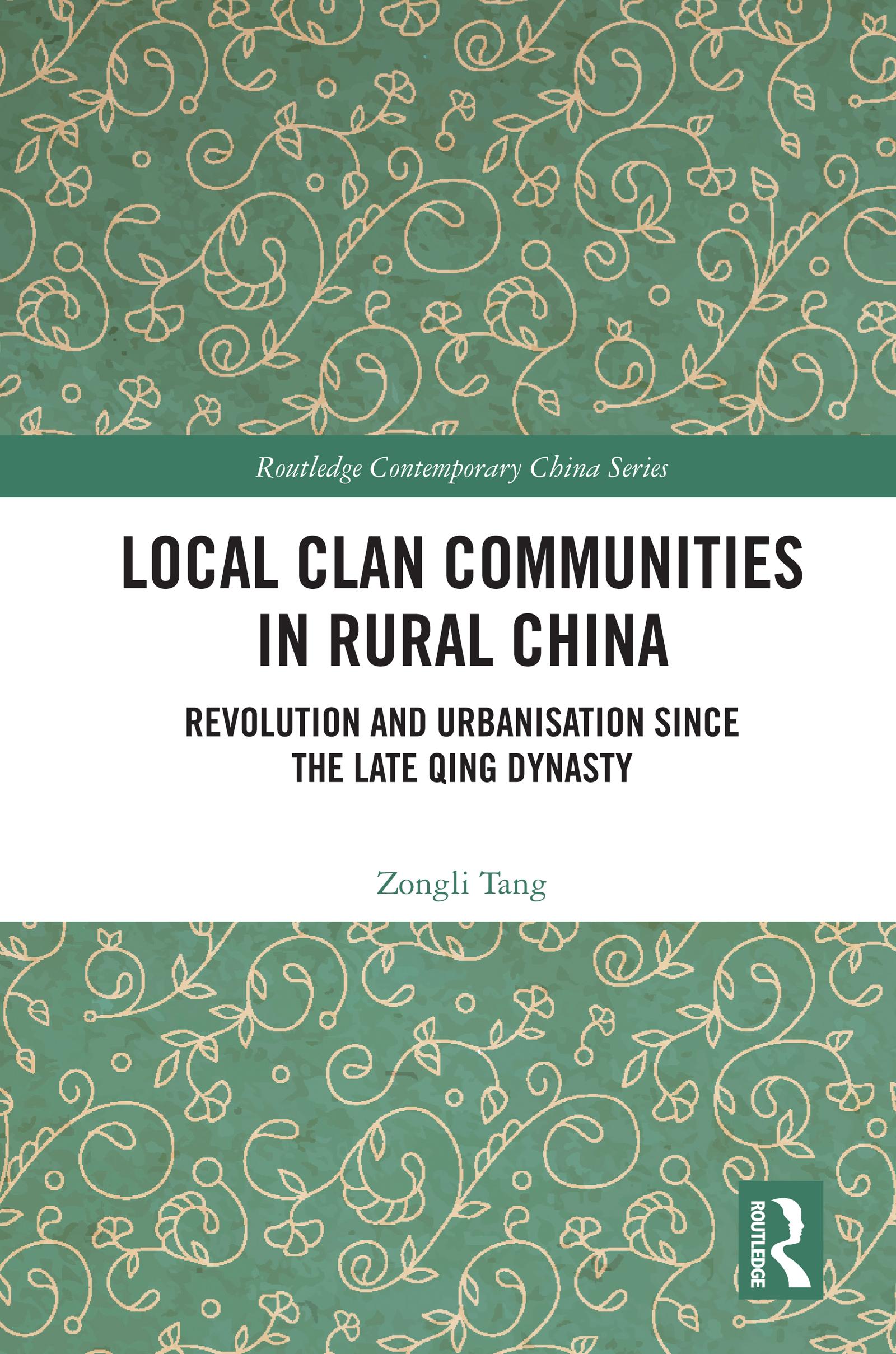
Using data collected in fieldwork and surveys, this book examines China’s clan system and local clan communities in rural Anhui, covering events in two periods: the imperial pattern as seen in the first half of the twentieth century and changes since 1949. Revealed by this research, during the late Qing and the Republic Era, a local clan in the investigated areas was run as a highly autonomous community with a strong religious focus, which challenges the corporate model raised by Maurice Freedman. Through examining single-surname villages, citang constructions, and updating of genealogies, local clans in Huadong, Huizhou and the lower Yangtze River plains in particular, developed earlier than those in the Pearl River Delta Region. Taking a cross-disciplinary viewpoint, this book analyses changes in local clan communities and clan culture as brought by the Chinese Revolution, Mao’s political campaigns, and Deng’s reforms. Starting with the late 1990s, a large migration from villages to cities has rapidly altered rural China. This geographic mobility would undermine the common residence that serves as part of a clan’s foundation. Under such situation, what transformations have taken place or will affect China’s clan system? Will the system continue to revitalise or die out? Local Clan Communities in Rural China reports these events/transformations and attempts to answer these questions. Placing a special emphasis on issues that have been overlooked by prior studies, this book brings to light many new facts and interpretations and provides a valuable reference to scholars in fields of sociology, anthropology, history, economics, cultural studies, urban studies, and population studies.
Zahle einfach mit Karte, Klarna, Apple Pay oder Google Pay. Nicht zufrieden? Du hast immer ein 14-tägiges Widerrufsrecht. Lies mehr in unseren AGB. Hast du Fragen, schreib uns eine E-Mail an hello@memmo.org.
Memmo macht das Lernen einfacher – wo auch immer du bist. Bei uns findest du deine Kursbücher und smarte Lerntools an einem Ort: Zusammenfassungen, Quizzes, Podcasts und Lernkarten. Und Ted, dein Lernbuddy, beantwortet alles, was du wissen möchtest. Über 50.000 Studierende lernen bereits hier – gemacht, damit du schneller lernst und weniger Stress hast.