
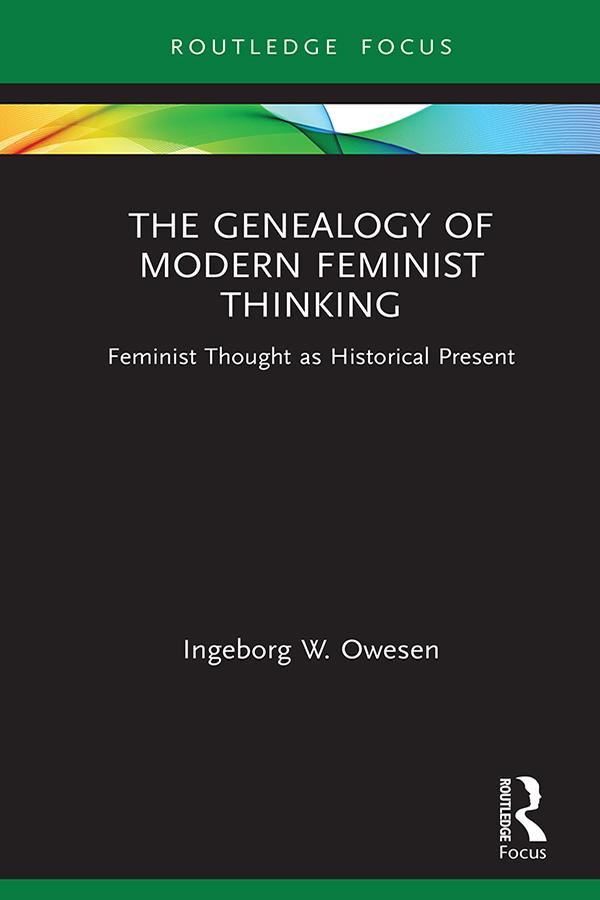
Within much contemporary feminist theory there is a tendency to forget or ignore its own historicity and consider itself as primarily oriented towards the present. This book explores the historical roots of some of feminism’s central concepts and debates, examining the philosophical conditions for feminist thought and taking as its point of departure the dynamic relationship between feminist thought and the history of philosophy. With close attention to the genealogy of key concepts such as equality, sex/gender and difference, alongside discussions of contemporary gender equality policy and contextual understandings of central figures including Wollstonecraft, Beauvoir and Irigaray, The Genealogy of Modern Feminist Thinking provides an analysis of feminism from its origins in the Early Modern period to its contemporary, post-modern forms. Shedding light on feminism as a product of Modernity and establishing it as part of the canon of European intellectual development, this book thus corrects the picture of feminism as a phenomenon that lacks historical continuity, revealing a history characterized by breaks, setbacks and forgetting, in which the forgetting itself forms part of a rich genealogy. As such, it will be of interest to philosophers, sociologists, political theorists and intellectual historians alike.
Zahle einfach mit Karte, Klarna, Apple Pay oder Google Pay. Nicht zufrieden? Du hast immer ein 14-tägiges Widerrufsrecht. Lies mehr in unseren AGB. Hast du Fragen, schreib uns eine E-Mail an hello@memmo.org.
Memmo macht das Lernen einfacher – wo auch immer du bist. Bei uns findest du deine Kursbücher und smarte Lerntools an einem Ort: Zusammenfassungen, Quizzes, Podcasts und Lernkarten. Und Ted, dein Lernbuddy, beantwortet alles, was du wissen möchtest. Über 50.000 Studierende lernen bereits hier – gemacht, damit du schneller lernst und weniger Stress hast.