
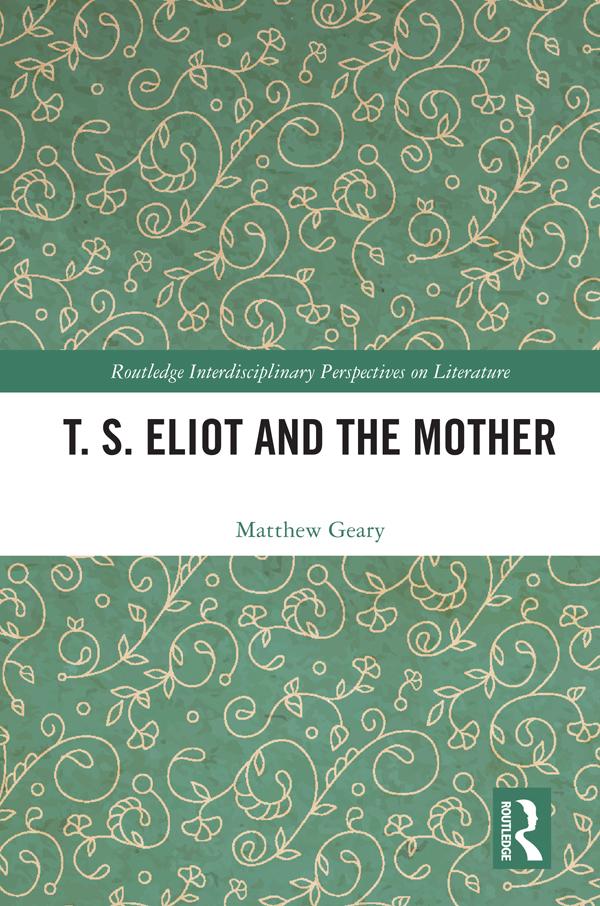
The first full-length study on T. S. Eliot and the mother, this book responds to a shortfall in understanding the true importance of Eliot’s poet-mother, Charlotte Champe Stearns, to his life and works. In doing so, it radically rethinks Eliot’s ambivalence towards women. In a context of mother–son ambivalence (simultaneous feelings of love and hate), it shows how his search for belief and love converged with a developing maternal poetics. Importantly, the chapters combine standard literary critical methods and extensive archival research with innovative feminist, maternal and psychoanalytic theorisations of mother–child relationships, such as those developed by Julia Kristeva, Luce Irigaray, Jessica Benjamin, Jan Campbell and Rozsika Parker. These maternal thinkers emphasise the vital importance and benefit of recognising the pre-Oedipal mother and maternal subjectivity, contrary to traditional, repressive Oedipal models of masculinity. Through this interdisciplinary approach, the chapters look at Eliot’s changing representations and articulations of the mother/ mother–child relationship from his very earliest writings through to the later plays. Focus is given to decisive mid-career works: Ash-Wednesday (1930), ‘Marina’ (1930), ‘Coriolan’ (1931–32) and The Family Reunion (1939), as well as to canonical works The Waste Land (1922) and Four Quartets (1943). Notably, the study draws heavily on the wide range of Eliot materials now available, including the new editions of the complete poems, the complete prose and the volumes of letters, which are transforming our perception of the poet and challenging critical attitudes. The book also gives unprecedented attention to Charlotte Eliot’s life and writings and brings her individual female experience and subjectivity to the fore. Significantly, it establishes Charlotte’s death in 1929 as a decisive juncture, marking both Eliot’s New Life and the apotheosis of the feminine symbolised in Ash-Wednesday. Central to this proposition is Geary’s new formulation for recognising and examining a maternal poetics, which also compels a new concept of maternal allegory as a modern mode of literary epiphany. T. S. Eliot and the Mother reveals the role of the mother and the dynamics of mother–son ambivalence to be far more complicated, enduring, changeable and essential to Eliot’s personal, religious and poetic development than previously acknowledged.
Zahle einfach mit Karte, Klarna, Apple Pay oder Google Pay. Nicht zufrieden? Du hast immer ein 14-tägiges Widerrufsrecht. Lies mehr in unseren AGB. Hast du Fragen, schreib uns eine E-Mail an hello@memmo.org.
Memmo macht das Lernen einfacher – wo auch immer du bist. Bei uns findest du deine Kursbücher und smarte Lerntools an einem Ort: Zusammenfassungen, Quizzes, Podcasts und Lernkarten. Und Ted, dein Lernbuddy, beantwortet alles, was du wissen möchtest. Über 50.000 Studierende lernen bereits hier – gemacht, damit du schneller lernst und weniger Stress hast.