
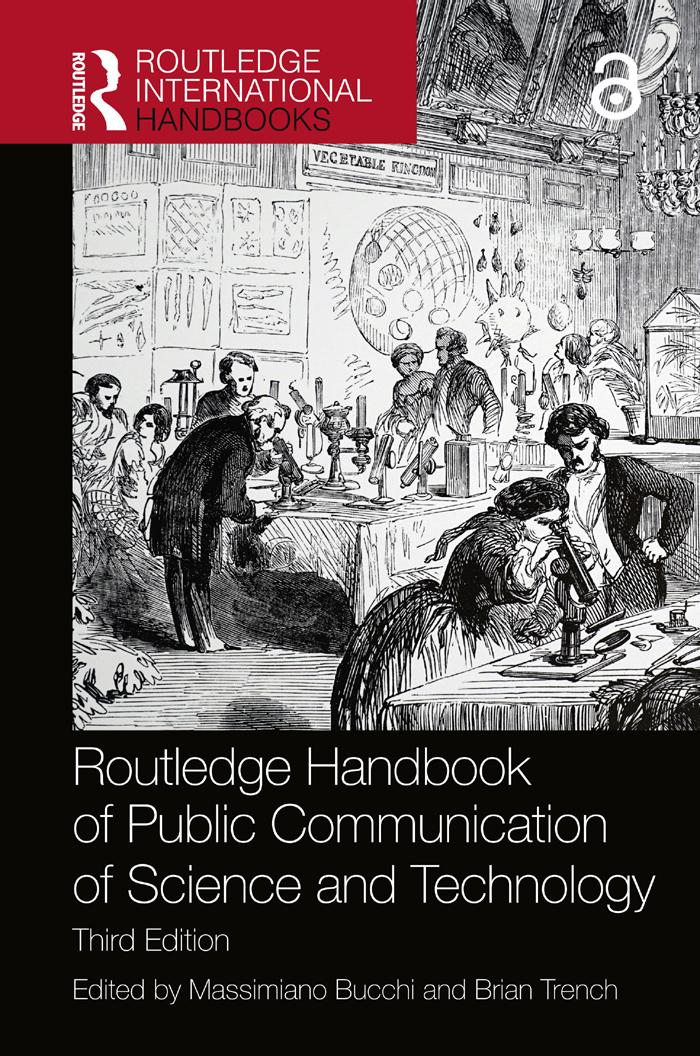
Communicating science and technology is a high priority of many research and policy institutions, a concern of many other private and public bodies, and an established subject of training and education. In the past few decades, the field has developed and expanded significantly, both in terms of professional practice, and in terms of research and reflection. At the same time, particularly in recent years, interactions between science and society have become a topic of heated public and political debates, touching issues like quality and credibility of information, trust in science and scientific actors and institutions and the roles of experts in crises and emergencies. This book provides a state-of-the-art review of this fast-growing and increasingly important area, through an examination of research done on the main actors, issues and arenas involved.
The third edition of the Handbook brings the reviews up-to-date and deepens the analysis. As well as substantial re-working of many chapters, it includes four new chapters addressing enduring themes (science publics, science-media theories), recent trends (art-science interactions) and new proposed insights on science communication as culture and as 'the social conversation around science'. New contributors are added to the group of leading scholars in the field featured in the previous editions.
The Handbook is a student-friendly resource, but its scope and expert contributions will equally appeal to practitioners and professionals in science communication. Combining the perspectives of different disciplines and of different geographical and cultural contexts, this original text provides an interdisciplinary as well as a global approach to public communication of science and technology. It is a valuable resource, notably an indispensable guide to the published work in the field, for students, researchers, educators and professionals in science communication, media and journalism studies, sociology, history of science, and science and technology studies.
Chapter 8 of this book is freely available as a downloadable Open Access PDF at http://www.taylorfrancis.com under a Creative Commons Attribution-Non Commercial-No Derivatives (CC-BY-NC-ND) 4.0 license.
Zahle einfach mit Karte, Klarna, Apple Pay oder Google Pay. Nicht zufrieden? Du hast immer ein 14-tägiges Widerrufsrecht. Lies mehr in unseren AGB. Hast du Fragen, schreib uns eine E-Mail an hello@memmo.org.
Memmo macht das Lernen einfacher – wo auch immer du bist. Bei uns findest du deine Kursbücher und smarte Lerntools an einem Ort: Zusammenfassungen, Quizzes, Podcasts und Lernkarten. Und Ted, dein Lernbuddy, beantwortet alles, was du wissen möchtest. Über 50.000 Studierende lernen bereits hier – gemacht, damit du schneller lernst und weniger Stress hast.