
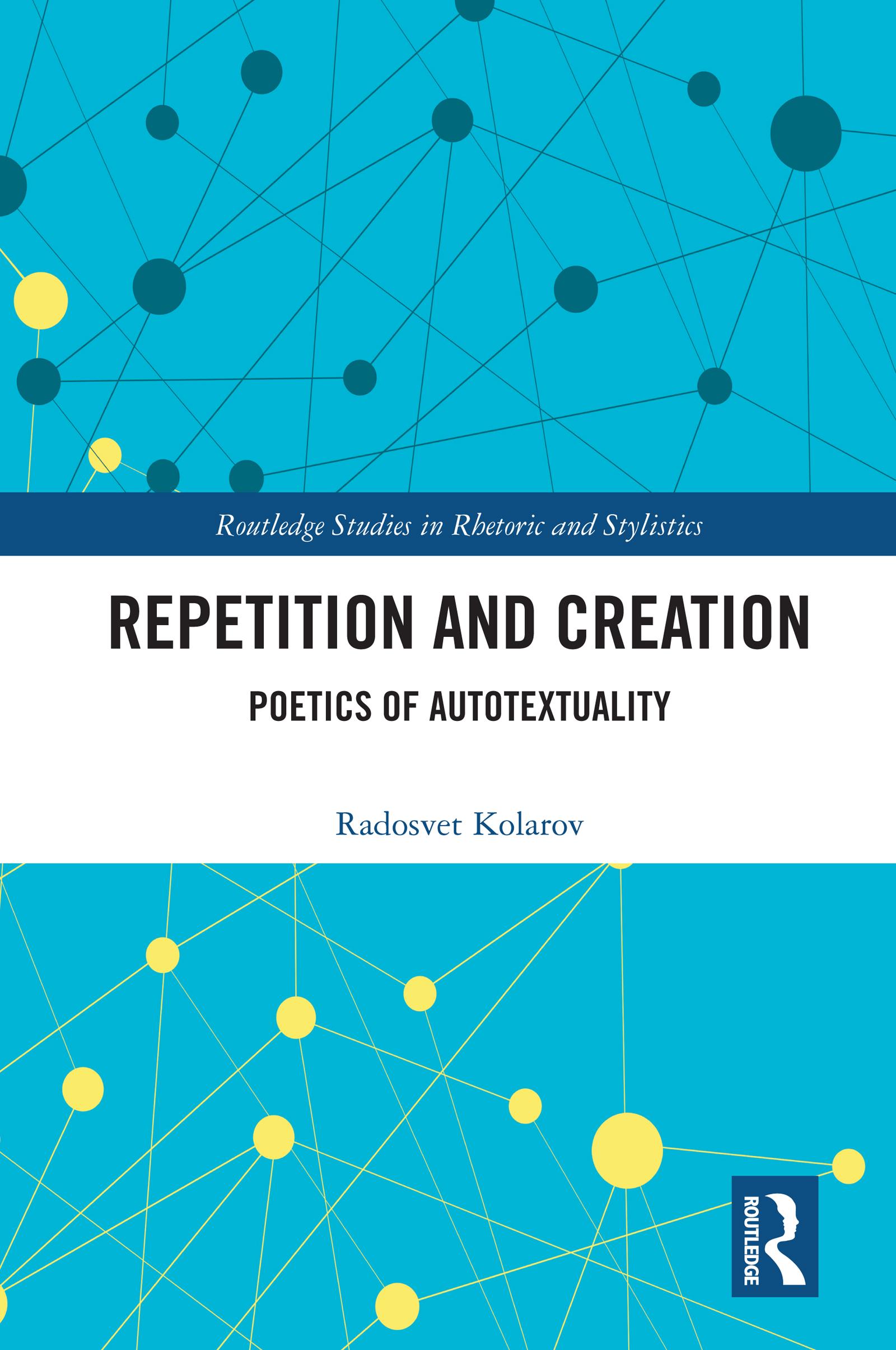
This book advances the notion of autotextuality, the dialogue between works in an author’s oeuvre, and the ways in which new texts are created in self-repetition through the tracing and revisiting of past texts and the subsequent uncovering of undisclosed meanings, unexhausted constructive principles, and alternative versions.
Kolarov draws on cognitive models, such as dual coding theory and conceptual blending, to substantiate a theory of autotextuality and build on previous work on self-repetition and difference to highlight the notion of “discursive desire,” in which new meanings are generated through repetition, and its distinct relationship to creativity. Drawing on analyses of well-established works in Bulgarian as well as the established oeuvres of such authors as Gogol, Dostoevsky, Kafka, and Baudelaire, the volume explores key themes in autotextuality such as the functions of creative memory, the connections between word and image, and the hermeneutic relationships and steps of transformation between texts.
This innovative work addresses topical questions of importance in literary theory today and will be of interest to students and scholars in literary studies and related areas of study within such fields as cognitive science, quantum mechanics, and psychology.
Zahle einfach mit Karte, Klarna, Apple Pay oder Google Pay. Nicht zufrieden? Du hast immer ein 14-tägiges Widerrufsrecht. Lies mehr in unseren AGB. Hast du Fragen, schreib uns eine E-Mail an hello@memmo.org.
Memmo macht das Lernen einfacher – wo auch immer du bist. Bei uns findest du deine Kursbücher und smarte Lerntools an einem Ort: Zusammenfassungen, Quizzes, Podcasts und Lernkarten. Und Ted, dein Lernbuddy, beantwortet alles, was du wissen möchtest. Über 50.000 Studierende lernen bereits hier – gemacht, damit du schneller lernst und weniger Stress hast.