
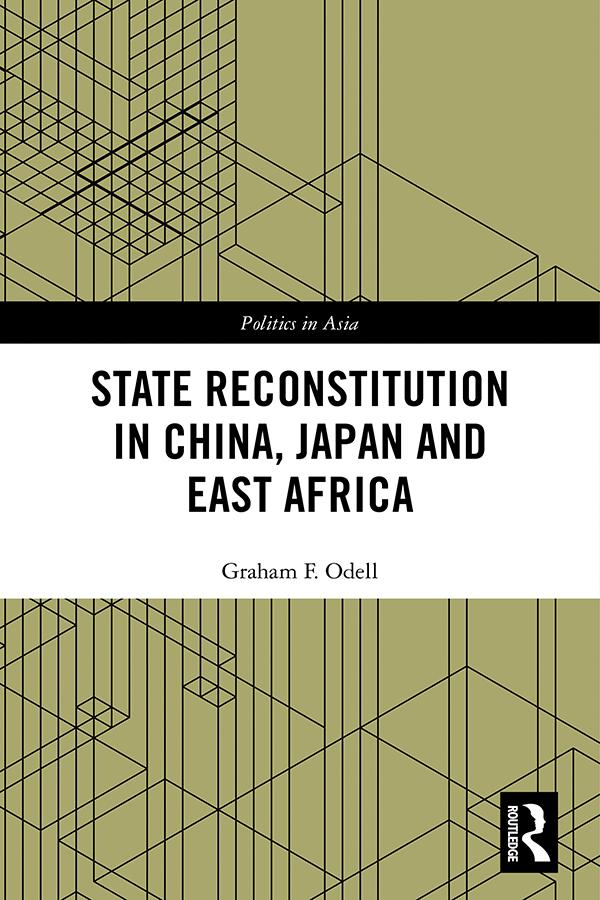
Presented through an investigation of Sengoku Japan and Republican China, this book proposes an innovative explanation of state formation that focuses on ideational and geographic factors.
This study addresses the question; why are some collapsed states able to reconstitute themselves where others have not? Graham F. Odell employs two cases of successful state reconstitution – Republican China (1912-1949) and Sengoku Japan (1477-1615) – to derive a new theoretical framework around this question. These cases are distinct across several significant factors, making them ideal for a research design that seeks to formulate an original theoretical explanation for a phenomenon. Taken together, these two periods of Chinese and Japanese history are paradigmatic cases of state collapse and reconstitution and thus intrinsically compelling to the study of state formation. By developing a new theory of successful state reconstitution through emphasizing the roles of ideology, political symbolism and the geographical distribution of social power, this text provides an answer to the question that has not only scholarly and practical implications, but also a wide geographical applicability.
This book will be key reading for scholars interested in matters of international politics, political science, and state formation, especially in East Asia.
Zahle einfach mit Karte, Klarna, Apple Pay oder Google Pay. Nicht zufrieden? Du hast immer ein 14-tägiges Widerrufsrecht. Lies mehr in unseren AGB. Hast du Fragen, schreib uns eine E-Mail an hello@memmo.org.
Memmo macht das Lernen einfacher – wo auch immer du bist. Bei uns findest du deine Kursbücher und smarte Lerntools an einem Ort: Zusammenfassungen, Quizzes, Podcasts und Lernkarten. Und Ted, dein Lernbuddy, beantwortet alles, was du wissen möchtest. Über 50.000 Studierende lernen bereits hier – gemacht, damit du schneller lernst und weniger Stress hast.