
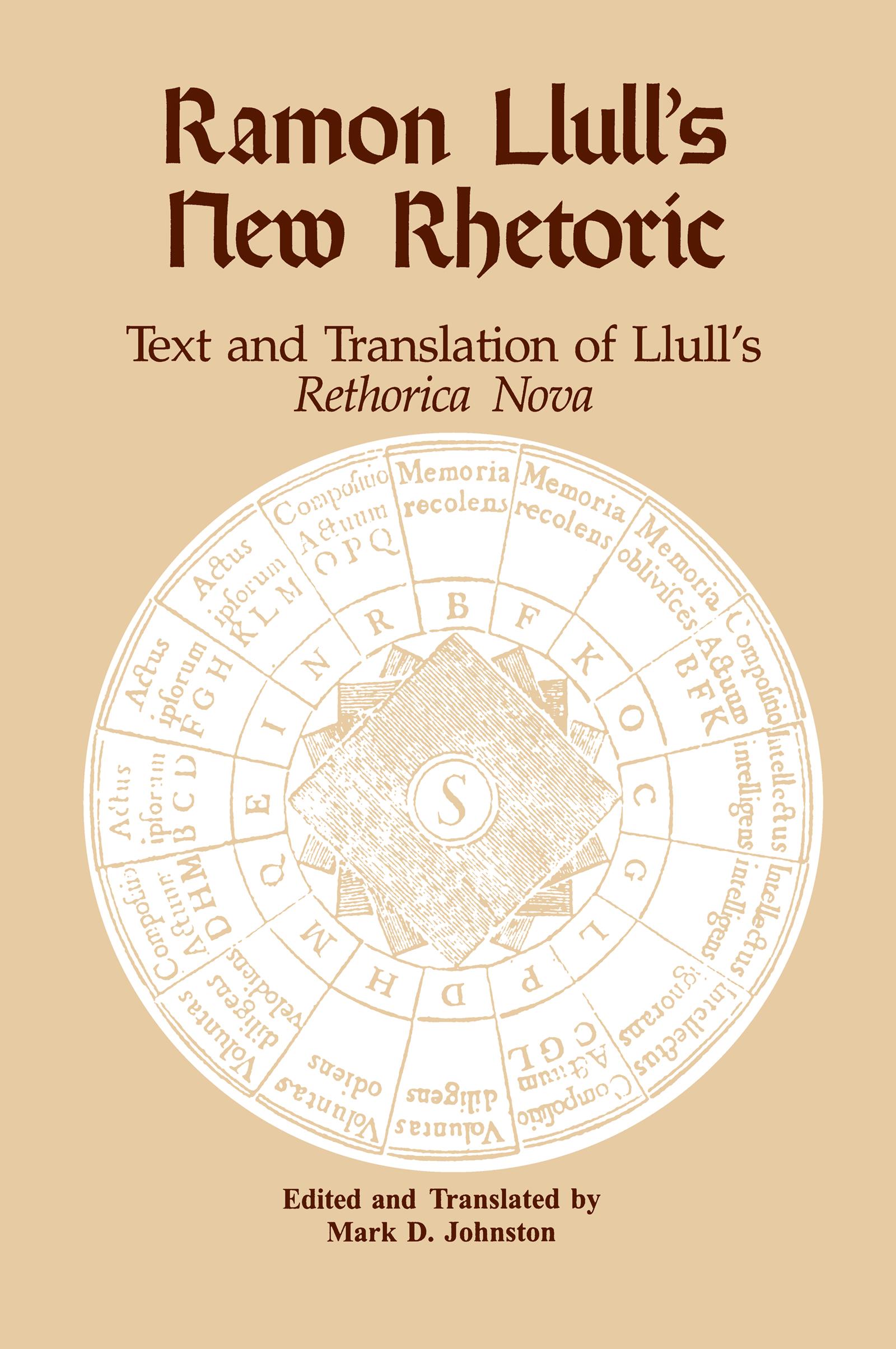
Modern histories of medieval culture often assert without qualification that the oral exercise of public eloquence during the European Middle Ages was limited to preaching by the clergy. The classical art of rhetoric supposedly survived only as a written subject for study in the schools. During the past thirty years, however, knowledge of medieval rhetorical theory and practice has grown tremendously. Historians and philologians have devoted particular attention to the relationship between oral and written communication in medieval Europe. Their investigations are beginning to suggest -- not surprisingly -- that interest in eloquence was not confined to the schools or clergy. Secular officials arguing in princely courts or town halls, and laypeople seeking to develop their learning or piety also cultivated an interest in rhetoric.
Given the paucity of testimony available, the New Rhetoric of the Mallorcan lay theologian and philosopher Ramon Llull (1232-1316) offers an exceptional witness to the non-academic and non-clerical concern for eloquence. His proposals for new Christian arts of communication are among the best evidence available for assessing the diffusion of rhetorical doctrines from the cloisters and schools into the courts, town halls, and private chapels of Western Europe around 1300.
Growing interest in Llull's work and in medieval rhetoric have combined to produce this first published edition. The first part on order shows how Llull's entire program attempts to correlate ethical, metaphysical, and linguistic categories into a single system of Anselmian "rightness." The next section on beauty could almost form a complete art of preaching in itself, thanks to the brief compilations of sermon material that it includes. The broad range of discursive elements and techniques in which Llull seeks verbal beauty makes this section very eclectic in scope. Part three on knowledge attempts to explain the diffusion of right linguistic and rhetorical doctrine almost exclusively through the Divine Dignities and other categories of the Great Art. The final section on love consists of ten proverbs regarding loving speech, each explicated with an appropriate exemplum.
Zahle einfach mit Karte, Klarna, Apple Pay oder Google Pay. Nicht zufrieden? Du hast immer ein 14-tägiges Widerrufsrecht. Lies mehr in unseren AGB. Hast du Fragen, schreib uns eine E-Mail an hello@memmo.org.
Memmo macht das Lernen einfacher – wo auch immer du bist. Bei uns findest du deine Kursbücher und smarte Lerntools an einem Ort: Zusammenfassungen, Quizzes, Podcasts und Lernkarten. Und Ted, dein Lernbuddy, beantwortet alles, was du wissen möchtest. Über 50.000 Studierende lernen bereits hier – gemacht, damit du schneller lernst und weniger Stress hast.