
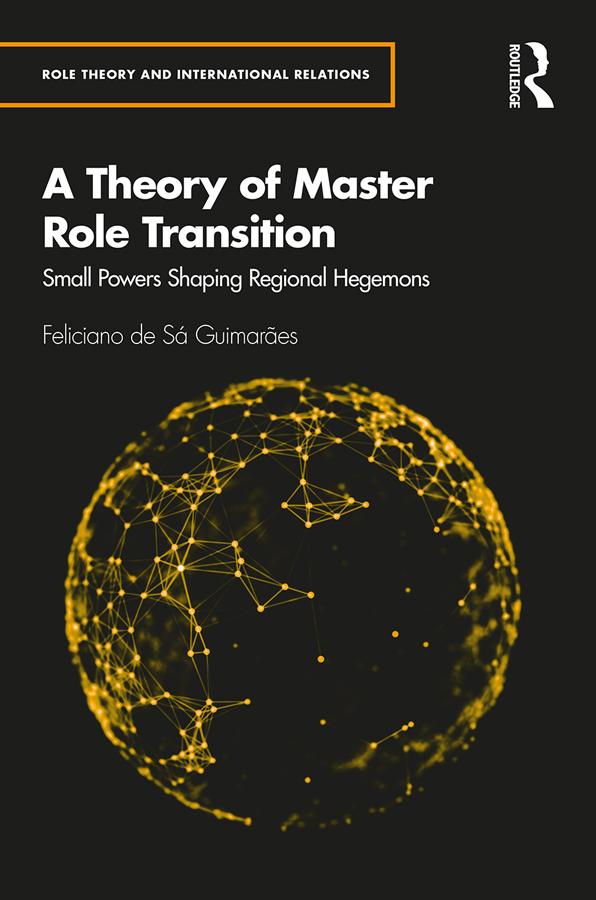
In this book, Feliciano de Sá Guimarães offers an original application of Role Theory. He proposes a theory of master role transitions to explain how small powers can change regional powers’ master roles without changing the regional material power distribution.
Master role transition is the replacement of an active dominant master role by a dormant or inactive role located within one’s role repertoire. Guimarães argues that only a combination of four necessary conditions can produce a full master role transition: asymmetrical material interdependence, altercasting, domestic contestation and regional contestation. In each one of these conditions, a small power uses material and ideational tools to promote a master role transition within the regional power role repertoire. To test his model, Guimarães turns to five case studies in Latin America, Southern Africa and South Asia: the 2006–2007 Bolivia–Brazil gas crisis, the 2008–2009 Paraguay–Brazil Itaipú Dam crisis, the 2008–2009 Ecuador–Brazil Odebrecht crisis, the 1998 South Africa–Lesotho military intervention crisis and the 1996India–Bangladesh Ganges water crisis.
A Theory of Master Role Transition is an excellent resource for those studying both theory and method in International Relations and foreign policy analysis.
Zahle einfach mit Karte, Klarna, Apple Pay oder Google Pay. Nicht zufrieden? Du hast immer ein 14-tägiges Widerrufsrecht. Lies mehr in unseren AGB. Hast du Fragen, schreib uns eine E-Mail an hello@memmo.org.
Memmo macht das Lernen einfacher – wo auch immer du bist. Bei uns findest du deine Kursbücher und smarte Lerntools an einem Ort: Zusammenfassungen, Quizzes, Podcasts und Lernkarten. Und Ted, dein Lernbuddy, beantwortet alles, was du wissen möchtest. Über 50.000 Studierende lernen bereits hier – gemacht, damit du schneller lernst und weniger Stress hast.