
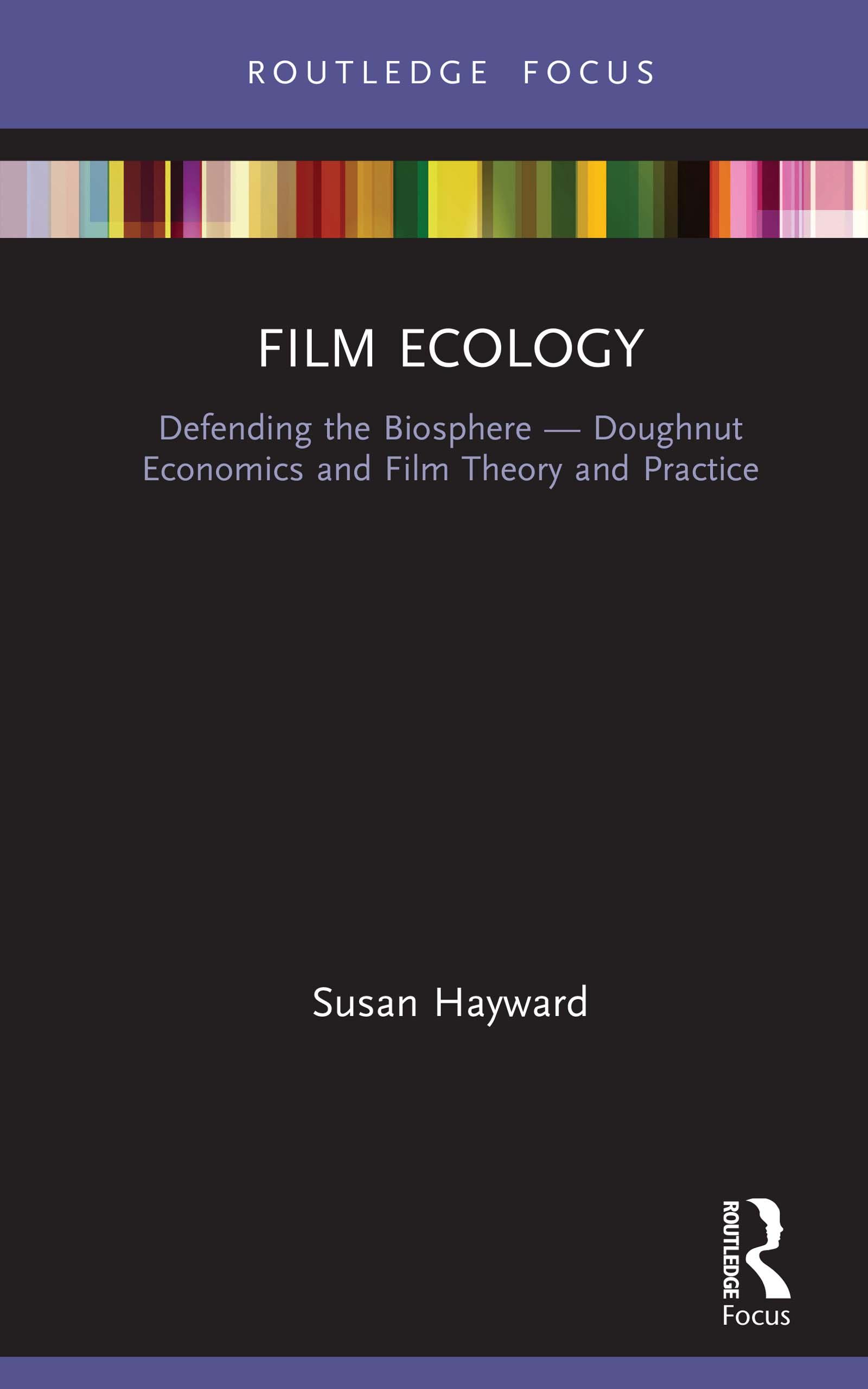
Using the Regenerative economic model – also known as Doughnut Economics – Susan Hayward offers a thought-provoking sketch for a renewed, tentatively revolutionary approach to both film theory and film practice.
This book attempts to answer the questions posed by T.J. Demos (in Against the Anthropocene, 2017): how do we find a way to address planetary harm and the issues it raises within the field of Film Studies? How do we construct a theoretical model that allows us to visualize the ecological transgressions brought about by the growth-model of capitalism which is heavily endorsed by mainstream narrative cinema? By turning to the model set out in Kate Raworth’s book Doughnut Economics (2017) and adapting its fundamental principles to a study of narrative cinema, Film Ecology proposes to show how, by using this model, we can usefully plot and investigate films according to criteria that are not genre/star/auteur-led, nor indeed embedded in anthropocentric theoretical models, but principles which are ecologically based. These arguments are brought to life with examples from mainstream narrative films such as The Giant (1956), Mildred Pierce (1945), Erin Brockovich (2000), Wall Street (1987), Hotel Rwanda (2004), and Missing Figures (2016).
This approach will inspire film practitioners, film theorists, critics and analysts, film students and film lovers alike to consider how they might integrate this Doughnut model into their thinking or work as part of their process.
Zahle einfach mit Karte, Klarna, Apple Pay oder Google Pay. Nicht zufrieden? Du hast immer ein 14-tägiges Widerrufsrecht. Lies mehr in unseren AGB. Hast du Fragen, schreib uns eine E-Mail an hello@memmo.org.
Memmo macht das Lernen einfacher – wo auch immer du bist. Bei uns findest du deine Kursbücher und smarte Lerntools an einem Ort: Zusammenfassungen, Quizzes, Podcasts und Lernkarten. Und Ted, dein Lernbuddy, beantwortet alles, was du wissen möchtest. Über 50.000 Studierende lernen bereits hier – gemacht, damit du schneller lernst und weniger Stress hast.