
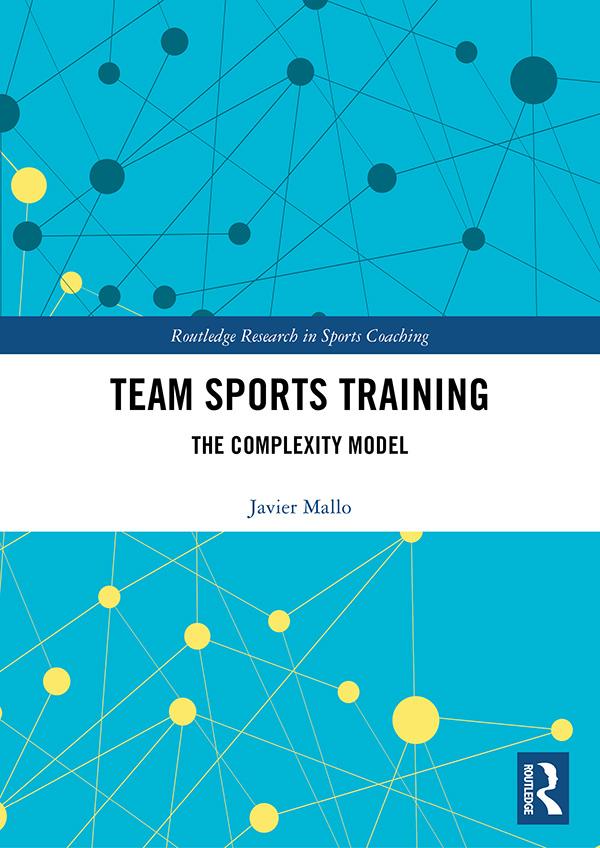
Team Sports Training: The Complexity Model presents a novel approach to team sports training, examining football (soccer), rugby, field hockey, basketball, handball and futsal through the paradigm of complexity.
Under a traditional prism, these sports have been analyzed using a deterministic perspective, where the constituent dimensions of the sportsmen were independently examined and treated in isolation. It was expected that the body worked as a perfect machine and, once all the components were maximized, the sportsmen improved their performance. If the same closed recipe was applied to all the players that formed part of the squad, the global team performance was expected to be enhanced.
As much as these reductionistic models seem coherent, when contrasted in practice we see that the reality of team sports is far more different from the closed conditions in which they were idealized. Team sports contain variable, heterogeneous and non-linear constrains which require the development of a different logic to organize their training.
During the last years, ecological psychology, the dynamical systems theory or the constraints-led approach have opened interesting fields of research from which many conceptual foundations can be applied to team sports. Based in this contemporary framework, the current book presents the study of the players and the teams as complex systems, using coordination dynamics to explain the emergence of the self-organisation episodes that characterize them. In addition, this thinking line provides the reader with the ability to apply all these innovative concepts to their practical training scenarios. Altogether, it is intended to challenge the reader to re-think their training strategy and to develop an original theory and practice of training specific to team sports.
Zahle einfach mit Karte, Klarna, Apple Pay oder Google Pay. Nicht zufrieden? Du hast immer ein 14-tägiges Widerrufsrecht. Lies mehr in unseren AGB. Hast du Fragen, schreib uns eine E-Mail an hello@memmo.org.
Memmo macht das Lernen einfacher – wo auch immer du bist. Bei uns findest du deine Kursbücher und smarte Lerntools an einem Ort: Zusammenfassungen, Quizzes, Podcasts und Lernkarten. Und Ted, dein Lernbuddy, beantwortet alles, was du wissen möchtest. Über 50.000 Studierende lernen bereits hier – gemacht, damit du schneller lernst und weniger Stress hast.