
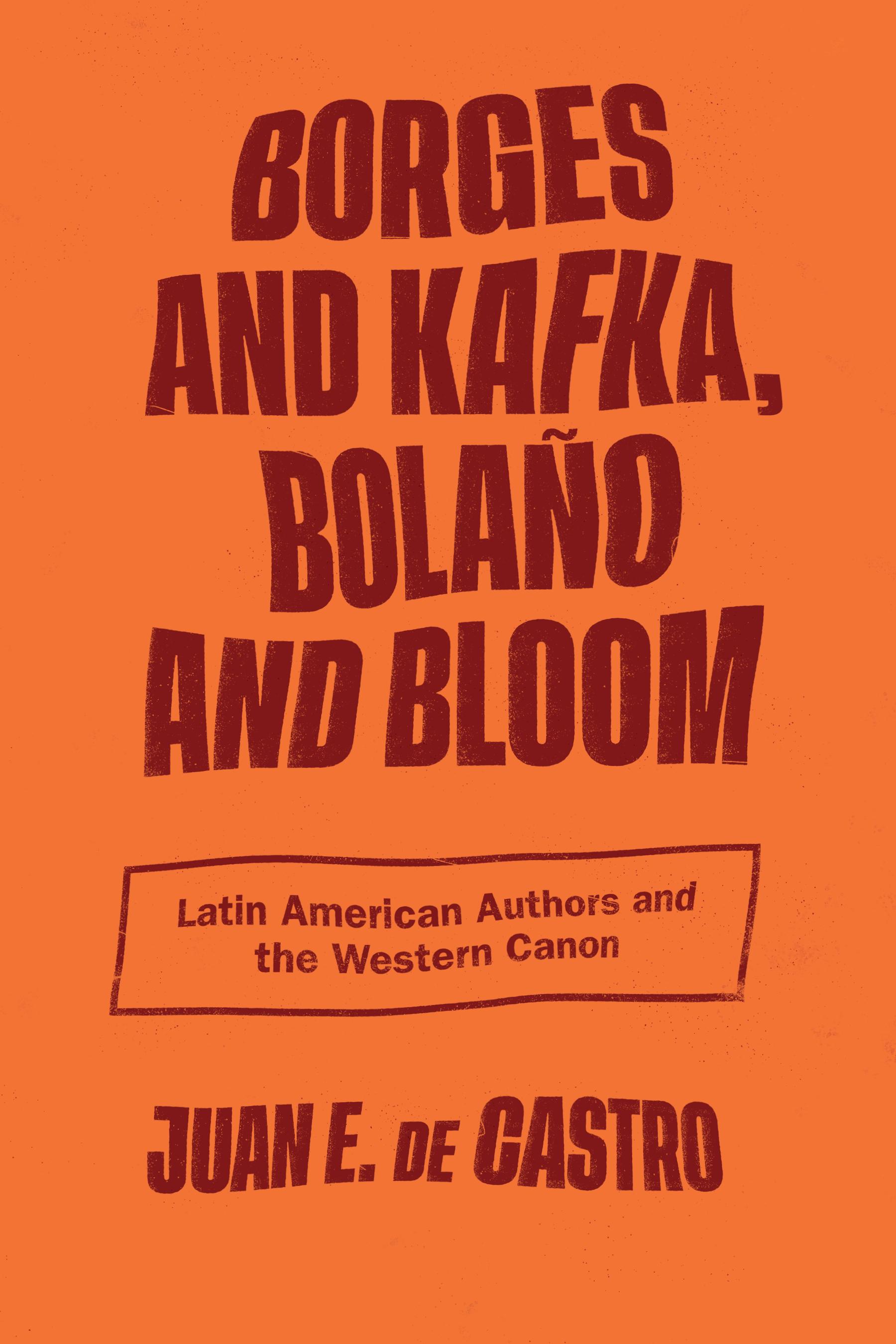
At a time in which many in the United States see Spanish America as a distinct and, for some, threatening culture clearly differentiated from that of Europe and the US, it may be of use to look at the works of some of the most representative and celebrated writers from the region to see how they imagined their relationship to Western culture and literature. In fact, while authors across stylistic and political divides—like Gabriela Mistral, Jorge Luis Borges, or Gabriel García Márquez—see their work as being framed within the confines of a globalized Western literary tradition, their relationship, rather than epigonal, is often subversive.
Borges and Kafka, Bolaño and Bloom is a parsing not simply of these authors' reactions to a canon, but of the notion of canon writ large and the inequities and erasures therein. It concludes with a look at the testimonial and autobiographical writings of Rigoberta Menchú and Lurgio Gavilán, who arguably represent the trajectory of Indigenous testimonial and autobiographical writing during the last forty years, noting how their texts represent alternative ways of relating to national and, on occasion, Western cultures. This study is a new attempt to map writers' diverse ways of thinking about locality and universality from within and without what is known as the canon.
Borges and Kafka, Bolaño and Bloom is a parsing not simply of these authors' reactions to a canon, but of the notion of canon writ large and the inequities and erasures therein. It concludes with a look at the testimonial and autobiographical writings of Rigoberta Menchú and Lurgio Gavilán, who arguably represent the trajectory of Indigenous testimonial and autobiographical writing during the last forty years, noting how their texts represent alternative ways of relating to national and, on occasion, Western cultures. This study is a new attempt to map writers' diverse ways of thinking about locality and universality from within and without what is known as the canon.
Zahle einfach mit Karte, Klarna, Apple Pay oder Google Pay. Nicht zufrieden? Du hast immer ein 14-tägiges Widerrufsrecht. Lies mehr in unseren AGB. Hast du Fragen, schreib uns eine E-Mail an hello@memmo.org.
Memmo macht das Lernen einfacher – wo auch immer du bist. Bei uns findest du deine Kursbücher und smarte Lerntools an einem Ort: Zusammenfassungen, Quizzes, Podcasts und Lernkarten. Und Ted, dein Lernbuddy, beantwortet alles, was du wissen möchtest. Über 50.000 Studierende lernen bereits hier – gemacht, damit du schneller lernst und weniger Stress hast.
Das könnte dir auch gefallen
Buch kaufen0