
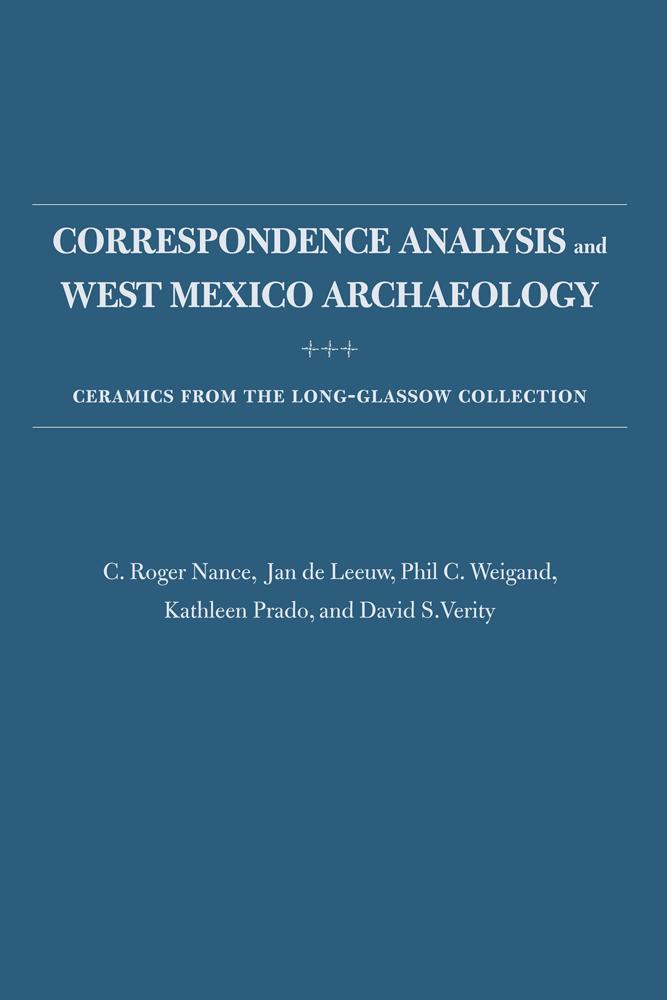
Because the archaeology of West Mexico has received little attention from researchers, large segments of the region’s prehistoric ceramic sequences have long remained incomplete. This book goes far toward filling that gap by analyzing a collection of potsherds excavated in the 1960s and housed since then, though heretofore unanalyzed, at UCLA. The authors employ the rarely used statistical technique known as correspondence analysis to sequence the Long-Glassow collection of artifacts.
The book explains how correspondence analysis works and how it can be applied in archaeology. In addition to describing the archaeological sites in north central Jalisco where the collection comes from, the authors provide an ethnohistorical overview including information on the earliest Spanish explorers to reach the sites. They sequence more than seventy ceramic types and derive a master sequence from more than ten thousand potsherds. In addition to Mesoamerican archaeologists, the audience will also include other archaeologists concerned with ceramic analysis or the application of statistics to archaeology.
Zahle einfach mit Karte, Klarna, Apple Pay oder Google Pay. Nicht zufrieden? Du hast immer ein 14-tägiges Widerrufsrecht. Lies mehr in unseren AGB. Hast du Fragen, schreib uns eine E-Mail an hello@memmo.org.
Memmo macht das Lernen einfacher – wo auch immer du bist. Bei uns findest du deine Kursbücher und smarte Lerntools an einem Ort: Zusammenfassungen, Quizzes, Podcasts und Lernkarten. Und Ted, dein Lernbuddy, beantwortet alles, was du wissen möchtest. Über 50.000 Studierende lernen bereits hier – gemacht, damit du schneller lernst und weniger Stress hast.