
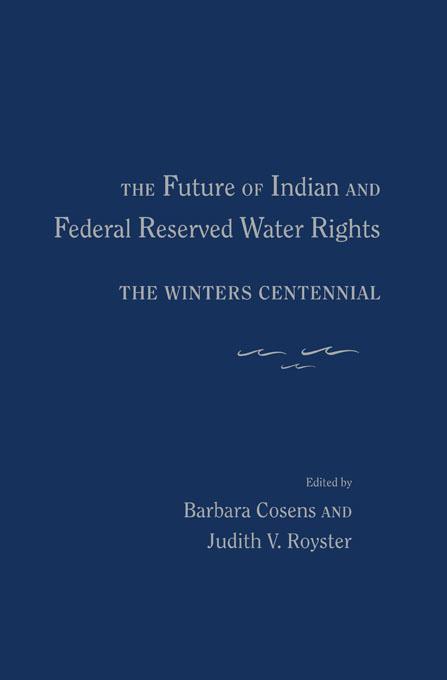
On January 6, 1908, the Supreme Court ruled that when land is set aside for the use of Indian tribes, that reservation of land includes reserved water rights. The Winters Doctrine, as it has come to be known, is now a fundamental principle of both federal Indian law and water law and has expanded beyond Indian reservations to include all federal reservations of land.
<br><br>
Ordinarily, there would not be much to say about a one hundred-year-old Supreme Court case. But while its central conclusion that a claim to water was reserved when the land was reserved for Indians represents a commitment to justice, the exact nature of that commitment-its legal basis, scope, implications for non-Indian water rights holders, the purposes for and quantities of water reserved, the geographic nexus between the land and the water reserved, and many other details of practical consequence-has been, and continues to be, litigated and negotiated. In this detailed collection of essays, lawyers, historians, and tribal leaders explore the nuances of these issues and legacies.
Zahle einfach mit Karte, Klarna, Apple Pay oder Google Pay. Nicht zufrieden? Du hast immer ein 14-tägiges Widerrufsrecht. Lies mehr in unseren AGB. Hast du Fragen, schreib uns eine E-Mail an hello@memmo.org.
Memmo macht das Lernen einfacher – wo auch immer du bist. Bei uns findest du deine Kursbücher und smarte Lerntools an einem Ort: Zusammenfassungen, Quizzes, Podcasts und Lernkarten. Und Ted, dein Lernbuddy, beantwortet alles, was du wissen möchtest. Über 50.000 Studierende lernen bereits hier – gemacht, damit du schneller lernst und weniger Stress hast.