
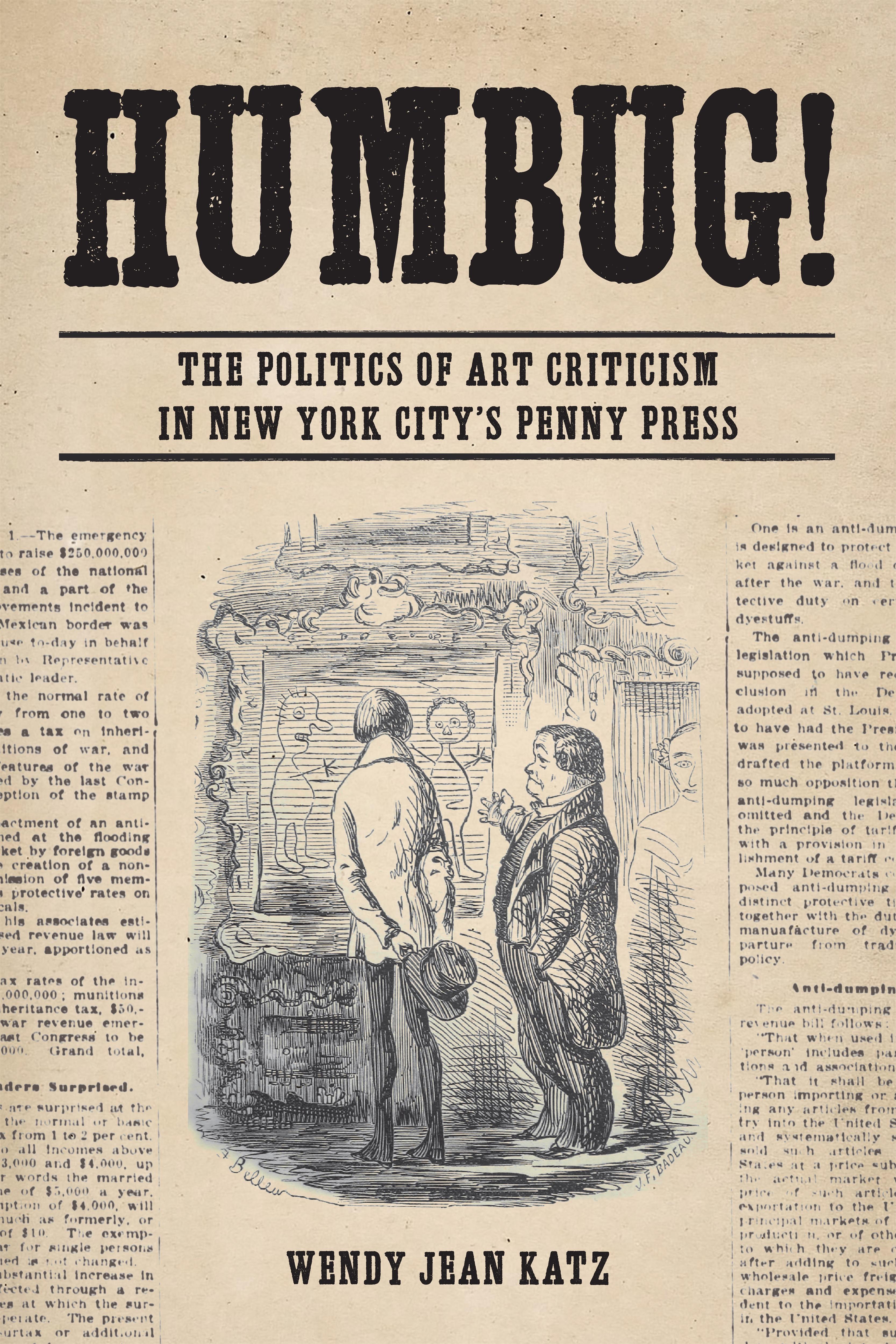
Approximately 300 daily and weekly newspapers flourished in New York before the Civil War. A majority of these newspapers, even those that proclaimed independence of party, were motivated by political conviction and often local conflicts. Their editors and writers jockeyed for government office and influence. Political infighting and their related maneuvers dominated the popular press, and these political and economic agendas led in turn to exploitation of art and art exhibitions. Humbug traces the relationships, class animosities, gender biases, and racial projections that drove the terms of art criticism, from the emergence of the penny press to the Civil War.
The inexpensive “penny” papers that appeared in the 1830s relied on advertising to survive. Sensational stories, satire, and breaking news were the key to selling papers on the streets. Coverage of local politicians, markets, crime, and personalities, including artists and art exhibitions, became the penny papers’ lifeblood. These cheap papers, though unquestionably part of the period’s expanding capitalist economy, offered socialists, working-class men, bohemians, and utopianists a forum in which they could propose new models for American art and society and tear down existing ones.
Arguing that the politics of the antebellum press affected the meaning of American art in ways that have gone unrecognized, Humbug covers the changing politics and rhetoric of this criticism. Author Wendy Katz demonstrates how the penny press’s drive for a more egalitarian society affected the taste and values that shaped art, and how the politics of their art criticism changed under pressure from nativists, abolitionists, and expansionists. Chapters explore James Gordon Bennett’s New York Herald and its attack on aristocratic monopolies on art; the penny press’s attack on the American Art-Union, an influential corporation whose Board purchased artworks from living artists, exhibited them in a free gallery, and then distributed them in an annual five-dollar lottery; exposés of the fraudulent trade in Old Masters works; and the efforts of socialists, freethinkers, and bohemians to reject the authority of the past.
Zahle einfach mit Karte, Klarna, Apple Pay oder Google Pay. Nicht zufrieden? Du hast immer ein 14-tägiges Widerrufsrecht. Lies mehr in unseren AGB. Hast du Fragen, schreib uns eine E-Mail an hello@memmo.org.
Memmo macht das Lernen einfacher – wo auch immer du bist. Bei uns findest du deine Kursbücher und smarte Lerntools an einem Ort: Zusammenfassungen, Quizzes, Podcasts und Lernkarten. Und Ted, dein Lernbuddy, beantwortet alles, was du wissen möchtest. Über 50.000 Studierende lernen bereits hier – gemacht, damit du schneller lernst und weniger Stress hast.