
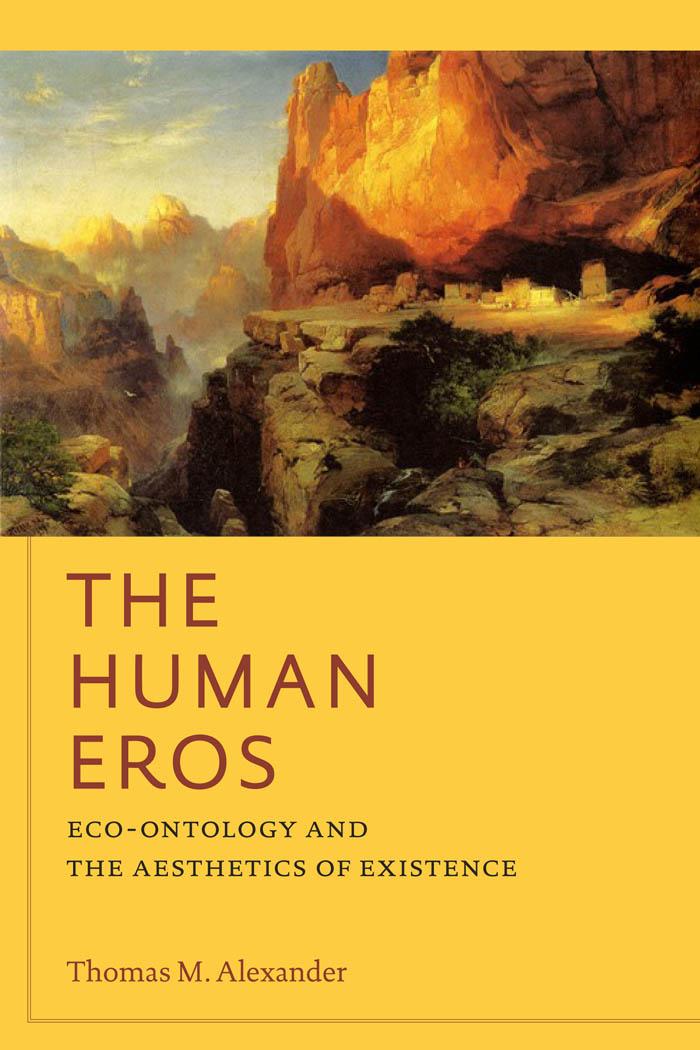
The Human Eros explores themes in classical American philosophy, primarily the thought of John Dewey, but also that of Ralph Waldo Emerson, George Santayana, and Native American traditions. Alexander’s primary claim is that human beings have an inherent need to experience meaning and value, a “Human Eros.” Our
various cultures are symbolic environments or “spiritual ecologies” within which the Human Eros seeks to thrive. This is how we inhabit the earth.
Encircling and sustaining our cultural existence is nature, yet Western philosophy has not provided adequate conceptual models for thinking ecologically. Alexander introduces the idea of “eco-ontology” to explore ways in which this might be done, beginning with the primacy of Nature over Being but also including the recognition of possibility and potentiality as inherent aspects of existence. He argues for the centrality of Dewey’s thought to an effective ecological philosophy. Both “pragmatism” and “naturalism,” he shows, need to be contextualized within an emergentist, relational, nonreductive view of nature and an aesthetic, imaginative, nonreductive view of intelligence.
Zahle einfach mit Karte, Klarna, Apple Pay oder Google Pay. Nicht zufrieden? Du hast immer ein 14-tägiges Widerrufsrecht. Lies mehr in unseren AGB. Hast du Fragen, schreib uns eine E-Mail an hello@memmo.org.
Memmo macht das Lernen einfacher – wo auch immer du bist. Bei uns findest du deine Kursbücher und smarte Lerntools an einem Ort: Zusammenfassungen, Quizzes, Podcasts und Lernkarten. Und Ted, dein Lernbuddy, beantwortet alles, was du wissen möchtest. Über 50.000 Studierende lernen bereits hier – gemacht, damit du schneller lernst und weniger Stress hast.