
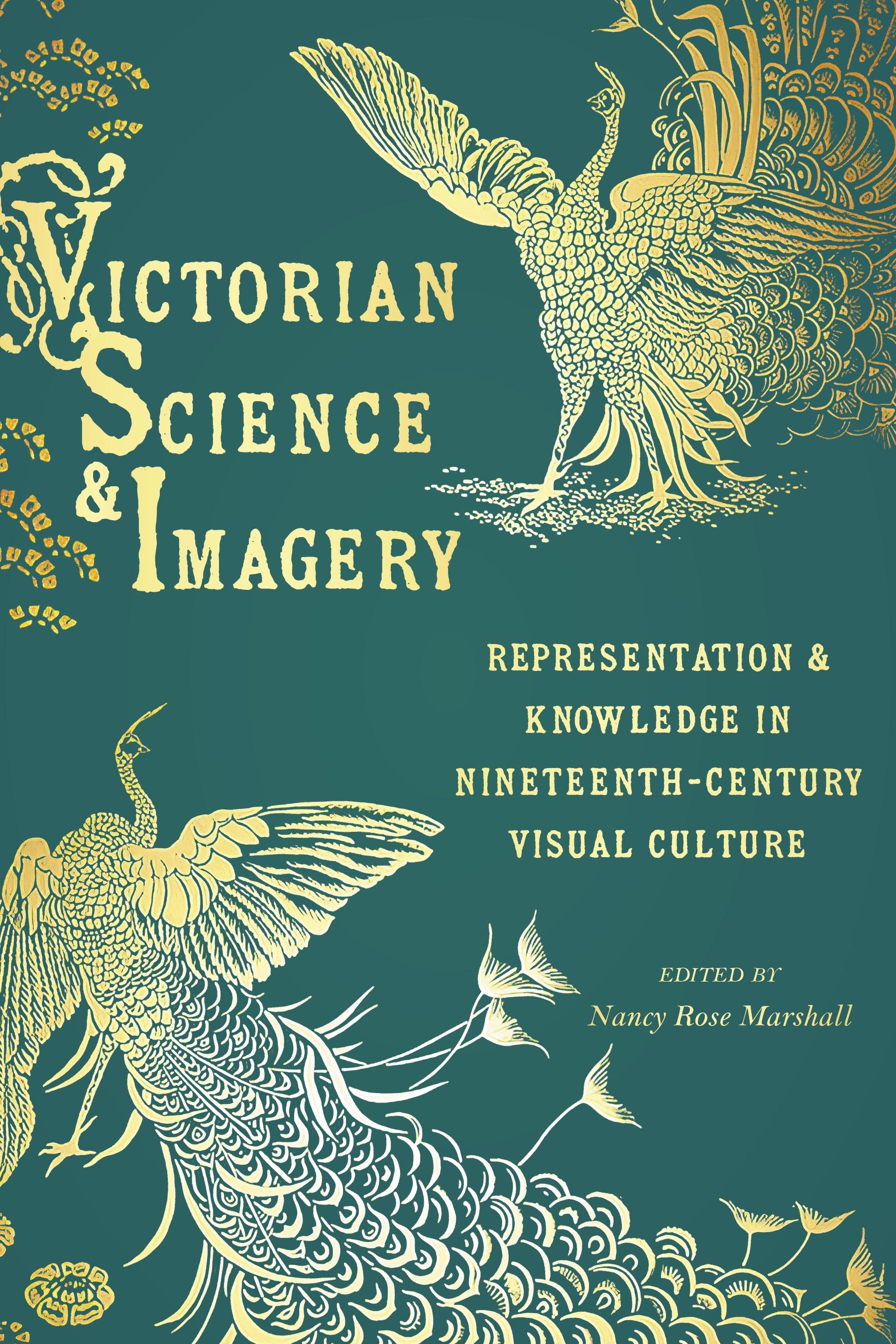
The nineteenth century was a period of science and imagery: when scientific theories and discoveries challenged longstanding boundaries between animal, plant, and human, and when art and visual culture produced new notions about the place of the human in the natural world. Just as scientists relied on graphic representation to conceptualize their ideas, artists moved seamlessly between scientific debate and creative expression to support or contradict popular scientific theories—such as Darwin’s theory of evolution and sexual selection—deliberately drawing on concepts in ways that allowed them to refute popular claims or disrupt conventional knowledges.
Focusing on the close kinship between the arts and sciences during the Victorian period, the art historians contributing to this volume reveal the unique ways in which nineteenth-century British and American visual culture participated in making science, and in which science informed art at a crucial moment in the history of the development of the modern world. Together, they explore topics in geology, meteorology, medicine, anatomy, evolution, and zoology, as well as a range of media from photography to oil painting. They remind us that science and art are not tightly compartmentalized, separate influences. Rather, these are fields that share forms, manifest as waves, layers, lines, or geometries; that invest in the idea of the evolution of form; and that generate surprisingly kindred responses, such as pain, pleasure, empathy, and sympathy.
Focusing on the close kinship between the arts and sciences during the Victorian period, the art historians contributing to this volume reveal the unique ways in which nineteenth-century British and American visual culture participated in making science, and in which science informed art at a crucial moment in the history of the development of the modern world. Together, they explore topics in geology, meteorology, medicine, anatomy, evolution, and zoology, as well as a range of media from photography to oil painting. They remind us that science and art are not tightly compartmentalized, separate influences. Rather, these are fields that share forms, manifest as waves, layers, lines, or geometries; that invest in the idea of the evolution of form; and that generate surprisingly kindred responses, such as pain, pleasure, empathy, and sympathy.
Zahle einfach mit Karte, Klarna, Apple Pay oder Google Pay. Nicht zufrieden? Du hast immer ein 14-tägiges Widerrufsrecht. Lies mehr in unseren AGB. Hast du Fragen, schreib uns eine E-Mail an hello@memmo.org.
Memmo macht das Lernen einfacher – wo auch immer du bist. Bei uns findest du deine Kursbücher und smarte Lerntools an einem Ort: Zusammenfassungen, Quizzes, Podcasts und Lernkarten. Und Ted, dein Lernbuddy, beantwortet alles, was du wissen möchtest. Über 50.000 Studierende lernen bereits hier – gemacht, damit du schneller lernst und weniger Stress hast.
Das könnte dir auch gefallen
Buch kaufen0