
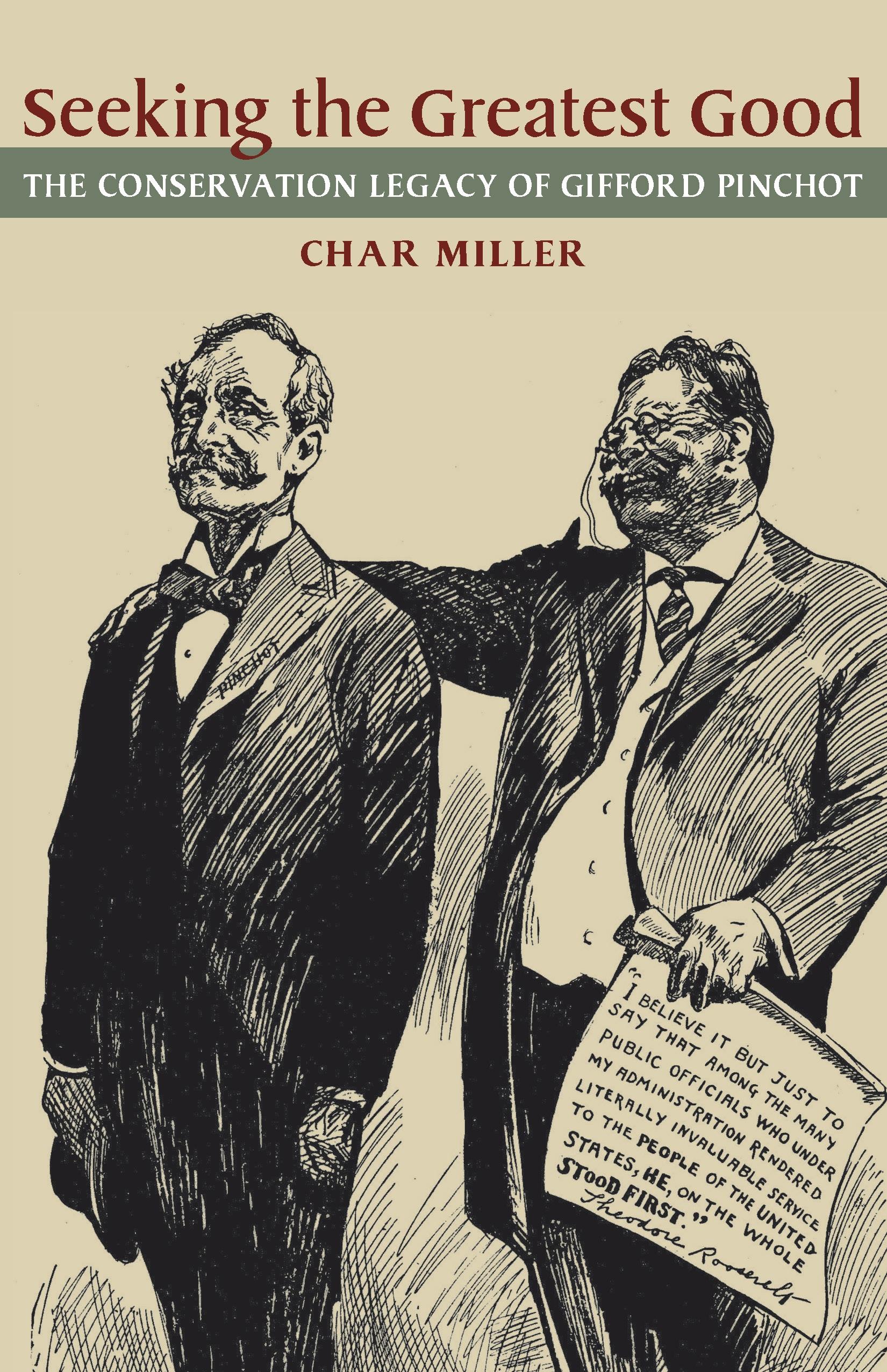
President John F. Kennedy officially dedicated the Pinchot Institute for Conservation Studies on September 24, 1963 to further the legacy and activism of conservationist Gifford Pinchot (1865-1946). Pinchot was the first chief of the United States Forest Service, appointed by Theodore Roosevelt in 1905. During his five-year term, he more than tripled the national forest reserves to 172 million acres. A pioneer in his field, Pinchot is widely regarded as one of the architects of American conservation and an adamant steward of natural resources for future generations.
Author Char Miller highlights many of the important contributions of the Pinchot Institute through its first fifty years of operation. As a union of the United States Forest Service and the Conservation Foundation, a private New York-based think tank, the institute was created to formulate policy and develop conservation education programs. Miller chronicles the institution's founding, a donation of the Pinchot family, at its Grey Towers estate in Milford, Pennsylvania. He views the contributions of Pinchot family members, from the institute's initial conception by Pinchot's son, Gifford Bryce Pinchot, through the family's ongoing participation in current conservation programming. Miller describes the institute's unique fusion of policy makers, scientists, politicians, and activists to increase our understanding of and responses to urban and rural forestry, water quality, soil erosion, air pollution, endangered species, land management and planning, and hydraulic franking.
Miller explores such innovative programs as Common Waters, which works to protect the local Delaware River Basin as a drinking water source for millions; EcoMadera, which trains the residents of Cristobal Col—n in Ecuador in conservation land management and sustainable wood processing; and the Forest Health-Human Health Initiative, which offers health-care credits to rural American landowners who maintain their carbon-capturing forestlands. Many of these individuals are age sixty-five or older and face daunting medical expenses that may force them to sell their land for timber.
Through these and countless other collaborative endeavors, the Pinchot Institute has continued to advance its namesake's ambition to protect ecosystems for future generations and provide vital environmental services in an age of a burgeoning population and a disruptive climate.
Author Char Miller highlights many of the important contributions of the Pinchot Institute through its first fifty years of operation. As a union of the United States Forest Service and the Conservation Foundation, a private New York-based think tank, the institute was created to formulate policy and develop conservation education programs. Miller chronicles the institution's founding, a donation of the Pinchot family, at its Grey Towers estate in Milford, Pennsylvania. He views the contributions of Pinchot family members, from the institute's initial conception by Pinchot's son, Gifford Bryce Pinchot, through the family's ongoing participation in current conservation programming. Miller describes the institute's unique fusion of policy makers, scientists, politicians, and activists to increase our understanding of and responses to urban and rural forestry, water quality, soil erosion, air pollution, endangered species, land management and planning, and hydraulic franking.
Miller explores such innovative programs as Common Waters, which works to protect the local Delaware River Basin as a drinking water source for millions; EcoMadera, which trains the residents of Cristobal Col—n in Ecuador in conservation land management and sustainable wood processing; and the Forest Health-Human Health Initiative, which offers health-care credits to rural American landowners who maintain their carbon-capturing forestlands. Many of these individuals are age sixty-five or older and face daunting medical expenses that may force them to sell their land for timber.
Through these and countless other collaborative endeavors, the Pinchot Institute has continued to advance its namesake's ambition to protect ecosystems for future generations and provide vital environmental services in an age of a burgeoning population and a disruptive climate.
Kategorie: Miljövetenskap & Klimat
e-ISBN: 9780822979210
Zahle einfach mit Karte, Klarna, Apple Pay oder Google Pay. Nicht zufrieden? Du hast immer ein 14-tägiges Widerrufsrecht. Lies mehr in unseren AGB. Hast du Fragen, schreib uns eine E-Mail an hello@memmo.org.
Memmo macht das Lernen einfacher – wo auch immer du bist. Bei uns findest du deine Kursbücher und smarte Lerntools an einem Ort: Zusammenfassungen, Quizzes, Podcasts und Lernkarten. Und Ted, dein Lernbuddy, beantwortet alles, was du wissen möchtest. Über 50.000 Studierende lernen bereits hier – gemacht, damit du schneller lernst und weniger Stress hast.
Das könnte dir auch gefallen
Buch kaufen0