
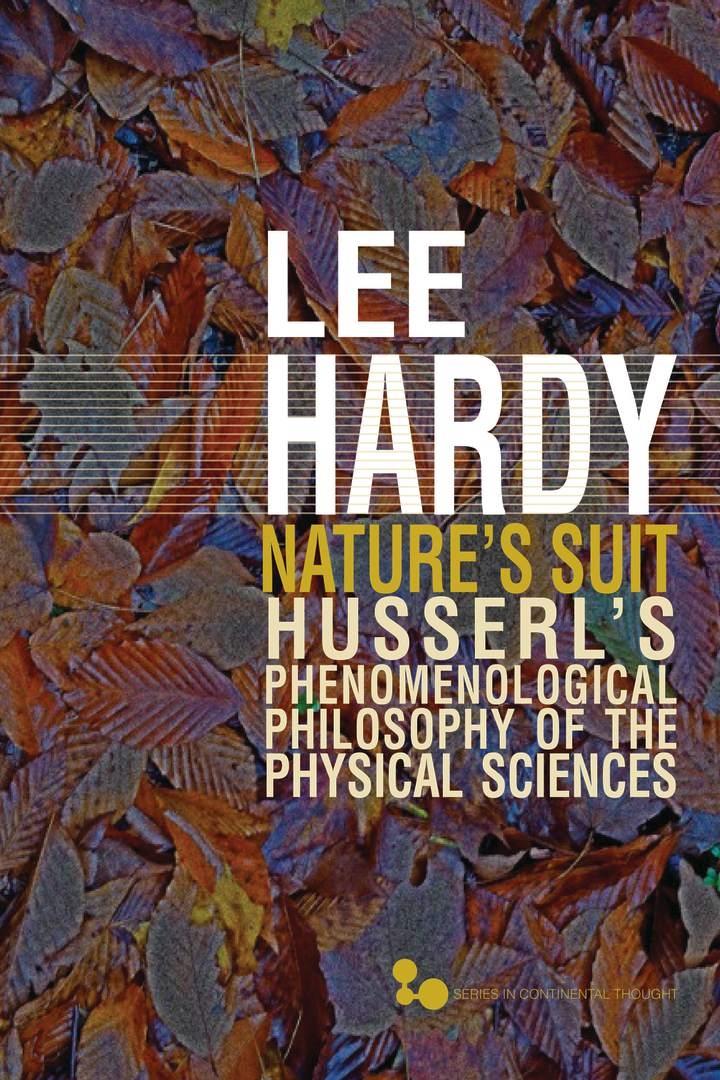
Edmund Husserl, founder of the phenomenological movement, is usually read as an idealist in his metaphysics and an instrumentalist in his philosophy of science. In Nature’s Suit, Lee Hardy argues that both views represent a serious misreading of Husserl’s texts.
Drawing upon the full range of Husserl’s major published works together with material from Husserl’s unpublished manuscripts, Hardy develops a consistent interpretation of Husserl’s conception of logic as a theory of science, his phenomenological account of truth and rationality, his ontology of the physical thing and mathematical objectivity, his account of the process of idealization in the physical sciences, and his approach to the phenomenological clarification and critique of scientific knowledge. Offering a jargon-free explanation of the basic principles of Husserl’s phenomenology, Nature’s Suit provides an excellent introduction to the philosophy of Edmund Husserl as well as a focused examination of his potential contributions to the philosophy of science.
While the majority of research on Husserl’s philosophy of the sciences focuses on the critique of science in his late work, The Crisis of European Sciences, Lee Hardy covers the entire breadth of Husserl’s reflections on science in a systematic fashion, contextualizing Husserl’s phenomenological critique to demonstrate that it is entirely compatible with the theoretical dimensions of contemporary science.
Zahle einfach mit Karte, Klarna, Apple Pay oder Google Pay. Nicht zufrieden? Du hast immer ein 14-tägiges Widerrufsrecht. Lies mehr in unseren AGB. Hast du Fragen, schreib uns eine E-Mail an hello@memmo.org.
Memmo macht das Lernen einfacher – wo auch immer du bist. Bei uns findest du deine Kursbücher und smarte Lerntools an einem Ort: Zusammenfassungen, Quizzes, Podcasts und Lernkarten. Und Ted, dein Lernbuddy, beantwortet alles, was du wissen möchtest. Über 50.000 Studierende lernen bereits hier – gemacht, damit du schneller lernst und weniger Stress hast.