
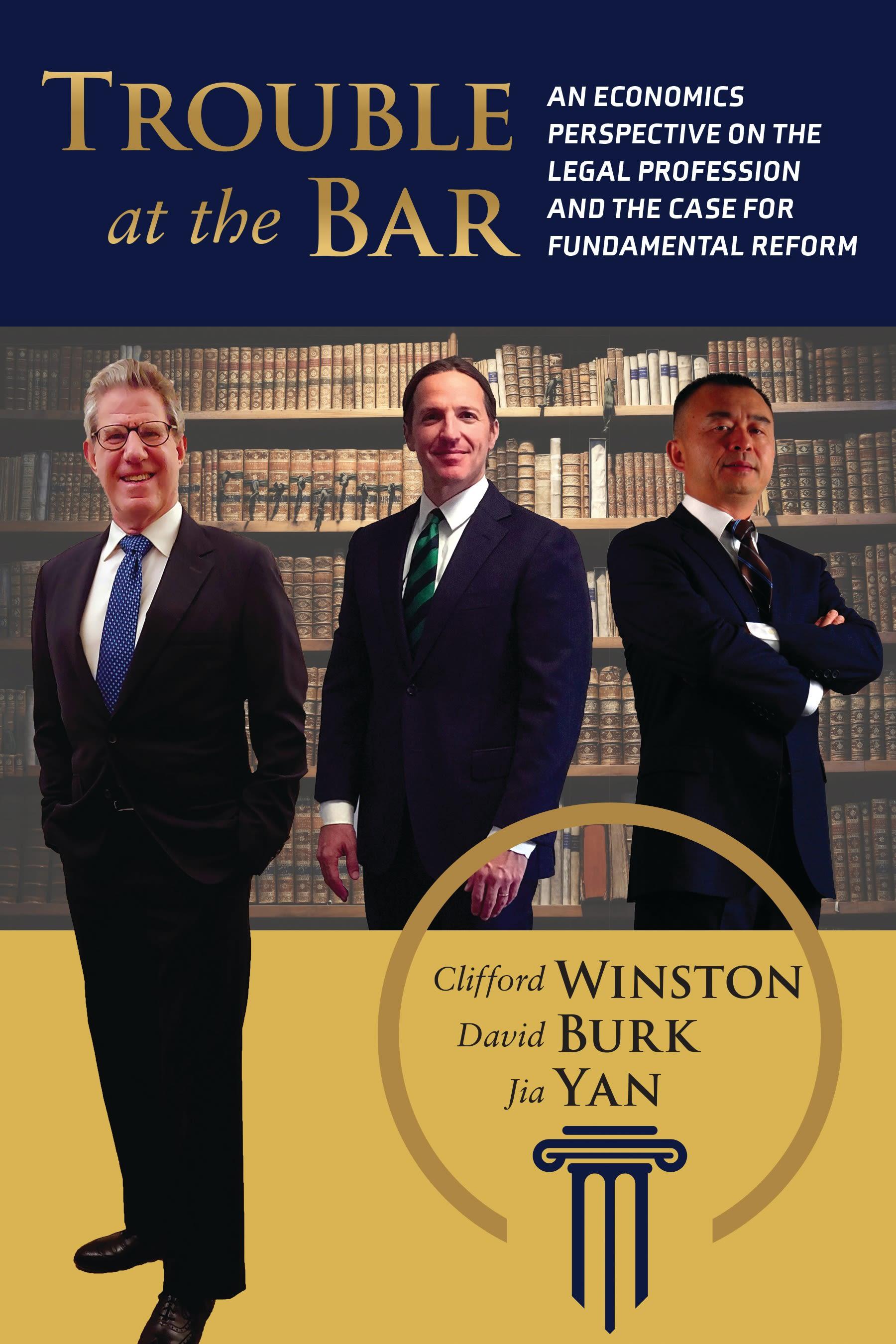
Deregulating the legal profession will benefit society by improving access to legal services and the efficacy of public policies.
Lawyers dominate a judicial system that has come under fire for limiting access to its services to primarily the most affluent members of society. Lawyers also have a pervasive influence throughout other parts of government. This is the first book offering a critical comprehensive overview of the legal profession's role in failing to serve the majority of the public and in contributing to the formation of inefficient public policies that reduce public welfare.
In Trouble at the Bar, the authors use an economic approach to provide empirical support for legal reformers who are concerned about their own profession. The authors highlight the adverse effects of the legal profession's self-regulation, which raises the cost of legal education, decreases the supply of lawyers, and limits the public's access to justice to the point where, in general, only certified lawyers can execute even simple contracts. At the same time, barriers to entry that limit competition create a closed environment that inhibits valid approaches to analyzing and solving legal problems that are at the heart of effective public policy.
Deregulating the legal profession, the authors argue, would allow more people to provide a variety of legal services without jeopardizing their quality, reduce the cost of those services, spur competition and innovation in the private sector, and increase the quality of lawyers who pursue careers in the public sector. Legal practitioners would enjoy more fulfilling careers, and society in general and its most vulnerable members in particular would benefit greatly.
Lawyers dominate a judicial system that has come under fire for limiting access to its services to primarily the most affluent members of society. Lawyers also have a pervasive influence throughout other parts of government. This is the first book offering a critical comprehensive overview of the legal profession's role in failing to serve the majority of the public and in contributing to the formation of inefficient public policies that reduce public welfare.
In Trouble at the Bar, the authors use an economic approach to provide empirical support for legal reformers who are concerned about their own profession. The authors highlight the adverse effects of the legal profession's self-regulation, which raises the cost of legal education, decreases the supply of lawyers, and limits the public's access to justice to the point where, in general, only certified lawyers can execute even simple contracts. At the same time, barriers to entry that limit competition create a closed environment that inhibits valid approaches to analyzing and solving legal problems that are at the heart of effective public policy.
Deregulating the legal profession, the authors argue, would allow more people to provide a variety of legal services without jeopardizing their quality, reduce the cost of those services, spur competition and innovation in the private sector, and increase the quality of lawyers who pursue careers in the public sector. Legal practitioners would enjoy more fulfilling careers, and society in general and its most vulnerable members in particular would benefit greatly.
Zahle einfach mit Karte, Klarna, Apple Pay oder Google Pay. Nicht zufrieden? Du hast immer ein 14-tägiges Widerrufsrecht. Lies mehr in unseren AGB. Hast du Fragen, schreib uns eine E-Mail an hello@memmo.org.
Memmo macht das Lernen einfacher – wo auch immer du bist. Bei uns findest du deine Kursbücher und smarte Lerntools an einem Ort: Zusammenfassungen, Quizzes, Podcasts und Lernkarten. Und Ted, dein Lernbuddy, beantwortet alles, was du wissen möchtest. Über 50.000 Studierende lernen bereits hier – gemacht, damit du schneller lernst und weniger Stress hast.