
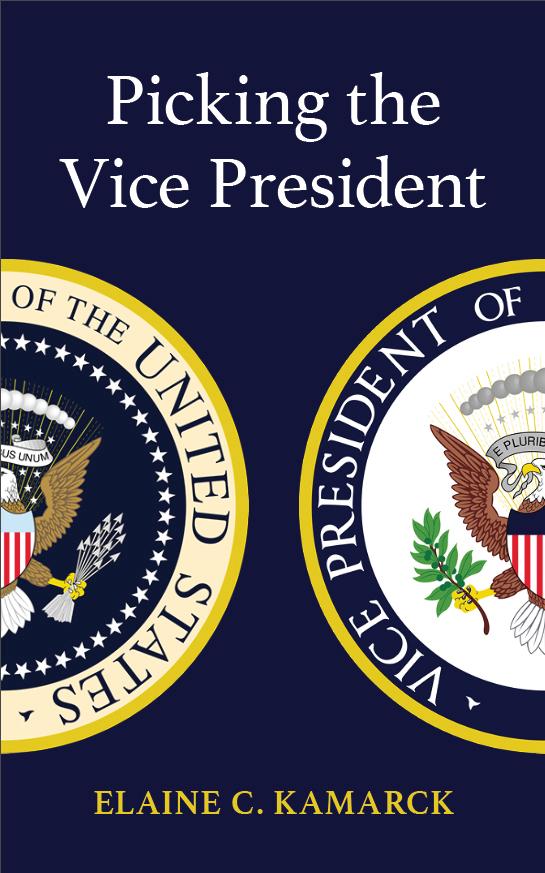
How Picking the Vice President Has Changedand Why It Matters
During the past three decades, two important things have changed about the U.S. vice presidency: the rationale for why presidential candidates choose particular running mates, and the role of vice presidents once in office. This is the first major book focusing on both of those elements, and it comes at a crucial moment in American history.
Until 1992, presidential candidates tended to select running mates simply to balance the ticket, sometimes geographically, sometimes to guarantee victory in an must-carry state, sometimes ideologically, and sometimes for all three reasons.
Bill Clinton changed that in 1992 when he selected Al Gore as his running mate, saying the experience and compatibility of the Tennessee senator would make him an ideal partner in governing. Gore's two immediate successors, Dick Cheney and Joe Biden, played similar roles under Presidents Bush and Obama. Mike Pence seems to also be following in that role as well, although the first draft of history on the Trump Administration is still being written.
What enabled this change in the vice presidency was not so much the personal characteristics of recent vice presidents but instead changes in the presidential nomination system. The increased importance of primaries and the overwhelming need to raise money have diminished the importance of balance on the ticket and increased the importance of partnershipselecting a partner who can help the president govern.
This book appears as Joe Biden prepares to choose his own running mate. No matter who wins the November 2020 elections, what Elaine Kamarck writes will be of interest to anyone following current affairs, students of American government, and journalists whose job will be to cover the next administration.
During the past three decades, two important things have changed about the U.S. vice presidency: the rationale for why presidential candidates choose particular running mates, and the role of vice presidents once in office. This is the first major book focusing on both of those elements, and it comes at a crucial moment in American history.
Until 1992, presidential candidates tended to select running mates simply to balance the ticket, sometimes geographically, sometimes to guarantee victory in an must-carry state, sometimes ideologically, and sometimes for all three reasons.
Bill Clinton changed that in 1992 when he selected Al Gore as his running mate, saying the experience and compatibility of the Tennessee senator would make him an ideal partner in governing. Gore's two immediate successors, Dick Cheney and Joe Biden, played similar roles under Presidents Bush and Obama. Mike Pence seems to also be following in that role as well, although the first draft of history on the Trump Administration is still being written.
What enabled this change in the vice presidency was not so much the personal characteristics of recent vice presidents but instead changes in the presidential nomination system. The increased importance of primaries and the overwhelming need to raise money have diminished the importance of balance on the ticket and increased the importance of partnershipselecting a partner who can help the president govern.
This book appears as Joe Biden prepares to choose his own running mate. No matter who wins the November 2020 elections, what Elaine Kamarck writes will be of interest to anyone following current affairs, students of American government, and journalists whose job will be to cover the next administration.
Zahle einfach mit Karte, Klarna, Apple Pay oder Google Pay. Nicht zufrieden? Du hast immer ein 14-tägiges Widerrufsrecht. Lies mehr in unseren AGB. Hast du Fragen, schreib uns eine E-Mail an hello@memmo.org.
Memmo macht das Lernen einfacher – wo auch immer du bist. Bei uns findest du deine Kursbücher und smarte Lerntools an einem Ort: Zusammenfassungen, Quizzes, Podcasts und Lernkarten. Und Ted, dein Lernbuddy, beantwortet alles, was du wissen möchtest. Über 50.000 Studierende lernen bereits hier – gemacht, damit du schneller lernst und weniger Stress hast.