
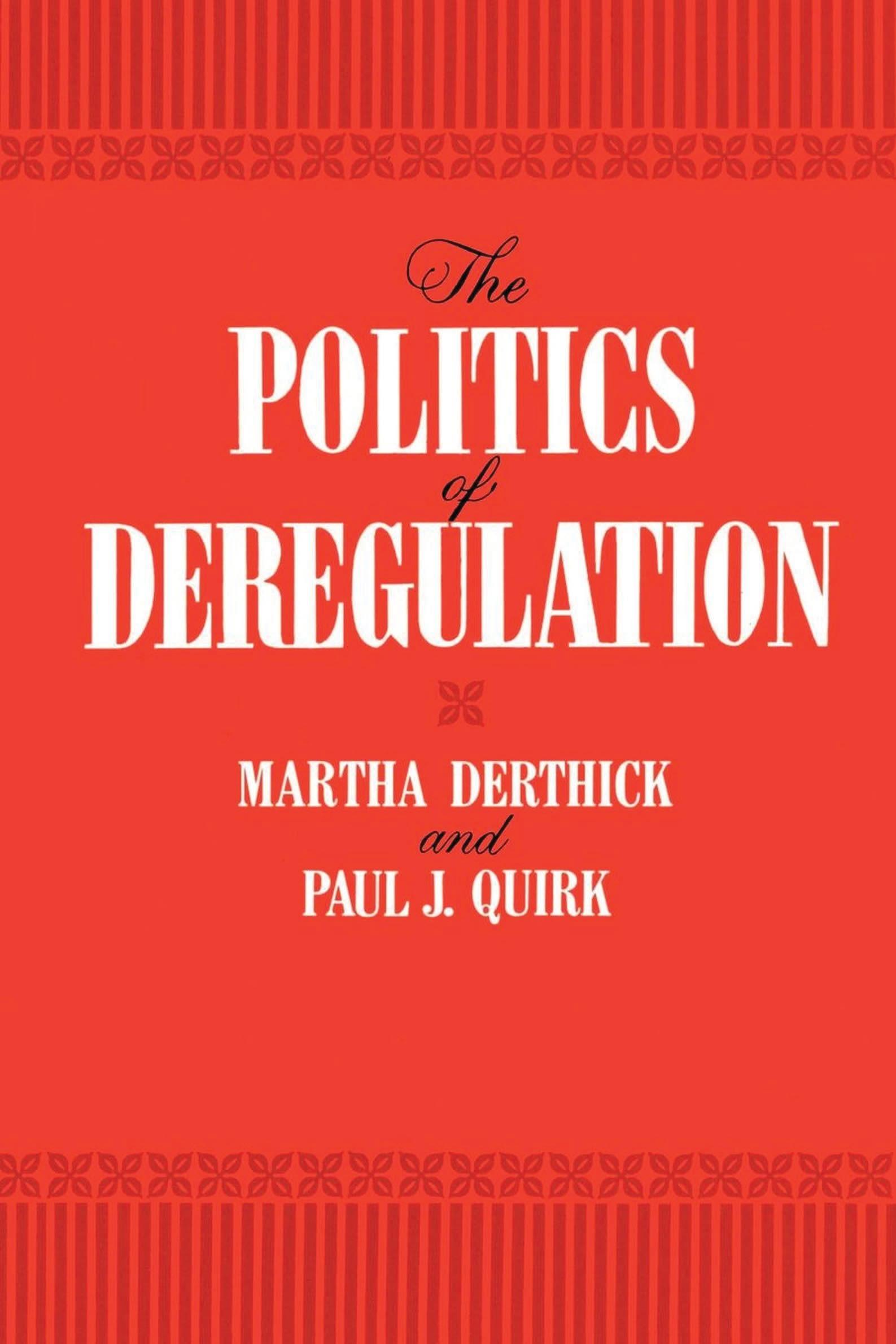
The standard wisdom among political scientists has been that ""iron triangles"" operated among regulatory agencies, the regulated industries, and members of Congress, all presumably with a stake in preserving regulation that protected the industries from competition. Despite almost unanimous agreement among economists that such regulation was inefficient, it seemed highly unlikely that deregulation could occur. Yet between 1975 and 1980 major deregulatory changes that strongly favored competition did take place in a wide range of industries. The results are familiar to airline passengers, users of telephone service, and trucking freight shippers, among others. Martha Derthick and Paul J. Quirk ask why this deregulation happened. How did a diffuse public interest prevail over the powerful industry and union interests that sought to preserve regulation? Why did the regulatory commissions, which were expected to be a major obstacle to deregulation, instead take the initiative on behalf of it? And why did influential members of Congress push for even greater deregulation? The authors concentrate on three cases: airlines, trucking, and telecommunications. They find important similarities among the cases and discuss the implications of these findings for two broader topics: the role that economic analysis has played in policy change, and the capacity of the American political system for transcending narrow interests.
Seiten: 300
Kategorie: Statsvetenskap & Politik
e-ISBN: 9780815723042
Versandgewicht: 1.2 kg
Versand in: 1-2 Tage
Zahle einfach mit Karte, Klarna, Apple Pay oder Google Pay. Nicht zufrieden? Du hast immer ein 14-tägiges Widerrufsrecht. Lies mehr in unseren AGB. Hast du Fragen, schreib uns eine E-Mail an hello@memmo.org.
Memmo macht das Lernen einfacher – wo auch immer du bist. Bei uns findest du deine Kursbücher und smarte Lerntools an einem Ort: Zusammenfassungen, Quizzes, Podcasts und Lernkarten. Und Ted, dein Lernbuddy, beantwortet alles, was du wissen möchtest. Über 50.000 Studierende lernen bereits hier – gemacht, damit du schneller lernst und weniger Stress hast.