
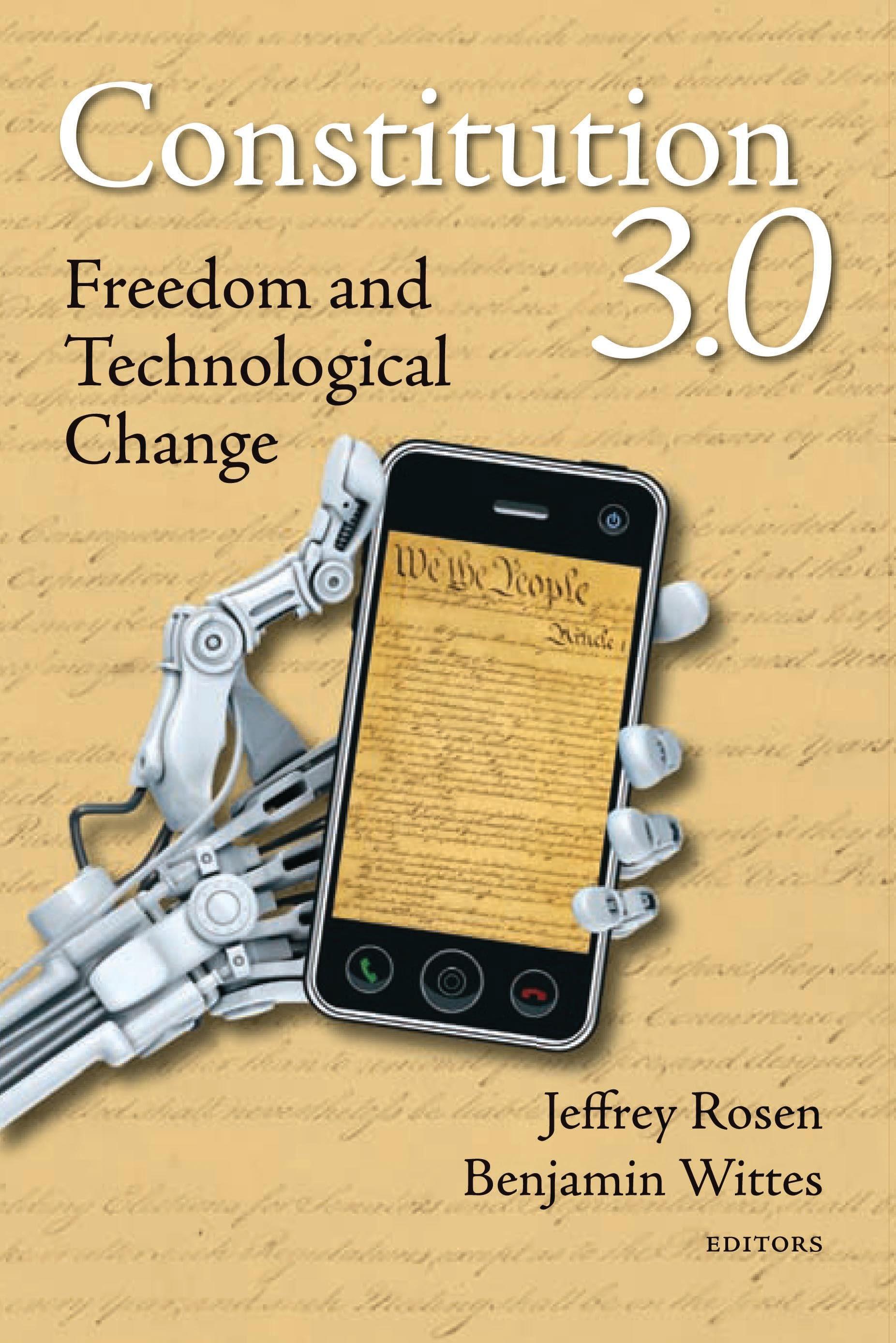
At the beginning of the twenty-first century, breathtaking changes in technology are posing stark challenges to our constitutional values. From free speech to privacy, from liberty and personal autonomy to the right against self-incrimination, basic constitutional principles are under stress from technological advances unimaginable even a few decades ago, let alone during the founding era. In this provocative collection, America's leading scholars of technology, law, and ethics imagine how to translate and preserve constitutional and legal values at a time of dizzying technological change.
Constitution 3.0 explores some of the most urgent constitutional questions of the near future. Will privacy become obsolete, for example, in a world where ubiquitous surveillance is becoming the norm? Imagine that Facebook and Google post live feeds from public and private surveillance cameras, allowing 24/7 tracking of any citizen in the world. How can we protect free speech now that Facebook and Google have more power than any king, president, or Supreme Court justice to decide who can speak and who can be heard? How will advanced brain-scan technology affect the constitutional right against self-incrimination? And on a more elemental level, should people have the right to manipulate their genes and design their own babies? Should we be allowed to patent new forms of life that seem virtually human? The constitutional challenges posed by technological progress are wide-ranging, with potential impacts on nearly every aspect of life in America and around the world.
The authors include Jamie Boyle, Duke Law School; Eric Cohen and Robert George, Princeton University; Jack Goldsmith, Harvard Law School; Orin Kerr, George Washington University Law School; Lawrence Lessig, Harvard Law School; Stephen Morse, University of Pennsylvania Law School; John Robertson, University of Texas Law School; Christopher Slobogin, Vanderbilt Law School; O. Carter Snead, Notre
Constitution 3.0 explores some of the most urgent constitutional questions of the near future. Will privacy become obsolete, for example, in a world where ubiquitous surveillance is becoming the norm? Imagine that Facebook and Google post live feeds from public and private surveillance cameras, allowing 24/7 tracking of any citizen in the world. How can we protect free speech now that Facebook and Google have more power than any king, president, or Supreme Court justice to decide who can speak and who can be heard? How will advanced brain-scan technology affect the constitutional right against self-incrimination? And on a more elemental level, should people have the right to manipulate their genes and design their own babies? Should we be allowed to patent new forms of life that seem virtually human? The constitutional challenges posed by technological progress are wide-ranging, with potential impacts on nearly every aspect of life in America and around the world.
The authors include Jamie Boyle, Duke Law School; Eric Cohen and Robert George, Princeton University; Jack Goldsmith, Harvard Law School; Orin Kerr, George Washington University Law School; Lawrence Lessig, Harvard Law School; Stephen Morse, University of Pennsylvania Law School; John Robertson, University of Texas Law School; Christopher Slobogin, Vanderbilt Law School; O. Carter Snead, Notre
Zahle einfach mit Karte, Klarna, Apple Pay oder Google Pay. Nicht zufrieden? Du hast immer ein 14-tägiges Widerrufsrecht. Lies mehr in unseren AGB. Hast du Fragen, schreib uns eine E-Mail an hello@memmo.org.
Memmo macht das Lernen einfacher – wo auch immer du bist. Bei uns findest du deine Kursbücher und smarte Lerntools an einem Ort: Zusammenfassungen, Quizzes, Podcasts und Lernkarten. Und Ted, dein Lernbuddy, beantwortet alles, was du wissen möchtest. Über 50.000 Studierende lernen bereits hier – gemacht, damit du schneller lernst und weniger Stress hast.