
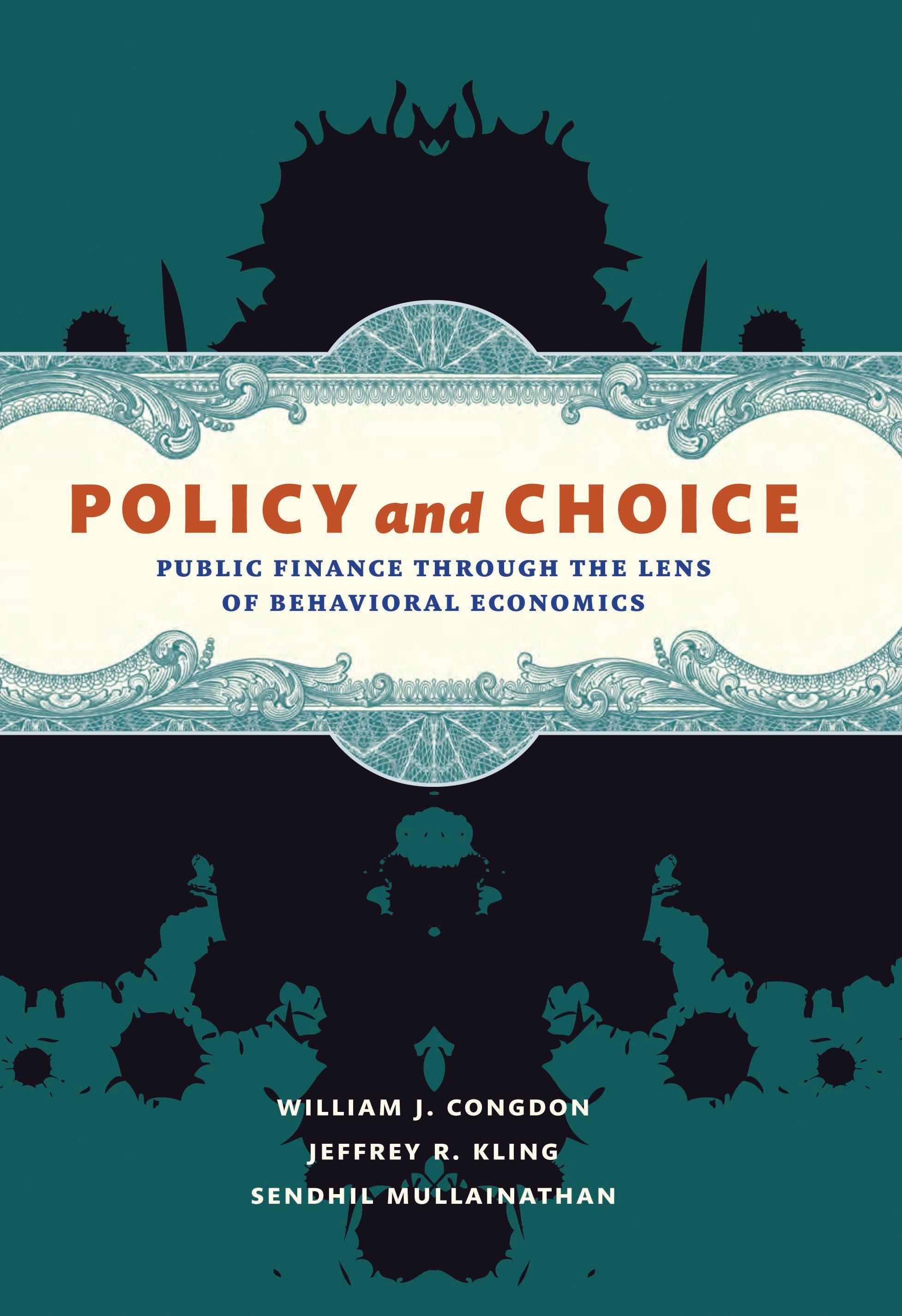
Traditional public finance provides a powerful framework for policy analysis, but it relies on a model of human behavior that the new science of behavioral economics increasingly calls into question. In Policy and Choice economists William Congdon, Jeffrey Kling, and Sendhil Mullainathan argue that public finance not only can incorporate many lessons of behavioral economics but also can serve as a solid foundation from which to apply insights from psychology to questions of economic policy.
The authors revisit the core questions of public finance, armed with a richer perspective on human behavior. They do not merely apply findings from psychology to specific economic problems; instead, they explore how psychological factors actually reshape core concepts in public finance such as moral hazard, deadweight loss, and incentives.
Part one sets the stage for integrating behavioral economics into public finance by interpreting the evidence from psychology and developing a framework for applying it to questions in public finance. In part two, the authors apply that framework to specific topics in public finance, including social insurance, externalities and public goods, income support and redistribution, and taxation.
In doing so, the authors build a unified analytical approach that encompasses both traditional policy levers, such as taxes and subsidies, and more psychologically informed instruments. The net result of this innovative approach is a fully behavioral public finance, an integration of psychology and the economics of the public sector that is explicit, systematic, rigorous, and realistic.
The authors revisit the core questions of public finance, armed with a richer perspective on human behavior. They do not merely apply findings from psychology to specific economic problems; instead, they explore how psychological factors actually reshape core concepts in public finance such as moral hazard, deadweight loss, and incentives.
Part one sets the stage for integrating behavioral economics into public finance by interpreting the evidence from psychology and developing a framework for applying it to questions in public finance. In part two, the authors apply that framework to specific topics in public finance, including social insurance, externalities and public goods, income support and redistribution, and taxation.
In doing so, the authors build a unified analytical approach that encompasses both traditional policy levers, such as taxes and subsidies, and more psychologically informed instruments. The net result of this innovative approach is a fully behavioral public finance, an integration of psychology and the economics of the public sector that is explicit, systematic, rigorous, and realistic.
Zahle einfach mit Karte, Klarna, Apple Pay oder Google Pay. Nicht zufrieden? Du hast immer ein 14-tägiges Widerrufsrecht. Lies mehr in unseren AGB. Hast du Fragen, schreib uns eine E-Mail an hello@memmo.org.
Memmo macht das Lernen einfacher – wo auch immer du bist. Bei uns findest du deine Kursbücher und smarte Lerntools an einem Ort: Zusammenfassungen, Quizzes, Podcasts und Lernkarten. Und Ted, dein Lernbuddy, beantwortet alles, was du wissen möchtest. Über 50.000 Studierende lernen bereits hier – gemacht, damit du schneller lernst und weniger Stress hast.