
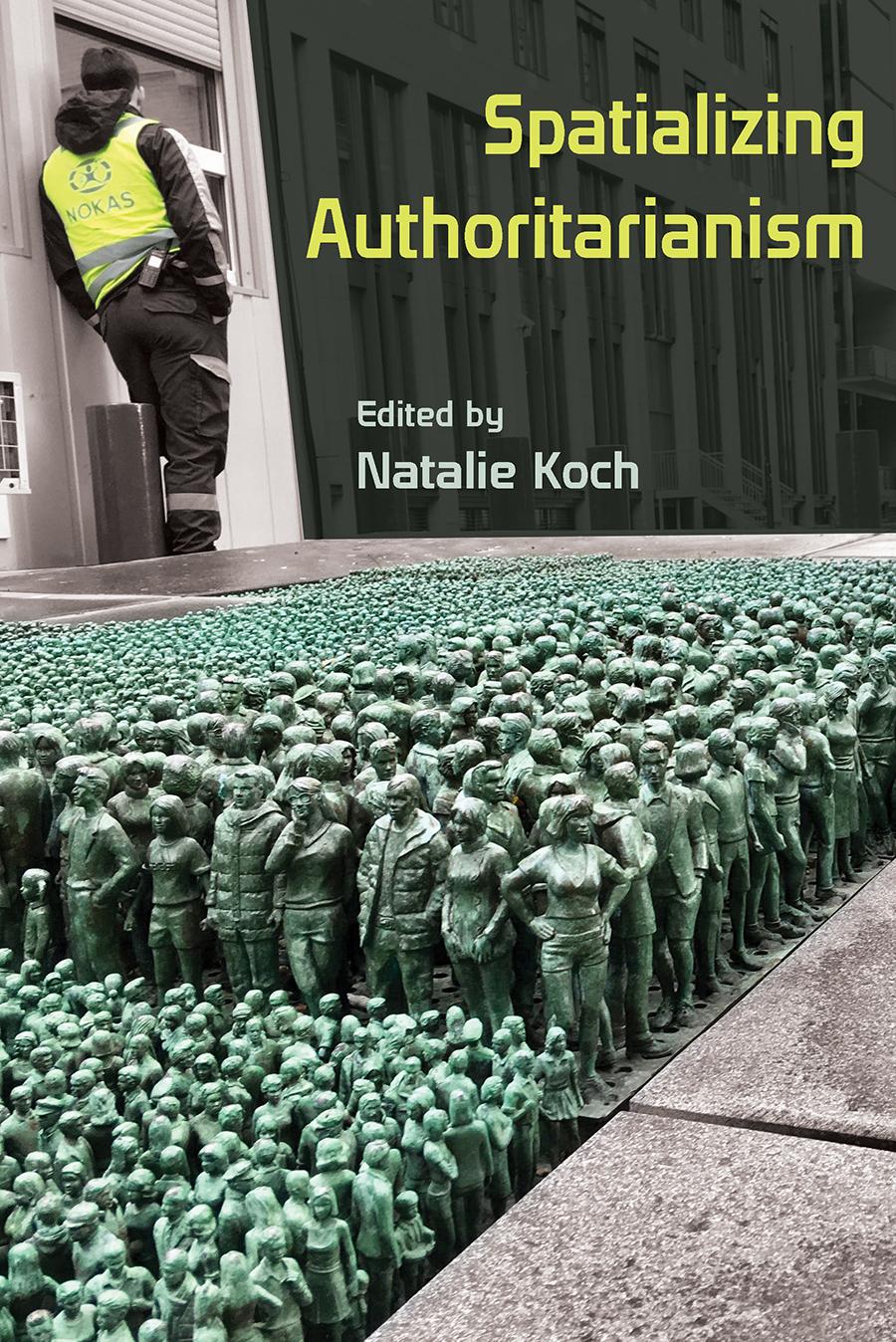
Authoritarianism has emerged as a prominent theme in popular and academic discussions of politics since the 2016 US presidential election and the coinciding expansion of authoritarian rhetoric and ideals across Europe, Asia, and beyond. Until recently, however, academic geographers have not focused squarely on the concept of authoritarianism. Its longstanding absence from the field is noteworthy as geographers have made extensive contributions to theorizing structural inequalities, injustice, and other expressions of oppressive or illiberal power relations and their diverse spatialities. Identifying this void, Spatializing Authoritarianism builds upon recent research to show that even when conceptualized as a set of practices rather than as a simple territorial label, authoritarianism has a spatiality: both drawing from and producing political space and scale in many often surprising ways. This volume advances the argument that authoritarianism must be investigated by accounting for the many scales at which it is produced, enacted, and imagined.
Including a diverse array of theoretical perspectives and empirical cases drawn from the Global South and North, this collection illustrates the analytical power of attending to authoritarianism’s diverse scalar and spatial expressions, and how intimately connected it is with identity narratives, built landscapes, borders, legal systems, markets, and other territorial and extraterritorial expressions of power.
Zahle einfach mit Karte, Klarna, Apple Pay oder Google Pay. Nicht zufrieden? Du hast immer ein 14-tägiges Widerrufsrecht. Lies mehr in unseren AGB. Hast du Fragen, schreib uns eine E-Mail an hello@memmo.org.
Memmo macht das Lernen einfacher – wo auch immer du bist. Bei uns findest du deine Kursbücher und smarte Lerntools an einem Ort: Zusammenfassungen, Quizzes, Podcasts und Lernkarten. Und Ted, dein Lernbuddy, beantwortet alles, was du wissen möchtest. Über 50.000 Studierende lernen bereits hier – gemacht, damit du schneller lernst und weniger Stress hast.