
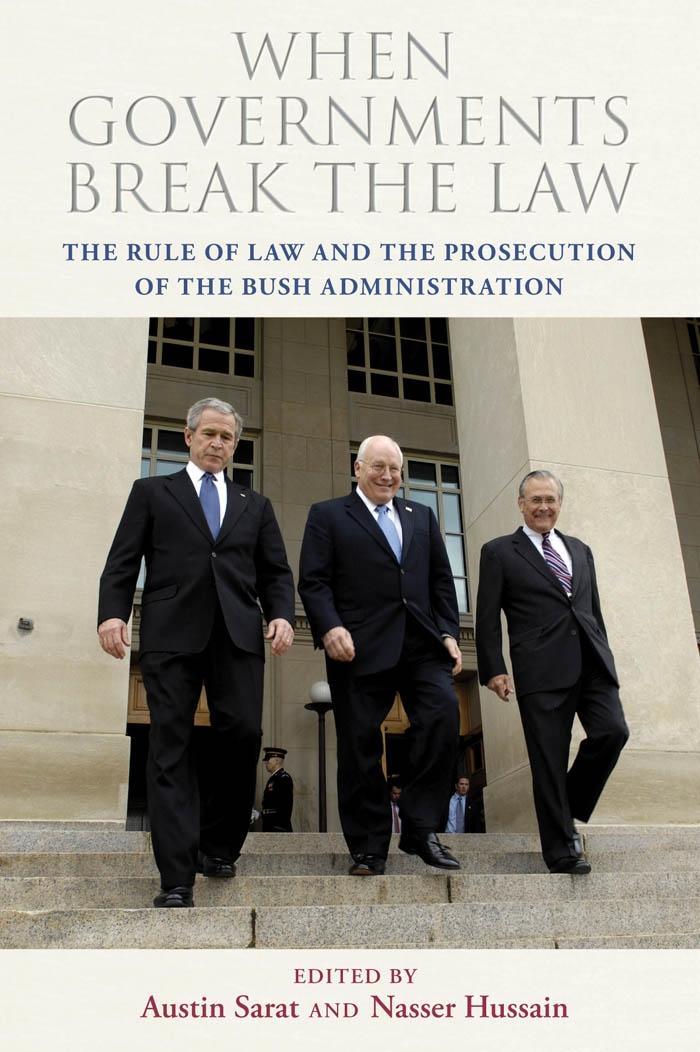
Recent controversies surrounding the war on terror and American intervention in Iraq and Afghanistan have brought rule of law rhetoric to a fevered pitch. While President Obama has repeatedly emphasized his Administration’s commitment to transparency and the rule of law, nowhere has this resolve been so quickly and severely tested than with the issue of the possible prosecution of Bush Administration officials. While some worry that without legal consequences there will be no effective deterrence for the repetition of future transgressions of justice committed at the highest levels of government, others echo Obama’s seemingly reluctant stance on launching an investigation into allegations of criminal wrongdoing by former President Bush, Vice President Cheney, Secretary Rumsfeld, and members of the Office of Legal Counsel. Indeed, even some of the Bush Administration’s harshest critics suggest that we should avoid such confrontations, that the price of political division is too high. Measured or partisan, scholarly or journalistic, clearly the debate about accountability for the alleged crimes of the Bush Administration will continue for some time.
Using this debate as its jumping off point, When Governments Break the Law takes an interdisciplinary approach to the legal challenges posed by the criminal wrongdoing of governments. But this book is not an indictment of the Bush Administration; rather, the contributors take distinct positions for and against the proposition, offering revealing reasons and illuminating alternatives. The contributors do not ask the substantive question of whether any Bush Administration officials, in fact, violated the law, but rather the procedural, legal, political, and cultural questions of what it would mean either to pursue criminal prosecutions or to refuse to do so. By presuming that officials could be prosecuted, these essays address whether they should.
When Governments Break the Law provides a valuable and timely commentary on what is likely to be an ongoing process of understanding the relationship between politics and the rule of law in times of crisis.
Contributors: Claire Finkelstein, Lisa Hajjar, Daniel Herwitz, Stephen Holmes, Paul Horwitz, Nasser Hussain, Austin Sarat, and Stephen I. Vladeck.
Zahle einfach mit Karte, Klarna, Apple Pay oder Google Pay. Nicht zufrieden? Du hast immer ein 14-tägiges Widerrufsrecht. Lies mehr in unseren AGB. Hast du Fragen, schreib uns eine E-Mail an hello@memmo.org.
Memmo macht das Lernen einfacher – wo auch immer du bist. Bei uns findest du deine Kursbücher und smarte Lerntools an einem Ort: Zusammenfassungen, Quizzes, Podcasts und Lernkarten. Und Ted, dein Lernbuddy, beantwortet alles, was du wissen möchtest. Über 50.000 Studierende lernen bereits hier – gemacht, damit du schneller lernst und weniger Stress hast.