
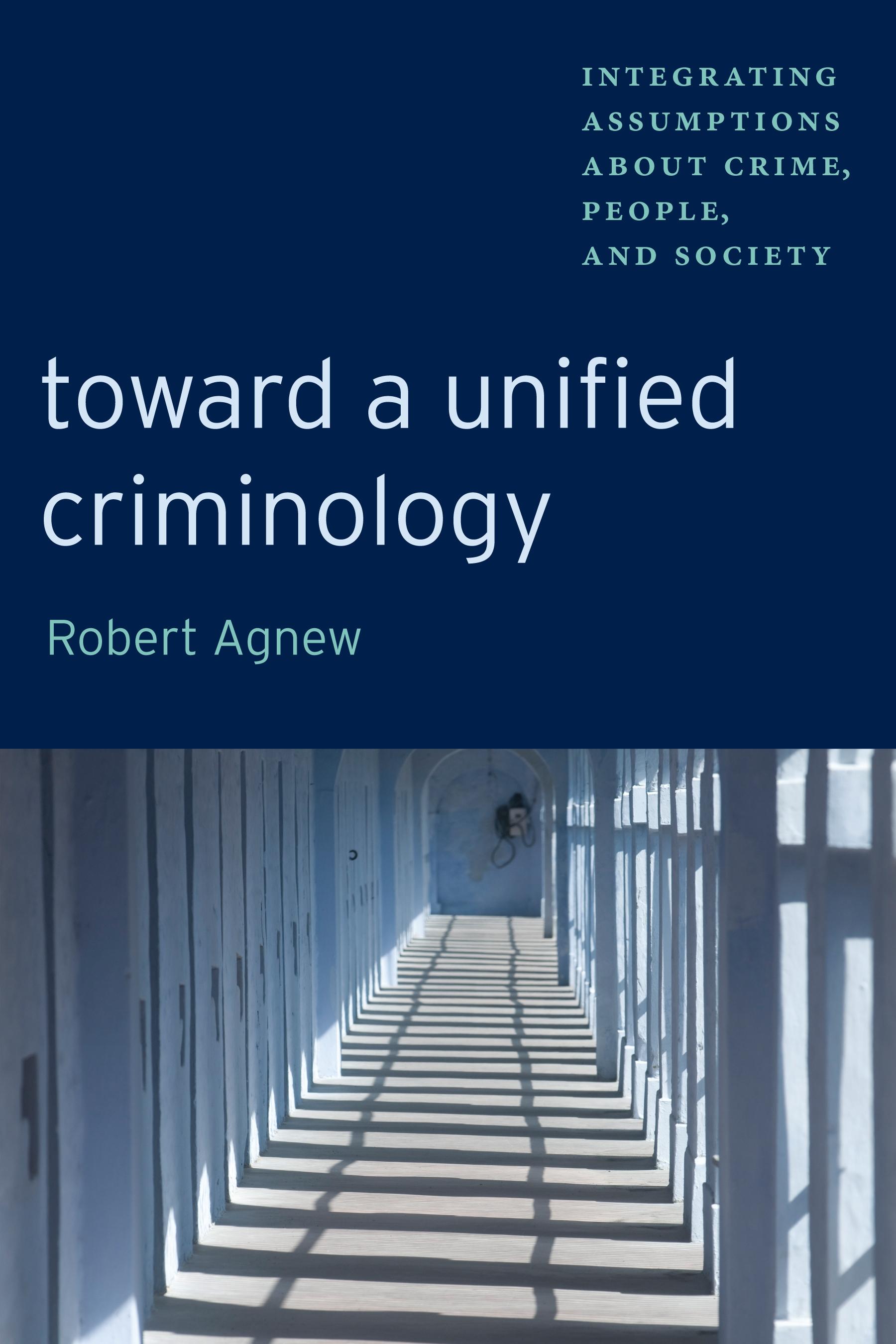
Why do people commit crimes? How do we control crime? The theories that criminologists use to answer these questions are built on a number of underlying assumptions, including those about the nature of crime, free will, human nature, and society. These assumptions have a fundamental impact on criminology: they largely determine what criminologists study, the causes they examine, the control strategies they recommend, and how they test their theories and evaluate crime-control strategies.
In Toward a Unified Criminology, noted criminologist Robert Agnew provides a critical examination of these assumptions, drawing on a range of research and perspectives to argue that these assumptions are too restrictive, unduly limiting the types of "crime" that are explored, the causes that are considered, and the methods of data collection and analysis that are employed. As such, they undermine our ability to explain and control crime. Agnew then proposes an alternative set of assumptions, drawing heavily on both mainstream and critical theories of criminology, with the goal of laying the foundation for a unified criminology that is better able to explain a broader range of crimes.
Zahle einfach mit Karte, Klarna, Apple Pay oder Google Pay. Nicht zufrieden? Du hast immer ein 14-tägiges Widerrufsrecht. Lies mehr in unseren AGB. Hast du Fragen, schreib uns eine E-Mail an hello@memmo.org.
Memmo macht das Lernen einfacher – wo auch immer du bist. Bei uns findest du deine Kursbücher und smarte Lerntools an einem Ort: Zusammenfassungen, Quizzes, Podcasts und Lernkarten. Und Ted, dein Lernbuddy, beantwortet alles, was du wissen möchtest. Über 50.000 Studierende lernen bereits hier – gemacht, damit du schneller lernst und weniger Stress hast.