
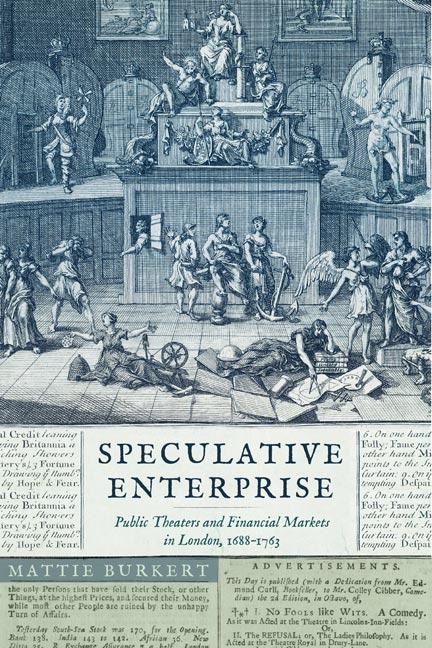
In the wake of the 1688 revolution, England’s transition to financial capitalism accelerated dramatically. Londoners witnessed the rise of credit-based currencies, securities markets, speculative bubbles, insurance schemes, and lotteries. Many understood these phenomena in terms shaped by their experience with another risky venture at the heart of London life: the public theater. Speculative Enterprise traces the links these observers drew between the operations of Drury Lane and Exchange Alley, including their hypercommercialism, dependence on collective opinion, and accessibility to people of different classes and genders.
Mattie Burkert identifies a discursive "theater-finance nexus" at work in plays by Colley Cibber, Richard Steele, and Susanna Centlivre as well as in the vibrant eighteenth-century media landscape. As Burkert demonstrates, the stock market and the entertainment industry were recognized as deeply interconnected institutions that, when considered together, illuminated the nature of the public more broadly and gave rise to new modes of publicity and resistance. In telling this story, Speculative Enterprise combines methods from literary studies, theater and performance history, media theory, and work on print and material culture to provide a fresh understanding of the centrality of theater to public life in eighteenth-century London.
Zahle einfach mit Karte, Klarna, Apple Pay oder Google Pay. Nicht zufrieden? Du hast immer ein 14-tägiges Widerrufsrecht. Lies mehr in unseren AGB. Hast du Fragen, schreib uns eine E-Mail an hello@memmo.org.
Memmo macht das Lernen einfacher – wo auch immer du bist. Bei uns findest du deine Kursbücher und smarte Lerntools an einem Ort: Zusammenfassungen, Quizzes, Podcasts und Lernkarten. Und Ted, dein Lernbuddy, beantwortet alles, was du wissen möchtest. Über 50.000 Studierende lernen bereits hier – gemacht, damit du schneller lernst und weniger Stress hast.