
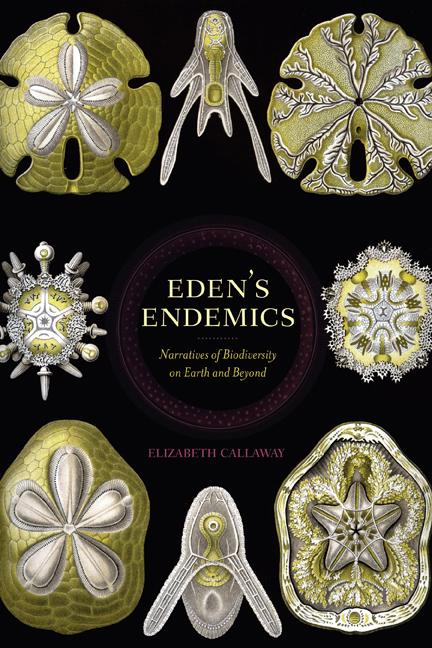
In the past thirty years biodiversity has become one of the central organizing principles through which we understand the nonhuman environment. Its deceptively simple definition as the variation among living organisms masks its status as a hotly contested term both within the sciences and more broadly. In Eden’s Endemics, Elizabeth Callaway looks to cultural objects—novels, memoirs, databases, visualizations, and poetry— that depict many species at once to consider the question of how we narrate organisms in their multiplicity.
Touching on topics ranging from seed banks to science fiction to bird-watching, Callaway argues that there is no set, generally accepted way to measure biodiversity. Westerners tend to conceptualize it according to one or more of an array of tropes rooted in colonial history such as the Lost Eden, Noah’s Ark, and Tree-of-Life imagery. These conceptualizations affect what kinds of biodiversities are prioritized for protection. While using biodiversity as a way to talk about the world aims to highlight what is most valued in nature, it can produce narratives that reinforce certain power differentials—with real-life consequences for conservation projects. Thus the choices made when portraying biodiversity impact what is visible, what is visceral, and what is unquestioned common sense about the patterns of life on Earth.
Zahle einfach mit Karte, Klarna, Apple Pay oder Google Pay. Nicht zufrieden? Du hast immer ein 14-tägiges Widerrufsrecht. Lies mehr in unseren AGB. Hast du Fragen, schreib uns eine E-Mail an hello@memmo.org.
Memmo macht das Lernen einfacher – wo auch immer du bist. Bei uns findest du deine Kursbücher und smarte Lerntools an einem Ort: Zusammenfassungen, Quizzes, Podcasts und Lernkarten. Und Ted, dein Lernbuddy, beantwortet alles, was du wissen möchtest. Über 50.000 Studierende lernen bereits hier – gemacht, damit du schneller lernst und weniger Stress hast.