
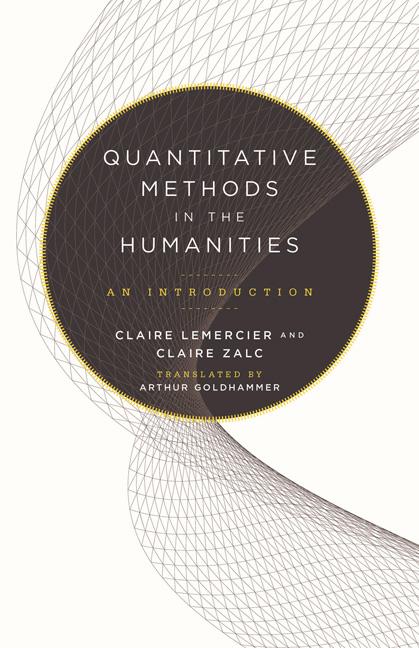
This timely and lucid guide is intended for students and scholars working on all historical periods and topics in the humanities and social sciences--especially for those who do not think of themselves as experts in quantification, "big data," or "digital humanities."
The authors reveal quantification to be a powerful and versatile tool, applicable to a myriad of materials from the past. Their book, accessible to complete beginners, offers detailed advice and practical tips on how to build a dataset from historical sources and how to categorize it according to specific research questions. Drawing on examples from works in social, political, economic, and cultural history, the book guides readers through a wide range of methods, including sampling, cross-tabulations, statistical tests, regression, factor analysis, network analysis, sequence analysis, event history analysis, geographical information systems, text analysis, and visualization. The requirements, advantages, and pitfalls of these techniques are presented in layperson’s terms, avoiding mathematical terminology.
Conceived primarily for historians, the book will prove invaluable to other humanists, as well as to social scientists looking for a nontechnical introduction to quantitative methods. Covering the most recent techniques, in addition to others not often enough discussed, the book will also have much to offer to the most seasoned practitioners of quantification.
Zahle einfach mit Karte, Klarna, Apple Pay oder Google Pay. Nicht zufrieden? Du hast immer ein 14-tägiges Widerrufsrecht. Lies mehr in unseren AGB. Hast du Fragen, schreib uns eine E-Mail an hello@memmo.org.
Memmo macht das Lernen einfacher – wo auch immer du bist. Bei uns findest du deine Kursbücher und smarte Lerntools an einem Ort: Zusammenfassungen, Quizzes, Podcasts und Lernkarten. Und Ted, dein Lernbuddy, beantwortet alles, was du wissen möchtest. Über 50.000 Studierende lernen bereits hier – gemacht, damit du schneller lernst und weniger Stress hast.