
“Street provides a crucial critical and cultural service by not only studying Eastwood’s individual films in sharp detail but also by providing a close and serious analysis of the cultural and historic times of the films.”—Sam B. Girgus, author of Clint Eastwood’s America
“By far the most comprehensive, sustained, and detailed discussion of the Dirty Harry phenomenon. A thorough and engaging account of how a fictitious renegade cop became an enduring icon of the angry conservative backlash that sought to halt 1960s liberalism in its tracks.”—Nick Heffernan, author of Culture, Environment and Ecopolitics
Clint Eastwood’s Dirty Harry became the prototype for a new kind of movie cop—an antihero in pursuit of his own vision of justice. The Dirty Harry series helped cement Eastwood and his character, Harry Callahan, as central figures in 1970s and 1980s Hollywood cinema.
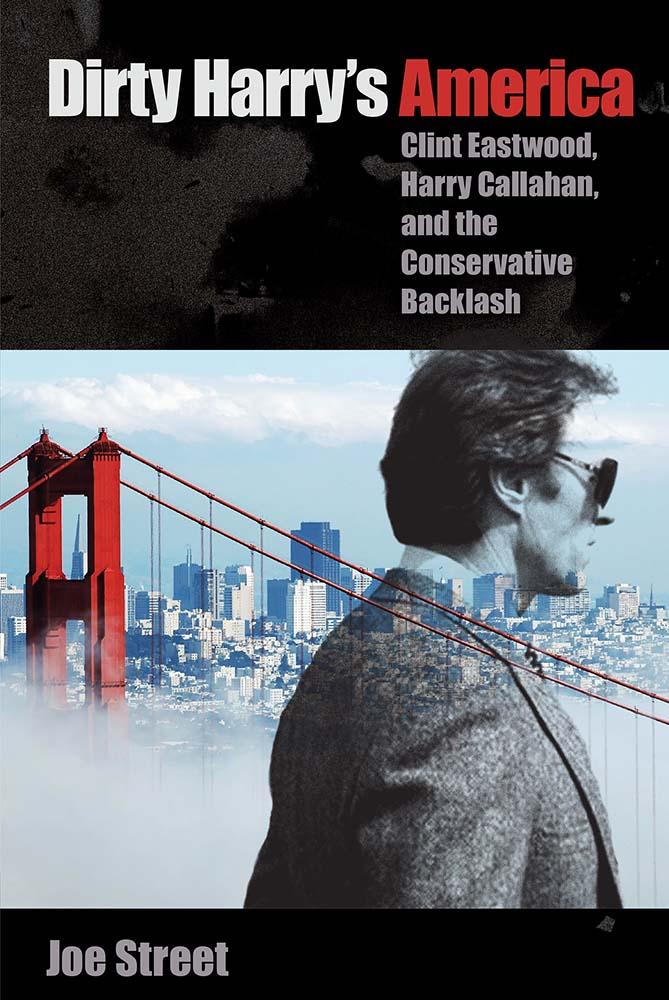
In Dirty Harry’s America, Joe Street argues that the movies shed critical light on the culture and politics of the post-1960s era and locates San Francisco as the symbolic cultural battleground of the time. Across the entire series, conservative anger and moral outrage confront elitist liberalism and moral relativism. Paying particular attention the films' representation of crime, family and community, sexuality, and race, Street maintains that through referencing real events and political struggles, the films themselves became active participants in the culture wars.
Unapologetic carrier of right and might, Harry Callahan becomes America’s Ur-conservative: “unbending, moral, incorruptible, and most important, always right.” Long after the series, Callahan’s legacy remains strong in American political discourse, cinema, and pop culture, and he continues to shape Eastwood’s later political and cinematic career.
“By far the most comprehensive, sustained, and detailed discussion of the Dirty Harry phenomenon. A thorough and engaging account of how a fictitious renegade cop became an enduring icon of the angry conservative backlash that sought to halt 1960s liberalism in its tracks.”—Nick Heffernan, author of Culture, Environment and Ecopolitics
Clint Eastwood’s Dirty Harry became the prototype for a new kind of movie cop—an antihero in pursuit of his own vision of justice. The Dirty Harry series helped cement Eastwood and his character, Harry Callahan, as central figures in 1970s and 1980s Hollywood cinema.
In Dirty Harry’s America, Joe Street argues that the movies shed critical light on the culture and politics of the post-1960s era and locates San Francisco as the symbolic cultural battleground of the time. Across the entire series, conservative anger and moral outrage confront elitist liberalism and moral relativism. Paying particular attention the films' representation of crime, family and community, sexuality, and race, Street maintains that through referencing real events and political struggles, the films themselves became active participants in the culture wars.
Unapologetic carrier of right and might, Harry Callahan becomes America’s Ur-conservative: “unbending, moral, incorruptible, and most important, always right.” Long after the series, Callahan’s legacy remains strong in American political discourse, cinema, and pop culture, and he continues to shape Eastwood’s later political and cinematic career.
Zahle einfach mit Karte, Klarna, Apple Pay oder Google Pay. Nicht zufrieden? Du hast immer ein 14-tägiges Widerrufsrecht. Lies mehr in unseren AGB. Hast du Fragen, schreib uns eine E-Mail an hello@memmo.org.
Memmo macht das Lernen einfacher – wo auch immer du bist. Bei uns findest du deine Kursbücher und smarte Lerntools an einem Ort: Zusammenfassungen, Quizzes, Podcasts und Lernkarten. Und Ted, dein Lernbuddy, beantwortet alles, was du wissen möchtest. Über 50.000 Studierende lernen bereits hier – gemacht, damit du schneller lernst und weniger Stress hast.
Das könnte dir auch gefallen
Buch kaufen0