
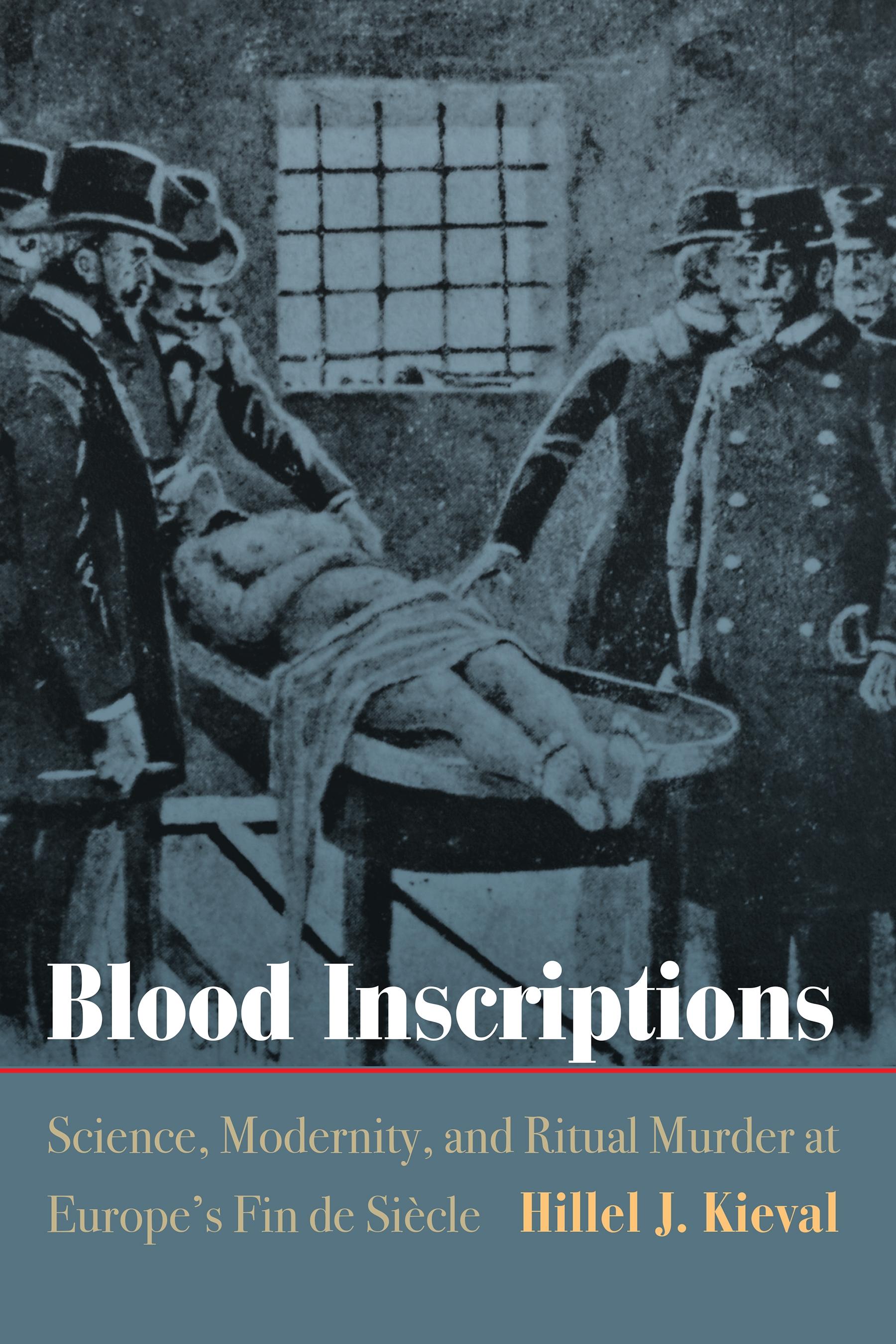
Although the Enlightenment had seemed to bring an end to the widely held belief that Jews murdered Christian children for ritual purposes, charges of the so-called blood libel were surprisingly widespread in central and eastern Europe on either side of the turn to the twentieth century. Well over one hundred accusations were made against Jews in this period, and prosecutors and government officials in Germany, Austria-Hungary, and Russia broke with long established precedent to bring six of these cases forward in sensational public trials. In Blood Inscriptions Hillel J. Kieval examines four cases—the prosecutions that took place at Tiszaeszlár in Hungary (1882-83), Xanten in Germany (1891-92), Polná in Austrian Bohemia (1899-1900), and Konitz, then Germany, now in Poland (1900-1902)—to consider the means by which discredited beliefs came to seem once again plausible.
Kieval explores how educated elites took up the accusations of Jewish ritual murder and considers the roles played by government bureaucracies, the journalistic establishment, forensic medicine, and advanced legal practices in structuring the investigations and trials. The prosecutors, judges, forensic scientists, criminologists, and academic scholars of Judaism and other expert witnesses all worked hard to establish their epistemological authority as rationalists, Kieval contends. Far from being a throwback to the Middle Ages, these ritual murder trials were in all respects a product of post-Enlightenment politics and culture. Harnessed to and disciplined by the rhetoric of modernity, they were able to proceed precisely because they were framed by the idioms of scientific discourse and rationality.
Zahle einfach mit Karte, Klarna, Apple Pay oder Google Pay. Nicht zufrieden? Du hast immer ein 14-tägiges Widerrufsrecht. Lies mehr in unseren AGB. Hast du Fragen, schreib uns eine E-Mail an hello@memmo.org.
Memmo macht das Lernen einfacher – wo auch immer du bist. Bei uns findest du deine Kursbücher und smarte Lerntools an einem Ort: Zusammenfassungen, Quizzes, Podcasts und Lernkarten. Und Ted, dein Lernbuddy, beantwortet alles, was du wissen möchtest. Über 50.000 Studierende lernen bereits hier – gemacht, damit du schneller lernst und weniger Stress hast.