
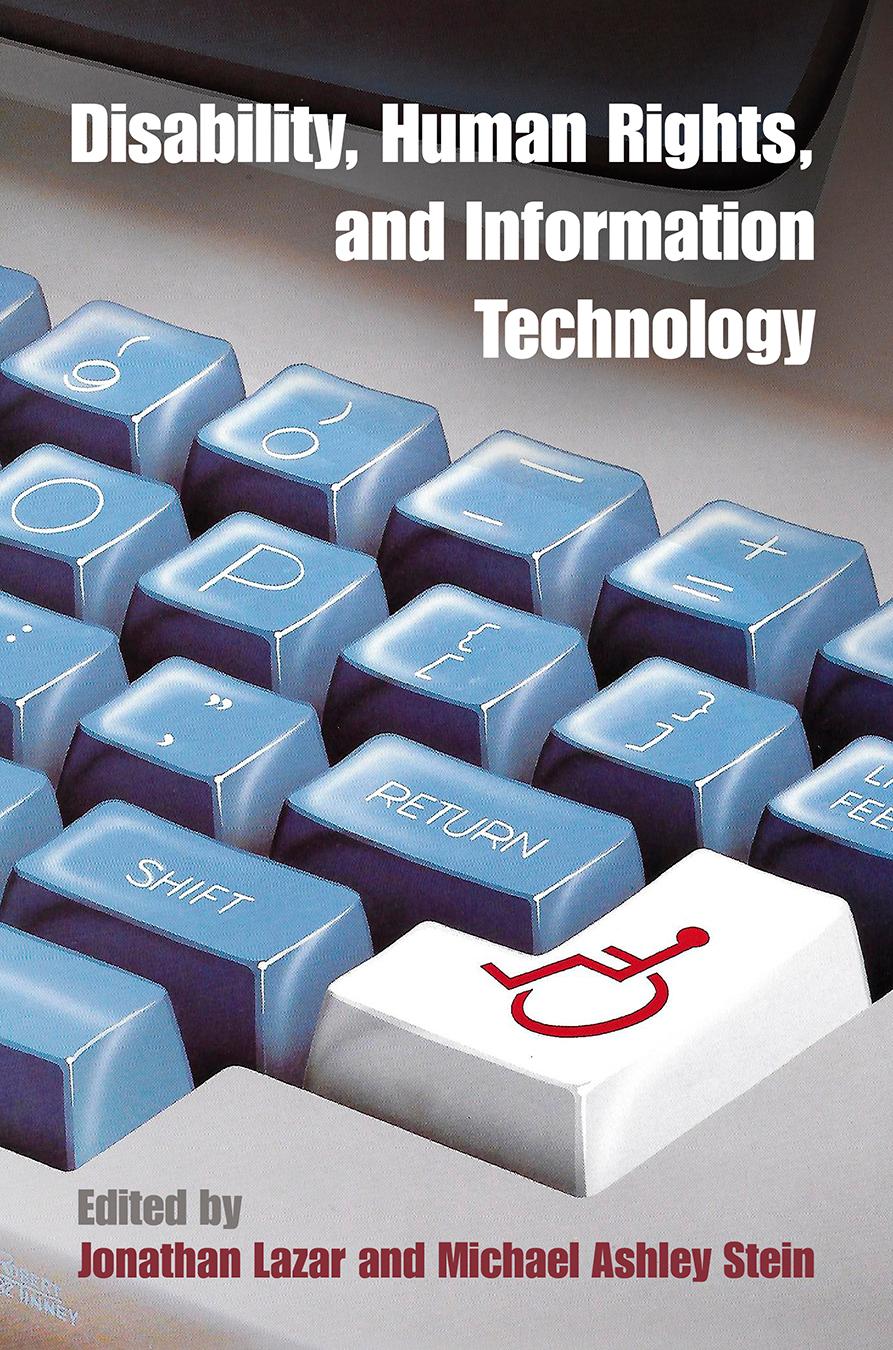
Disability, Human Rights, and Information Technology addresses the global issue of equal access to information and communications technology (ICT) by persons with disabilities. The right to access the same digital content at the same time and at the same cost as people without disabilities is implicit in several human rights instruments and is featured prominently in Articles 9 and 21 of the Convention on the Rights of Persons with Disabilities. The right to access ICT, moreover, invokes complementary civil and human rights issues: freedom of expression; freedom to information; political participation; civic engagement; inclusive education; the right to access the highest level of scientific and technological information; and participation in social and cultural opportunities.
Despite the ready availability and minimal cost of technology to enable people with disabilities to access ICT on an equal footing as consumers without disabilities, prevailing practice around the globe continues to result in their exclusion. Questions and complexities may also arise where technologies advance ahead of existing laws and policies, where legal norms are established but not yet implemented, or where legal rights are defined but clear technical implementations are not yet established.
At the intersection of human-computer interaction, disability rights, civil rights, human rights, international development, and public policy, the volume's contributors examine crucial yet underexplored areas, including technology access for people with cognitive impairments, public financing of information technology, accessibility and e-learning, and human rights and social inclusion.
Contributors: John Bertot, Peter Blanck, Judy Brewer, Joyram Chakraborty, Tim Elder, Jim Fruchterman, G. Anthony Giannoumis, Paul Jaeger, Sanjay Jain, Deborah Kaplan, Raja Kushalnagar, Jonathan Lazar, Fredric I. Lederer, Janet E. Lord, Ravi Malhotra, Jorge Manhique, Mirriam Nthenge, Joyojeet Pal, Megan A. Rusciano, David Sloan, Michael Ashley Stein, Brian Wentz, Marco Winckler, Mary J. Ziegler.
Zahle einfach mit Karte, Klarna, Apple Pay oder Google Pay. Nicht zufrieden? Du hast immer ein 14-tägiges Widerrufsrecht. Lies mehr in unseren AGB. Hast du Fragen, schreib uns eine E-Mail an hello@memmo.org.
Memmo macht das Lernen einfacher – wo auch immer du bist. Bei uns findest du deine Kursbücher und smarte Lerntools an einem Ort: Zusammenfassungen, Quizzes, Podcasts und Lernkarten. Und Ted, dein Lernbuddy, beantwortet alles, was du wissen möchtest. Über 50.000 Studierende lernen bereits hier – gemacht, damit du schneller lernst und weniger Stress hast.