
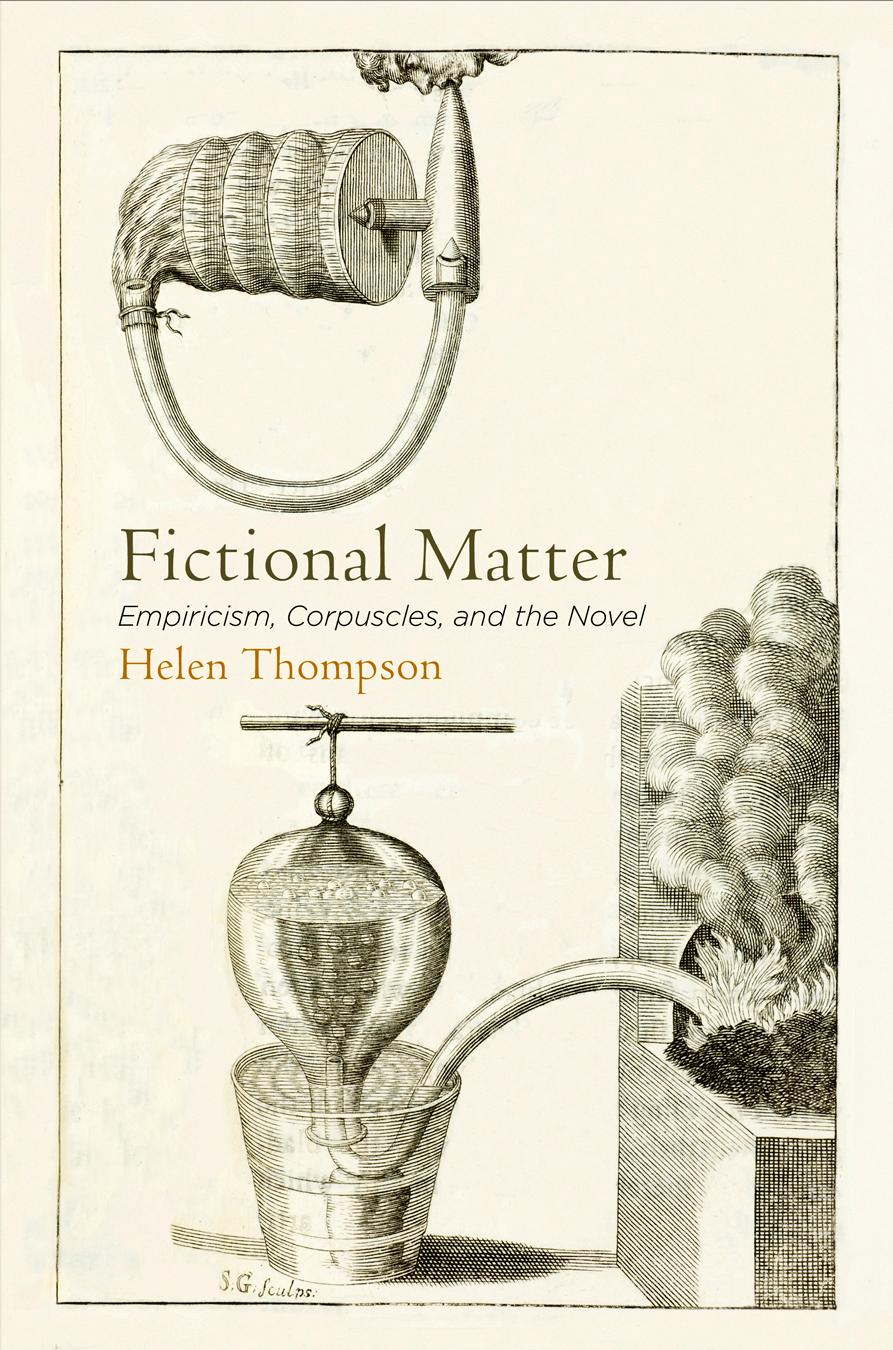
In a groundbreaking study of the relationship between chemistry and literary history, Helen Thompson explores the ways in which chemical conceptions of matter shaped eighteenth-century British culture. Although the scientific revolution championed experimental, sense-based knowledge, chemists claimed that perceptible bodies were made of invisible particles or "corpuscles." Neither modern elements nor classical atoms, corpuscles were reactive, divisible units of matter. Imperceptible but real, the corpuscle transformed empirical knowledge in early modern science and the novel.
Thompson offers new analyses of the chemistry, alchemy, color theory, physiology, environmental science, and medicine pioneered by Robert Boyle, Isaac Newton, Stephen Hales, John Mitchell, John Arbuthnot, and Thomas Sydenham to argue that they shaped cultural conceptions of racial, class, sex, and species identity. Juxtaposing science with readings of novels by Daniel Defoe, Eliza Haywood, Jonathan Swift, Samuel Richardson, Henry Fielding, William Rufus Chetwood, and Penelope Aubin, she shows how, at the level of form as well as character, novels represent perceptual knowledge that refers not to innate essence but to dynamic and unstable relations.
The realist narrative mode that experimental science bequeaths to literary history, Fictional Matter argues, does not transparently mirror perceptible objects. Instead, novels represent the forms and relations through which imperceptible particles stimulate sensory experience. In this lucid, revisionary analysis of corpuscular chemistry, Thompson advances a new account of the influence of experimental science and empirical knowledge on the emergent realist novel.
Zahle einfach mit Karte, Klarna, Apple Pay oder Google Pay. Nicht zufrieden? Du hast immer ein 14-tägiges Widerrufsrecht. Lies mehr in unseren AGB. Hast du Fragen, schreib uns eine E-Mail an hello@memmo.org.
Memmo macht das Lernen einfacher – wo auch immer du bist. Bei uns findest du deine Kursbücher und smarte Lerntools an einem Ort: Zusammenfassungen, Quizzes, Podcasts und Lernkarten. Und Ted, dein Lernbuddy, beantwortet alles, was du wissen möchtest. Über 50.000 Studierende lernen bereits hier – gemacht, damit du schneller lernst und weniger Stress hast.