
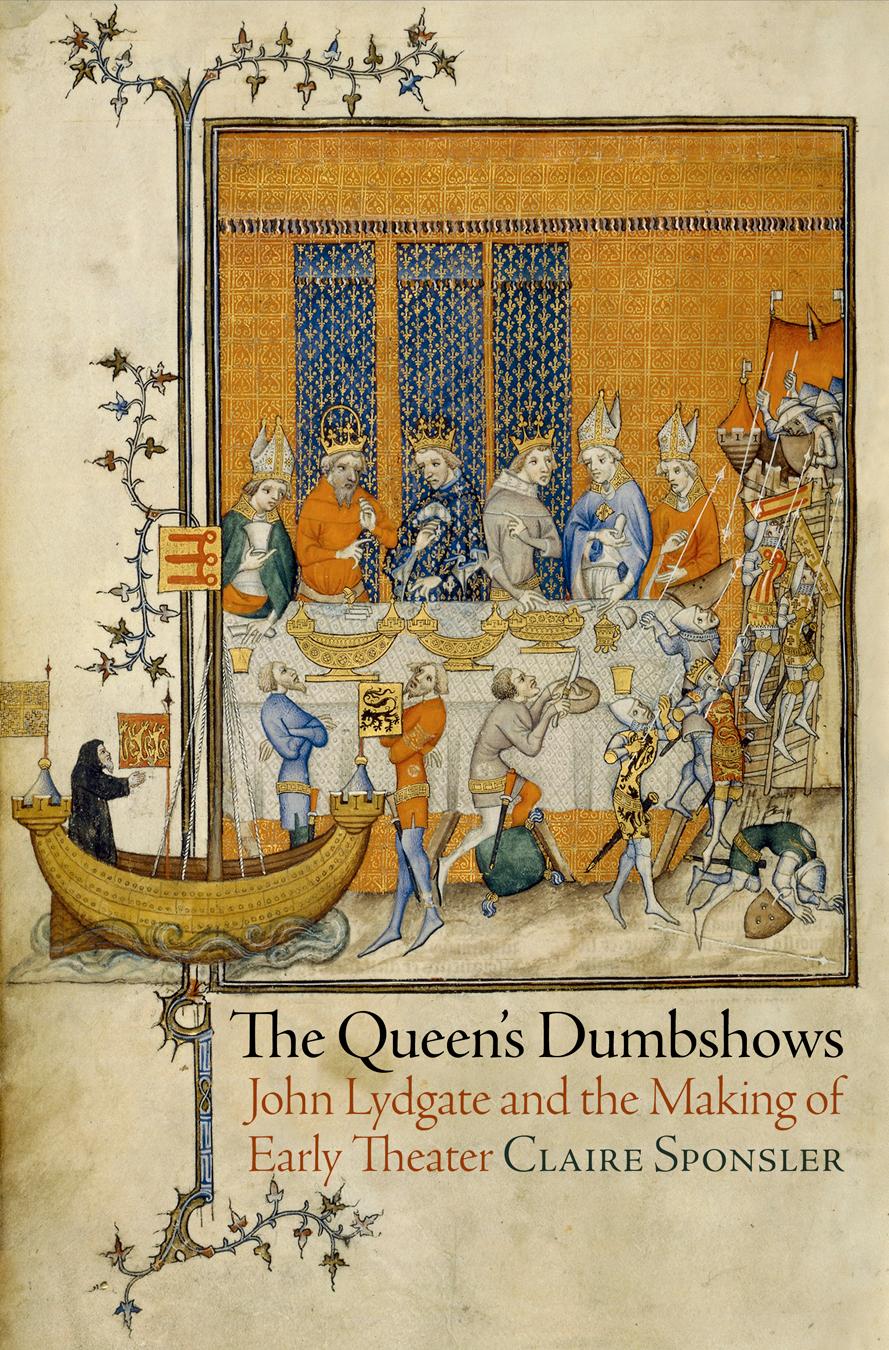
No medieval writer reveals more about early English drama than John Lydgate, Claire Sponsler contends. Best known for his enormously long narrative poems The Fall of Princes and The Troy Book, Lydgate also wrote numerous verses related to theatrical performances and ceremonies. This rich yet understudied body of material includes mummings for London guildsmen and sheriffs, texts for wall hangings that combined pictures and poetry, a Corpus Christi procession, and entertainments for the young Henry VI and his mother.
In The Queen's Dumbshows, Sponsler reclaims these writings to reveal what they have to tell us about performance practices in the late Middle Ages. Placing theatricality at the hub of fifteenth-century British culture, she rethinks what constituted drama in the period and explores the relationship between private forms of entertainment, such as household banquets, and more overtly public forms of political theater, such as royal entries and processions. She delineates the intersection of performance with other forms of representation such as feasts, pictorial displays, and tableaux, and parses the connections between the primarily visual and aural modes of performance and the reading of literary texts written on paper or parchment. In doing so, she has written a book of signal importance to scholars of medieval literature and culture, theater history, and visual studies.
Zahle einfach mit Karte, Klarna, Apple Pay oder Google Pay. Nicht zufrieden? Du hast immer ein 14-tägiges Widerrufsrecht. Lies mehr in unseren AGB. Hast du Fragen, schreib uns eine E-Mail an hello@memmo.org.
Memmo macht das Lernen einfacher – wo auch immer du bist. Bei uns findest du deine Kursbücher und smarte Lerntools an einem Ort: Zusammenfassungen, Quizzes, Podcasts und Lernkarten. Und Ted, dein Lernbuddy, beantwortet alles, was du wissen möchtest. Über 50.000 Studierende lernen bereits hier – gemacht, damit du schneller lernst und weniger Stress hast.