
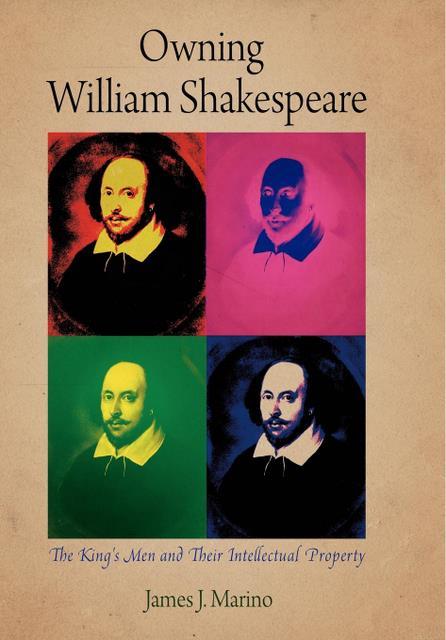
Copyright is by no means the only device for asserting ownership of a work. Some writers, including playwrights in the early modern period, did not even view print copyright as the most important of their authorial rights. A rich vein of recent scholarship has examined the interaction between royal monopolies, which have been identified with later notions of intrinsic authorial ownership, and the internal copy registration practices of the English book trades. Yet this dialogue was but one part of a still more complicated conversation in early modern England, James J. Marino argues; other customs and other sets of professional demands were at least as important, most strikingly in the exercise of the performance rights of plays.
In Owning William Shakespeare James Marino explores the actors' system of intellectual property as something fundamentally different from the property regimes exercised by the London printers or the royal monopolists. Focusing on Hamlet, The Taming of the Shrew, King Lear, and other works, he demonstrates how Shakespeare's acting company asserted ownership of its plays through intense rewriting combined with progressively insistent attribution to Shakespeare. The familiar versions of these plays were created through ongoing revision in the theater, a process that did not necessarily begin with Shakespeare's original manuscript or end when he died. An ascription by the company of any play to "Shakespeare" did not imply that it was following a fixed, authorial text; rather, Marino writes, it indicates an attempt to maintain exclusive control over a set of open-ended, theatrically revised scripts.
Combining theater history, textual studies, and literary theory, Owning William Shakespeare rethinks both the way Shakespeare's plays were created and the way they came to be known as his. It overturns a century of scholarship aimed at re-creating the playwright's lost manuscripts, focusing instead on the way the plays continued to live and grow onstage.
Zahle einfach mit Karte, Klarna, Apple Pay oder Google Pay. Nicht zufrieden? Du hast immer ein 14-tägiges Widerrufsrecht. Lies mehr in unseren AGB. Hast du Fragen, schreib uns eine E-Mail an hello@memmo.org.
Memmo macht das Lernen einfacher – wo auch immer du bist. Bei uns findest du deine Kursbücher und smarte Lerntools an einem Ort: Zusammenfassungen, Quizzes, Podcasts und Lernkarten. Und Ted, dein Lernbuddy, beantwortet alles, was du wissen möchtest. Über 50.000 Studierende lernen bereits hier – gemacht, damit du schneller lernst und weniger Stress hast.