
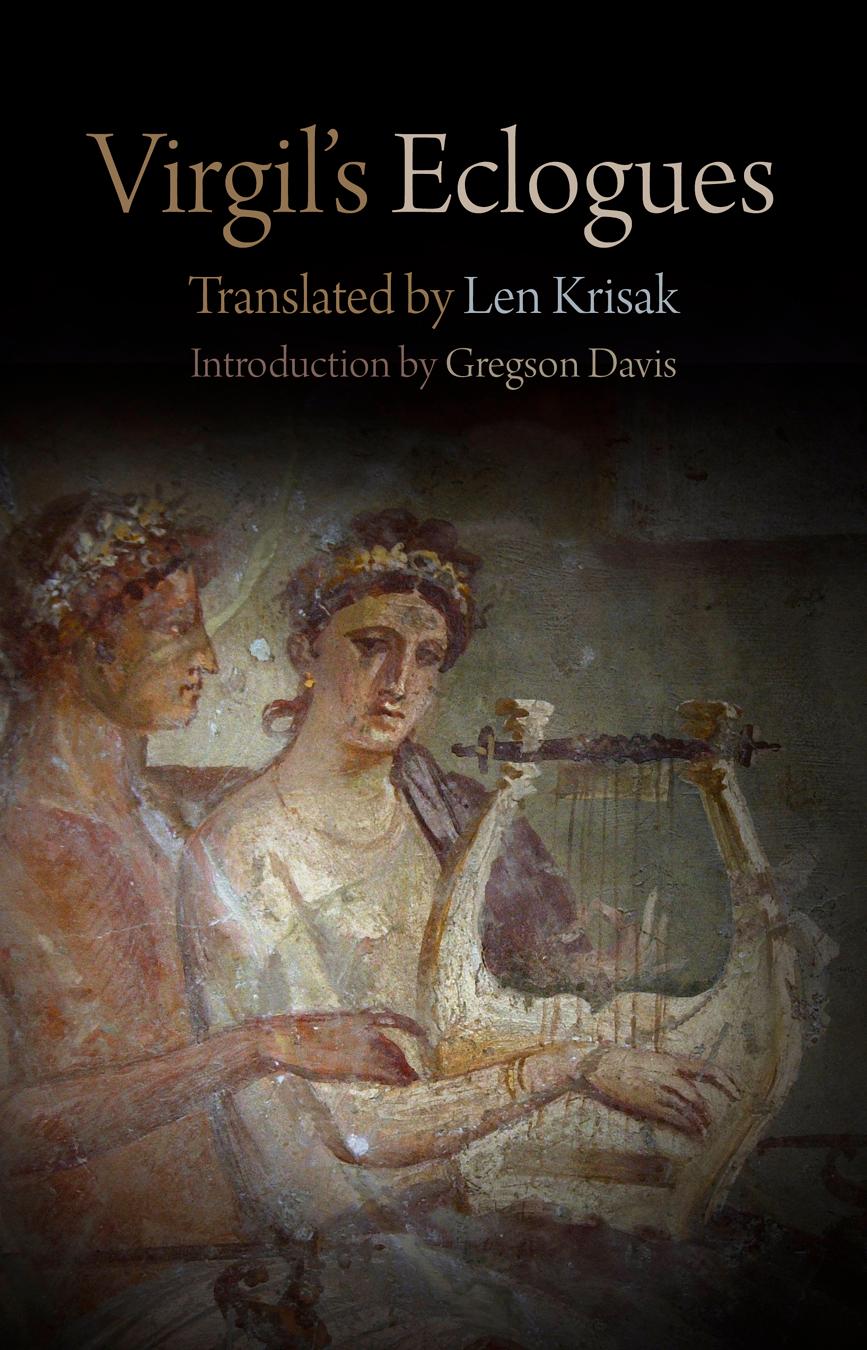
Publius Vergilius Maro (70-19 B.C.), known in English as Virgil, was perhaps the single greatest poet of the Roman empire—a friend to the emperor Augustus and the beneficiary of wealthy and powerful patrons. Most famous for his epic of the founding of Rome, the Aeneid, he wrote two other collections of poems: the Georgics and the Bucolics, or Eclogues.
The Eclogues were Virgil's first published poems. Ancient sources say that he spent three years composing and revising them at about the age of thirty. Though these poems begin a sequence that continues with the Georgics and culminates in the Aeneid, they are no less elegant in style or less profound in insight than the later, more extensive works. These intricate and highly polished variations on the idea of the pastoral poem, as practiced by earlier Greek poets, mix political, social, historical, artistic, and moral commentary in musical Latin that exerted a profound influence on subsequent Western poetry.
Poet Len Krisak's vibrant metric translation captures the music of Virgil's richly textured verse by employing rhyme and other sonic devices. The result is English poetry rather than translated prose. Presenting the English on facing pages with the original Latin, Virgil's Eclogues also features an introduction by scholar Gregson Davis that situates the poems in the time in which they were created.
Zahle einfach mit Karte, Klarna, Apple Pay oder Google Pay. Nicht zufrieden? Du hast immer ein 14-tägiges Widerrufsrecht. Lies mehr in unseren AGB. Hast du Fragen, schreib uns eine E-Mail an hello@memmo.org.
Memmo macht das Lernen einfacher – wo auch immer du bist. Bei uns findest du deine Kursbücher und smarte Lerntools an einem Ort: Zusammenfassungen, Quizzes, Podcasts und Lernkarten. Und Ted, dein Lernbuddy, beantwortet alles, was du wissen möchtest. Über 50.000 Studierende lernen bereits hier – gemacht, damit du schneller lernst und weniger Stress hast.