
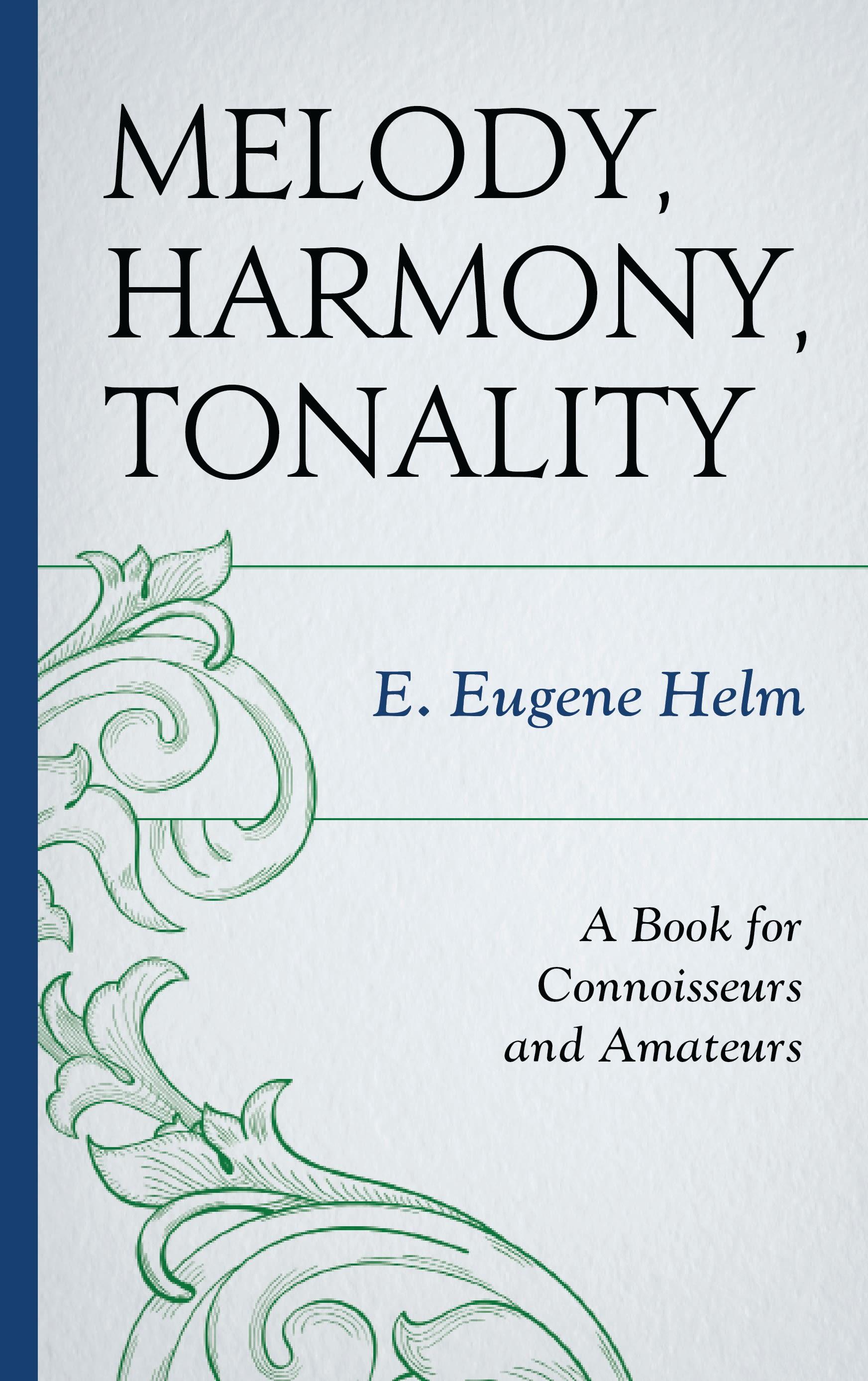
Where did the major scale come from? Why does most traditional non-Western music not share Western principles of harmony? What does the inner structure of a canon have to do with religious belief? Why, in historical terms, is J.S. Bach’s music regarded as a perfect combination of melody and harmony? Why do clocks in church towers strike dominant-tonic-dominant-tonic? What do cathedrals have to do with monochords? How can the harmonic series be demonstrated with a rope tied to a doorknob, and how can it be heard by standing next to an electric fan? Why are the free ocean waves in Debussy’s La Mer, the turbulent river waves in Smetana’s Moldau, and the fountain ripples in Ravel’s Jeux d’Eau pushed at times into four-bar phrases? Why is the metric system inherently unsuitable for organizing music and poetry? In what way does Plato’s Timaeus resemble the prelude to Wagner’s Das Rheingold? Just how does Beethoven’s work perfectly illustrate fully functional tonality, and why were long-range works based on this type of tonality impossible before the introduction of equal temperament? In this new century, what promising materials are available to composers in the wake of harmonic experimentation and, some would argue, exhaustion?
The answers to these seemingly complicated questions are not the sole province of music professors or orchestra conductors. In fact, as E. Eugene Helm demonstrates, they can just as easily be explained to amateurs, and their answers are important if we are to understand how Western music works. The full range of Western music is explored through 21 concise chapters on such topics as melody, harmony, counterpoint, texture, melody types, improvisation, music notation, free imitation, canon and fugue, vibration and its relation to harmony, tonality, and the place of music in architecture and astronomy. Intended for amateurs and professionals, concert-goers and conductors, Helm offers in down-to-earth language an explanation of the foundations of our Western music heritage, deepening our understanding and the listening experience of it for all.
The answers to these seemingly complicated questions are not the sole province of music professors or orchestra conductors. In fact, as E. Eugene Helm demonstrates, they can just as easily be explained to amateurs, and their answers are important if we are to understand how Western music works. The full range of Western music is explored through 21 concise chapters on such topics as melody, harmony, counterpoint, texture, melody types, improvisation, music notation, free imitation, canon and fugue, vibration and its relation to harmony, tonality, and the place of music in architecture and astronomy. Intended for amateurs and professionals, concert-goers and conductors, Helm offers in down-to-earth language an explanation of the foundations of our Western music heritage, deepening our understanding and the listening experience of it for all.
Zahle einfach mit Karte, Klarna, Apple Pay oder Google Pay. Nicht zufrieden? Du hast immer ein 14-tägiges Widerrufsrecht. Lies mehr in unseren AGB. Hast du Fragen, schreib uns eine E-Mail an hello@memmo.org.
Memmo macht das Lernen einfacher – wo auch immer du bist. Bei uns findest du deine Kursbücher und smarte Lerntools an einem Ort: Zusammenfassungen, Quizzes, Podcasts und Lernkarten. Und Ted, dein Lernbuddy, beantwortet alles, was du wissen möchtest. Über 50.000 Studierende lernen bereits hier – gemacht, damit du schneller lernst und weniger Stress hast.