
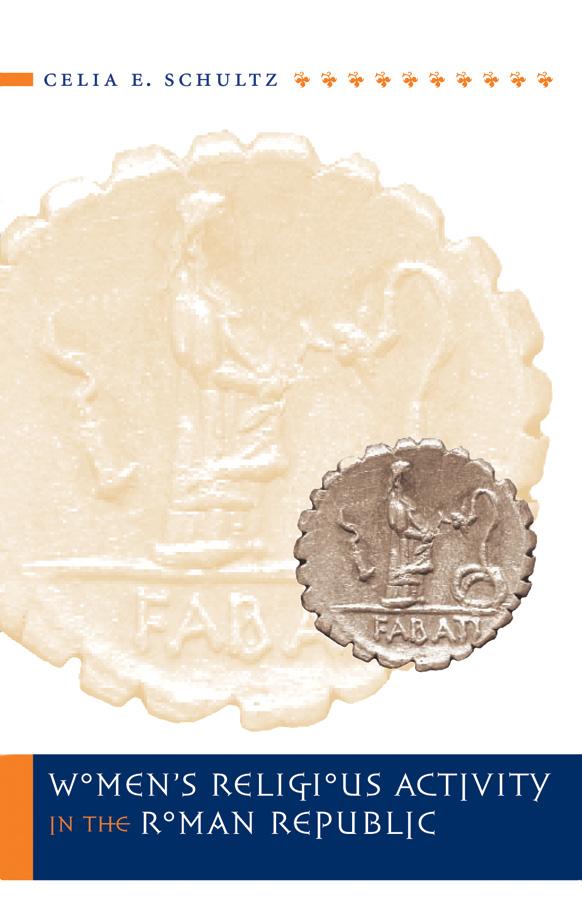
Expanding the discussion of religious participation of women in ancient Rome, Celia E. Schultz demonstrates that in addition to observances of marriage, fertility, and childbirth, there were more — and more important — religious opportunities available to Roman women than are commonly considered.
Based on research in ancient literature, inscriptions, and archaeological remains from the fifth to the first century B.C.E., Schultz’s study shows that women honored gods unaffiliated with domestic matters, including Hercules and Jupiter; they took part in commercial, military, and political rites; they often worshipped alongside men; and they were not confined to the private sphere, the traditional domain of women. The Vestal Virgins did not stand alone but were instead the most prominent members of a group of women who held high-profile religious positions: priestesses of Ceres, Liber, and Venus; the flaminica Dialis and the regina sacrorum; other cult officials; and aristocratic matrons who often took leading roles in religious observances even though they were not priestesses. Schultz argues that women were vital participants — both professional and nonprofessional — in the religion of the Roman Republic and that social and marital status, in addition to gender, were important factors in determining their opportunities for religious participation in the public sphere.
Based on research in ancient literature, inscriptions, and archaeological remains from the fifth to the first century B.C.E., Schultz’s study shows that women honored gods unaffiliated with domestic matters, including Hercules and Jupiter; they took part in commercial, military, and political rites; they often worshipped alongside men; and they were not confined to the private sphere, the traditional domain of women. The Vestal Virgins did not stand alone but were instead the most prominent members of a group of women who held high-profile religious positions: priestesses of Ceres, Liber, and Venus; the flaminica Dialis and the regina sacrorum; other cult officials; and aristocratic matrons who often took leading roles in religious observances even though they were not priestesses. Schultz argues that women were vital participants — both professional and nonprofessional — in the religion of the Roman Republic and that social and marital status, in addition to gender, were important factors in determining their opportunities for religious participation in the public sphere.
Seiten: 248
Kategorie: Arkeologi & Antikvetenskap
e-ISBN: 9780807877258
Versandgewicht: 1.2 kg
Versand in: 1-2 Tage
Zahle einfach mit Karte, Klarna, Apple Pay oder Google Pay. Nicht zufrieden? Du hast immer ein 14-tägiges Widerrufsrecht. Lies mehr in unseren AGB. Hast du Fragen, schreib uns eine E-Mail an hello@memmo.org.
Memmo macht das Lernen einfacher – wo auch immer du bist. Bei uns findest du deine Kursbücher und smarte Lerntools an einem Ort: Zusammenfassungen, Quizzes, Podcasts und Lernkarten. Und Ted, dein Lernbuddy, beantwortet alles, was du wissen möchtest. Über 50.000 Studierende lernen bereits hier – gemacht, damit du schneller lernst und weniger Stress hast.
Das könnte dir auch gefallen
Buch kaufen0