
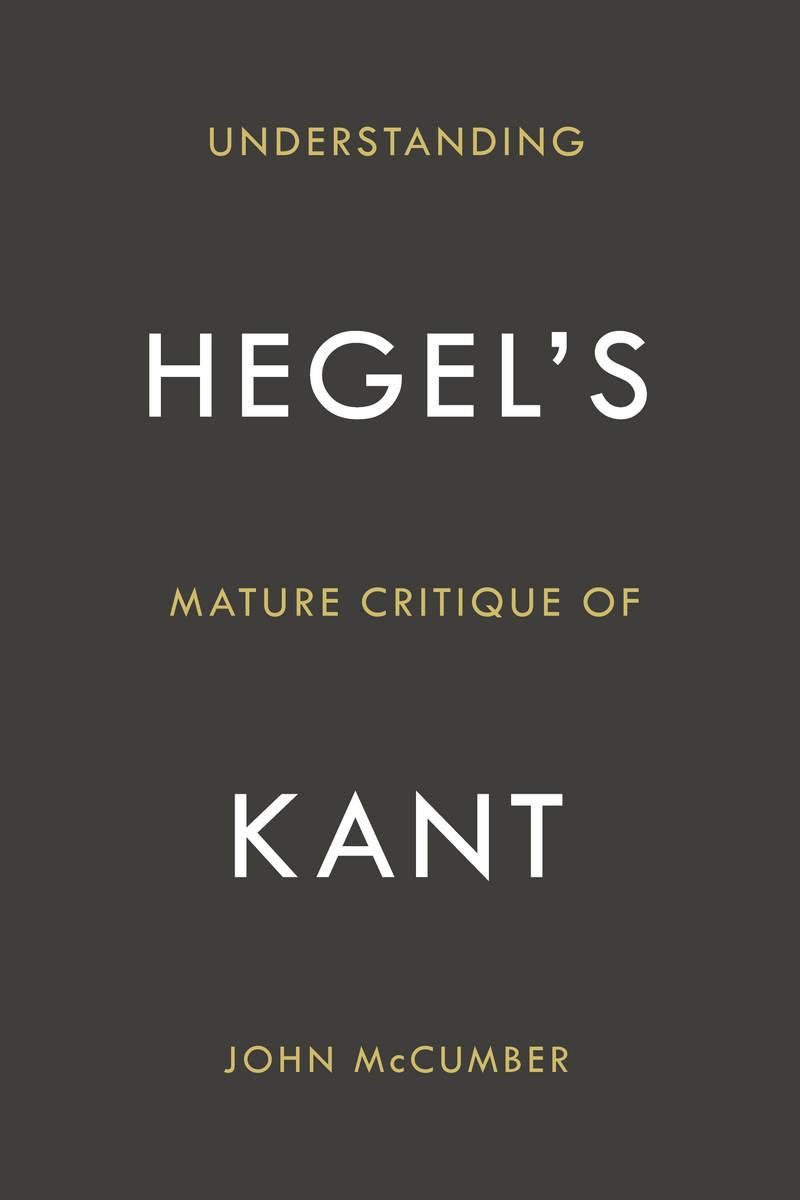
Hegel's critique of Kant was a turning point in the history of philosophy: for the first time, the concrete, situated, and in certain senses "naturalistic" style pioneered by Hegel confronted the thin, universalistic, and argumentatively purified style of philosophy that had found its most rigorous expression in Kant. The controversy has hardly died away: it virtually haunts contemporary philosophy from epistemology to ethical theory. Yet if this book is right, the full import of Hegel's critique of Kant has not been understood. Working from Hegel's mature texts (after 1807) and reading them in light of an overall interpretation of Hegel's project as a linguistic, "definitional" system, the book offers major reinterpretations of Hegel's views: The Kantian thing-in-itself is not denied but relocated as a temporal aspect of our experience. Hegel's linguistic idealism is understood in terms of his realistic view of sensation. Instead of claiming that Kant's categorical imperative is too empty to provide concrete moral guidance, Hegel praises its emptiness as the foundation for a diverse society.
Zahle einfach mit Karte, Klarna, Apple Pay oder Google Pay. Nicht zufrieden? Du hast immer ein 14-tägiges Widerrufsrecht. Lies mehr in unseren AGB. Hast du Fragen, schreib uns eine E-Mail an hello@memmo.org.
Memmo macht das Lernen einfacher – wo auch immer du bist. Bei uns findest du deine Kursbücher und smarte Lerntools an einem Ort: Zusammenfassungen, Quizzes, Podcasts und Lernkarten. Und Ted, dein Lernbuddy, beantwortet alles, was du wissen möchtest. Über 50.000 Studierende lernen bereits hier – gemacht, damit du schneller lernst und weniger Stress hast.