
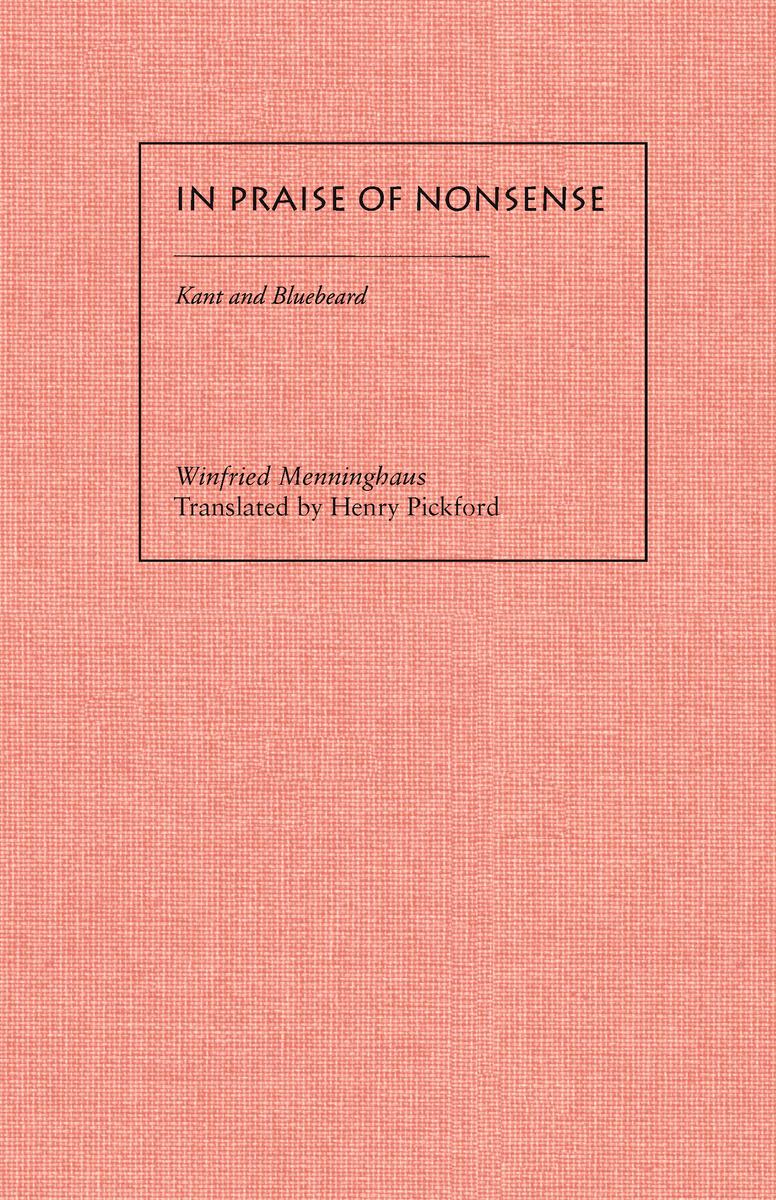
Shells, leafwork, picture frames, hummingbirds, wallpaper decorations, hems of clothing—such are the examples Kant's Critique of Judgment offers for a "free" and purely aesthetic beauty. Menninghaus's book demonstrates that all these examples refer to a widely unknown debate on the arabesque and that Kant, in displacing it, addresses genuinely "modern" phenomena. The early Romantic poetics and literature of the arabesque follow and radicalize Kant's move.
Menninghaus shows parergonality and "nonsense" to be two key features in the spread of the arabesque from architecture and the fine arts to philosophy and finally to literature. On the one hand, comparative readings of the parergon in Enlightenment aesthetics, Kant, and Schlegel reveal the importance of this term for establishing the very notion of a self-reflective work of art. On the other hand, drawing on Kant's posthumous anthropological notebooks, Menninghaus extrapolates an entire Kantian theory of what it means to produce nonsense and why the Critique of Judgment defines genius precisely through the power (as well as the dangers) of doing so.
Ludwig Tieck's 1797 rewriting of Charles Perrault's famous Bluebeard tale (1697) explicitly claims to be an "arabesque" book "without any sense and coherence." Menninghaus's close reading of this capricious narrative reveals a specifically Romantic—as opposed, say, to a Victorian or dadaistic—type of nonsense. Benjamin's as well as Propp's, Lévi-Strauss's, and Meletinskij's oppositions of myth and fairy tale lend additional credit to a Romantic poetics that inaugurates "universal poetry" while performing a bizarre trajectory through arabesque ornament, nonsense, parergonality, and the fairy tale.
Zahle einfach mit Karte, Klarna, Apple Pay oder Google Pay. Nicht zufrieden? Du hast immer ein 14-tägiges Widerrufsrecht. Lies mehr in unseren AGB. Hast du Fragen, schreib uns eine E-Mail an hello@memmo.org.
Memmo macht das Lernen einfacher – wo auch immer du bist. Bei uns findest du deine Kursbücher und smarte Lerntools an einem Ort: Zusammenfassungen, Quizzes, Podcasts und Lernkarten. Und Ted, dein Lernbuddy, beantwortet alles, was du wissen möchtest. Über 50.000 Studierende lernen bereits hier – gemacht, damit du schneller lernst und weniger Stress hast.