
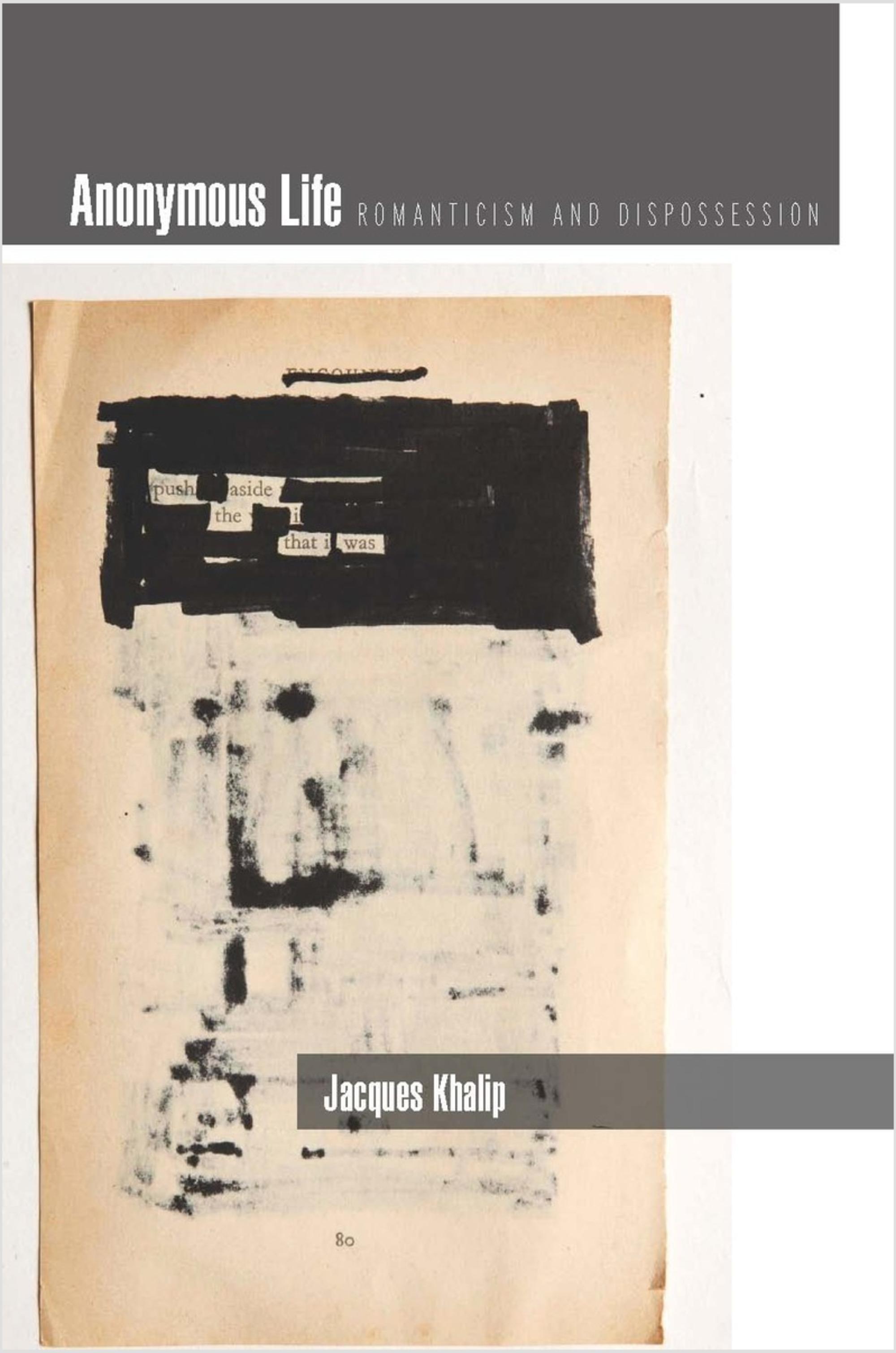
Romanticism is often synonymous with models of identity and action that privilege individual empowerment and emotional autonomy. In the last two decades, these models have been the focus of critiques of Romanticism's purported self-absorption and alienation from politics. While such critiques have proven useful, they often draw attention to the conceptual or material tensions of romantic subjectivity while accepting a conspicuous, autonomous subject as a given, thus failing to appreciate the possibility that Romanticism sustains an alternative model of being, one anonymous and dispossessed, one whose authority is irreducible to that of an easily recognizable, psychologized persona. In Anonymous Life, Khalip goes against the grain of these dominant critical stances by examining anonymity as a model of being that is provocative for writers of the era because it resists the Enlightenment emphasis on transparency and self-disclosure. He explores how romantic subjectivity, even as it negotiates with others in the social sphere, frequently rejects the demands of self-assertion and fails to prove its authenticity and coherence.
Zahle einfach mit Karte, Klarna, Apple Pay oder Google Pay. Nicht zufrieden? Du hast immer ein 14-tägiges Widerrufsrecht. Lies mehr in unseren AGB. Hast du Fragen, schreib uns eine E-Mail an hello@memmo.org.
Memmo macht das Lernen einfacher – wo auch immer du bist. Bei uns findest du deine Kursbücher und smarte Lerntools an einem Ort: Zusammenfassungen, Quizzes, Podcasts und Lernkarten. Und Ted, dein Lernbuddy, beantwortet alles, was du wissen möchtest. Über 50.000 Studierende lernen bereits hier – gemacht, damit du schneller lernst und weniger Stress hast.