
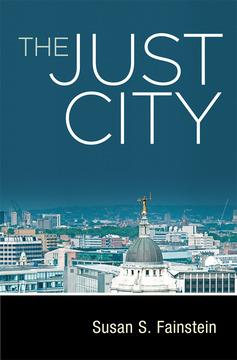
"The just city is one in which equity, democracy, and diversity are important considerations. This is in contrast with the city as growth machine. Fainstein examines three cities: New York, London, and Amsterdam. She provides a history of post–World War II planning and then focuses on fairly recent cases of development in each. Her goals, though modest, are important if growing inequality in urban areas is to be reversed. Recommended."
― Choice
For much of the twentieth century improvement in the situation of disadvantaged communities was a focus for urban planning and policy. Yet over the past three decades the ideological triumph of neoliberalism has caused the allocation of spatial, political, economic, and financial resources to favor economic growth at the expense of wider social benefits. Susan Fainstein's concept of the "just city" encourages planners and policymakers to embrace a different approach to urban development. Her objective is to combine progressive city planners' earlier focus on equity and material well-being with considerations of diversity and participation so as to foster a better quality of urban life within the context of a global capitalist political economy. Fainstein applies theoretical concepts about justice developed by contemporary philosophers to the concrete problems faced by urban planners and policymakers and argues that, despite structural obstacles, meaningful reform can be achieved at the local level.
In the first half of The Just City, Fainstein draws on the work of John Rawls, Martha Nussbaum, Iris Marion Young, Nancy Fraser, and others to develop an approach to justice relevant to twenty-first-century cities, one that incorporates three central concepts: diversity, democracy, and equity. In the book's second half, Fainstein tests her ideas through case studies of New York, London, and Amsterdam by evaluating their postwar programs for housing and development in relation to the three norms. She concludes by identifying a set of specific criteria for urban planners and policymakers to consider when developing programs to assure greater justice in both the process of their formulation and their effects.
Zahle einfach mit Karte, Klarna, Apple Pay oder Google Pay. Nicht zufrieden? Du hast immer ein 14-tägiges Widerrufsrecht. Lies mehr in unseren AGB. Hast du Fragen, schreib uns eine E-Mail an hello@memmo.org.
Memmo macht das Lernen einfacher – wo auch immer du bist. Bei uns findest du deine Kursbücher und smarte Lerntools an einem Ort: Zusammenfassungen, Quizzes, Podcasts und Lernkarten. Und Ted, dein Lernbuddy, beantwortet alles, was du wissen möchtest. Über 50.000 Studierende lernen bereits hier – gemacht, damit du schneller lernst und weniger Stress hast.