
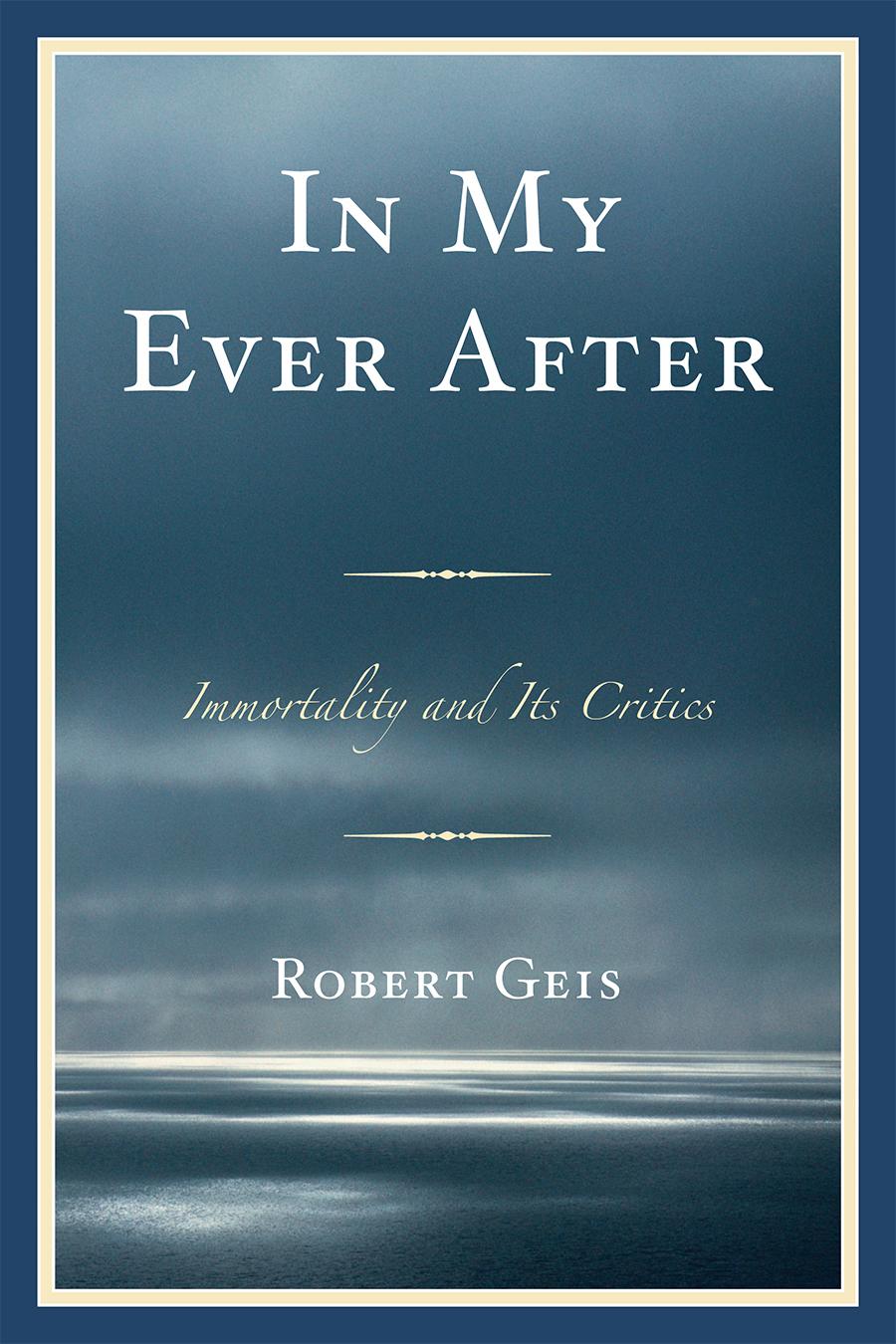
In My Ever After is not a mass media style "general readership" book on immortality; rather, it is an argument against a current school -- neurophilosophy's virtual equation of consciousness and the world. Without exposing the equation's weaknesses, the question of immortality, Geis argues, is moot. Part I identifies many epistemic and scientific grounds for a real world outside consciousness and self-refutational flaws in quantum physics. It employs the phenomenological method to situate "consciousness" and "other" in their relations. Part II sets forth why consciousness cannot be electrical in origin, and then how partibility and subjectivity, in tandem with the power of conceptualization, evince reasons for accepting immortal consciousness as a condition of all human awareness. A discussion of why pharmacologic explanations for the OBE and NDE are wanting, plus neurologic arguments for memory's non-localizability, and how animal sentience adds to philosophic conviction coordinate with Scripture on animal existence beyond the grave, concludes the argument.
Zahle einfach mit Karte, Klarna, Apple Pay oder Google Pay. Nicht zufrieden? Du hast immer ein 14-tägiges Widerrufsrecht. Lies mehr in unseren AGB. Hast du Fragen, schreib uns eine E-Mail an hello@memmo.org.
Memmo macht das Lernen einfacher – wo auch immer du bist. Bei uns findest du deine Kursbücher und smarte Lerntools an einem Ort: Zusammenfassungen, Quizzes, Podcasts und Lernkarten. Und Ted, dein Lernbuddy, beantwortet alles, was du wissen möchtest. Über 50.000 Studierende lernen bereits hier – gemacht, damit du schneller lernst und weniger Stress hast.