
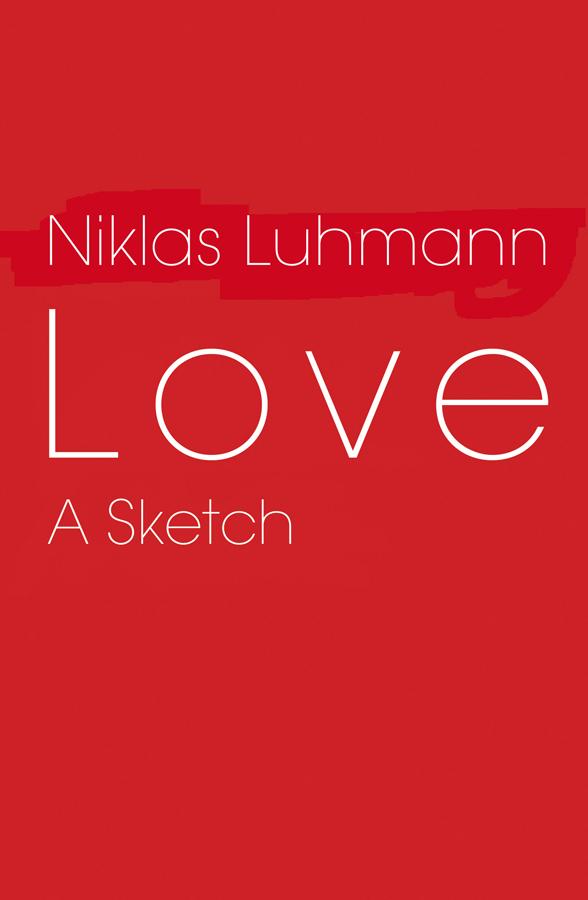
Love seems like the most personal experience, one that touches each of us in a unique way that is more personal than social, and hence it is not surprising that it has been largely neglected by sociologists and social theorists. While it has long been a central preoccupation of writers and novelists, love has rarely attracted anything more than the most cursory attention of social scientists.
This short text, originally written in 1969 by the eminent German social theorist Niklas Luhmann, goes a long way to redressing this neglect. Rather than seeing love as a unique and ineffable personal experience, Luhmann treats love as a solution to a problem that depends on a wider range of social structures and forms. Human beings are faced with a world of enormous complexity and they have to find ways to order and make sense of this world. In other words, they need certain facilities for action Ð what Luhmann calls ‘media of communication’ Ð that enable them to select from a host of alternatives in ways that will be understood as meaningful by others. Love is one of these media; truth, power, money and art are others. With the development of modern societies, greater demands are made on this medium of love, altering the relationship between love and sexuality and giving rise to the distinctive difficulties we associate with love today.
This short text by one of the most brilliant social theorists of the 20th century will be of great interest to students and scholars throughout the social sciences and humanities. It is a concise and pithy statement of what is still the only sociological theory of love we have.
This short text, originally written in 1969 by the eminent German social theorist Niklas Luhmann, goes a long way to redressing this neglect. Rather than seeing love as a unique and ineffable personal experience, Luhmann treats love as a solution to a problem that depends on a wider range of social structures and forms. Human beings are faced with a world of enormous complexity and they have to find ways to order and make sense of this world. In other words, they need certain facilities for action Ð what Luhmann calls ‘media of communication’ Ð that enable them to select from a host of alternatives in ways that will be understood as meaningful by others. Love is one of these media; truth, power, money and art are others. With the development of modern societies, greater demands are made on this medium of love, altering the relationship between love and sexuality and giving rise to the distinctive difficulties we associate with love today.
This short text by one of the most brilliant social theorists of the 20th century will be of great interest to students and scholars throughout the social sciences and humanities. It is a concise and pithy statement of what is still the only sociological theory of love we have.
Zahle einfach mit Karte, Klarna, Apple Pay oder Google Pay. Nicht zufrieden? Du hast immer ein 14-tägiges Widerrufsrecht. Lies mehr in unseren AGB. Hast du Fragen, schreib uns eine E-Mail an hello@memmo.org.
Memmo macht das Lernen einfacher – wo auch immer du bist. Bei uns findest du deine Kursbücher und smarte Lerntools an einem Ort: Zusammenfassungen, Quizzes, Podcasts und Lernkarten. Und Ted, dein Lernbuddy, beantwortet alles, was du wissen möchtest. Über 50.000 Studierende lernen bereits hier – gemacht, damit du schneller lernst und weniger Stress hast.
Das könnte dir auch gefallen
Buch kaufen0